Introduction
You can run a client presentation without notes, hold six competing priorities in your head during a meeting, and solve complex problems before noon. But getting out the door on time? Consistently. That's where everything falls apart.
This isn't disorganization. It's not laziness. For adults with ADHD, the brain's architecture — specifically how it handles planning, time, and motivation — makes standard routine advice largely useless. Most of it was designed for neurotypical brains.
This article covers:
- What's actually happening neurologically when routines fail
- A step-by-step process for building one that fits how your brain works
- The variables that determine long-term success
- How to recover when things fall apart, without the shame spiral that derails most ADHD adults for weeks
Key Takeaways
- Most routines fail adults with ADHD because they're designed for neurotypical brains — not executive function and dopamine regulation challenges
- Effective ADHD routines are built around anchor points and energy patterns, not rigid minute-by-minute schedules
- Environment design — not willpower — is the real driver of whether a routine holds
- Building in a recovery protocol is what separates a routine that lasts from one that collapses after a hard week
Why Routines Feel So Hard with ADHD
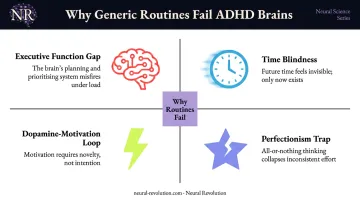
The Executive Function Gap
Planning, task initiation, working memory, and time perception are all regulated by prefrontal cortex circuits that function differently in ADHD brains. A 2023 review in the International Journal of Environmental Research and Public Health found measurable problems across multiple dimensions of time processing — time estimation, duration discrimination, and time management — alongside decreased prefrontal activity.
This isn't a character flaw. The brain is working with different hardware.
Time Blindness and the "Now vs. Not Now" Problem
Researcher Russell Barkley has described ADHD as returning control of behavior to the temporal now — a condition he's characterized as "temporal myopia," or nearsightedness to time. For practical purposes: the future doesn't feel real. Tasks scheduled for 3pm feel as abstract as tasks scheduled for next Tuesday.
This is why clock-based routines so often fail. If the future doesn't feel urgent, the motivation to prepare for it doesn't fire.
The Dopamine-Motivation Loop
Research from Volkow et al. published in Molecular Psychiatry confirmed that disruption of the dopamine reward pathway is directly associated with motivation deficits in adults with ADHD. The ADHD brain needs at least one of the following to engage:
- Interest — genuine curiosity or novelty
- Challenge — a difficulty level that requires real effort
- Urgency — a deadline with real consequences
- Personal relevance — a direct connection to something that matters
Routine tasks — by definition repetitive and familiar — lose their dopamine hook within days.
The Perfectionism Trap
For high-achieving adults, one additional factor compounds everything: rejection-sensitive dysphoria (RSD). As described by clinician William Dodson, MD, ADHD often involves extreme emotional sensitivity to perceived failure, and CHADD notes that "anything less than perfect feels like a total failure" is a pattern common to both children and adults with ADHD.
One missed morning becomes evidence that the whole system is broken. The routine gets abandoned entirely.
Together, these four factors — executive function gaps, time blindness, dopamine demands, and perfectionism — explain why generic routine advice fails. The goal is building systems that work with the ADHD brain's actual strengths: pattern recognition, big-picture thinking, creative intensity. Not demanding performance the brain's architecture can't reliably deliver.
How to Build an ADHD Daily Routine That Actually Sticks
One critical note before diving in: attempting to implement all of this at once is one of the most common failure modes. Work through these steps in sequence. Start with one phase. Build gradually.
Step 1: Map Your Energy, Not Your Clock
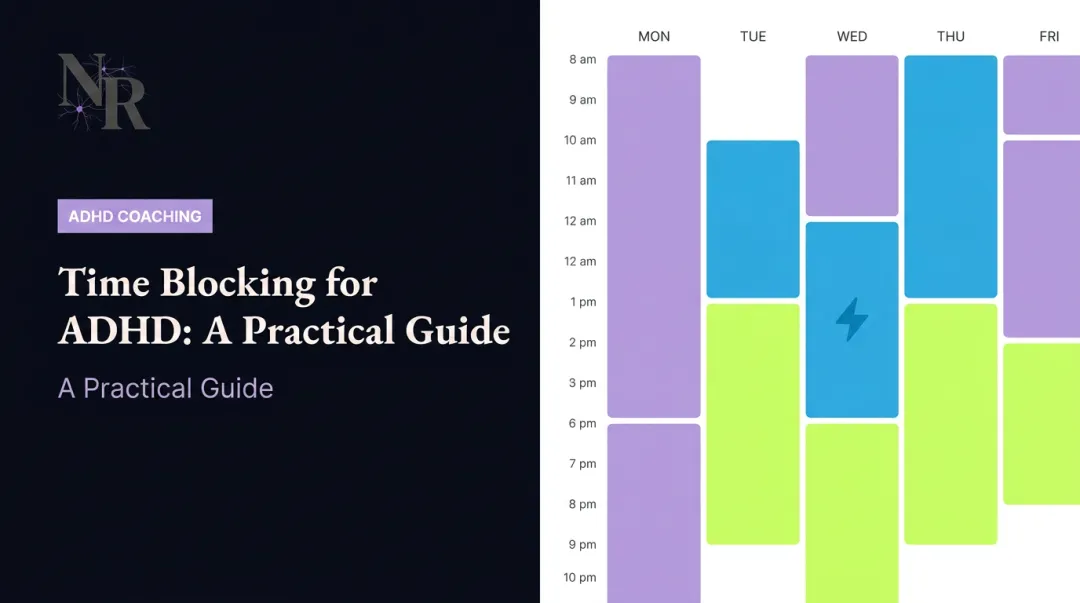
Before scheduling anything, spend 3–5 days tracking when your focus, motivation, and energy are naturally highest and lowest. This "energy audit" becomes the foundation of your time blocks.
What this might look like in practice:
- A founder notices her clearest thinking happens between 8–11am, and afternoons are nearly useless for creative work — so she protects mornings for writing and strategy, and uses afternoons for admin and calls
- A consultant finds he hits a reliable second wind around 7pm, making evenings unexpectedly productive for deep work if he doesn't exhaust himself in pointless meetings during the day
- A tech professional realizes her "focus crashes" happen immediately after lunch — and stops scheduling complex code reviews for 1pm
The goal isn't to optimize every hour. It's to stop fighting biology.
Step 2: Identify 3–5 Anchor Tasks
Anchor tasks are the non-negotiable actions that provide the day's skeleton: a consistent wake time, meals, the start of work, a wind-down signal. Everything else slots around these anchors, not the other way around.
Fewer anchors mean more flexibility without losing structure. A routine built on 15 anchors has too many failure points. Four anchors, done consistently, is enough.
Step 3: Design Your Environment Before You Need It
ADHD routines are primarily maintained by environmental cues, not memory or motivation. The concept: let the physical and digital environment do the remembering instead of relying on the brain. Willpower is unreliable; a well-designed environment isn't.
Practical environment design strategies:
- Visual cues: Leave tomorrow's gym bag by the door tonight. Keep the vitamin bottle next to the coffee maker
- Launch pads: A designated spot where everything needed for the morning sits pre-staged the night before
- Digital cues: Phone alarm labeled "Leave NOW, not in 5 minutes," not just a time
- Friction removal: Anything requiring more than two steps to start will get skipped on hard days — simplify the access path
Neural Revolution's coaching builds this kind of infrastructure directly into client work: calendar architecture, working memory offload systems, and environment design calibrated to how the ADHD brain actually operates.
Step 4: Attach New Behaviors to Existing Ones
Habit stacking gives new behaviors a neurological foothold by anchoring them to patterns already wired in. For ADHD brains, this matters more than for neurotypical ones because it dramatically reduces initiation cost, which is disproportionately high when dopamine isn't naturally firing.
Examples:
- Review the day's top three priorities while coffee brews — not before, not after
- Run a two-minute end-of-day capture before closing the laptop
- Check tomorrow's calendar while brushing teeth at night
The existing behavior carries the new one until it develops its own groove.
Step 5: Build in Flexibility and a Restart Protocol
A rigid sequence is a fragile one. Build three tiers:
| Version | When to Use | What It Includes |
|---|---|---|
| Full routine | Good energy, normal day | All anchor tasks + habit stacks |
| Minimum viable | Low-energy, chaotic days | 2–3 anchor tasks only |
| Restart signal | After falling off track | One task or 5-minute ritual to re-enter |
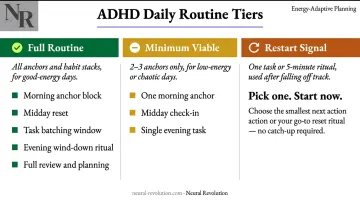
The restart signal is the most underbuilt piece of most routines. It might be making your bed, brewing coffee, or sitting at your desk for five minutes with your task list. The point isn't the ritual : it's the signal that re-entry has happened.
Dr. Eliza Barach's DREAMS™ framework takes the same approach to goal-setting: flexible, emotionally resonant, and built with the expectation of non-linearity rather than demanding perfect compliance. That same philosophy applies directly to how sustainable routines get structured.
Key Variables That Determine Whether Your Routine Sticks
Routine design matters, but several variables determine whether even a well-designed routine survives contact with real life.
Motivation Architecture
ADHD brains need interest, challenge, urgency, or passion to sustain behavior. A routine stripped of all reward will decay within weeks.
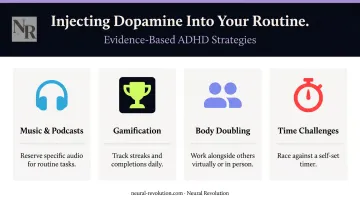
Ways to inject dopamine hooks into routine tasks:
- Music or podcasts reserved for specific routine activities
- Gamification (tracking streaks, completion markers)
- Body doubling — working alongside another person, virtually or in person
- Time challenges ("Can I get through email in 25 minutes?")
Sleep and Circadian Rhythms
A review in Nature and Science of Sleep reported insomnia in 67% of adults with ADHD compared to 29% of healthy controls, and roughly one in three adults with ADHD meets criteria for Delayed Sleep Phase Disorder. A routine built on a chronically sleep-deprived brain will fail regardless of how well it's designed. Sleep isn't background noise — it's the platform everything else runs on.
Task Granularity
Vague items on a routine — "work on project," "be productive" — are essentially invisible to the ADHD brain. They require additional planning, sequencing, and working memory load just to begin. Adult ADHD CBT research consistently supports breaking tasks into specific, concrete subtasks as a primary initiation strategy.
Replace "work on report" with "open the document and write the first paragraph."
Accountability and Social Scaffolding
A 2024 study in ACM Transactions on Accessible Computing surveying 220 neurodivergent participants found body doubling supported task initiation, sustained motivation, and task completion — with mechanisms including accountability, visual focus reminders, and reduced overwhelm.
That research tracks with what shows up in practice: whether it's an ADHD coach, an accountability partner, or a virtual coworking setup, adding social scaffolding dramatically increases follow-through. Neural Revolution's FOCUS Forward group coaching program builds this structure in directly — including membership to Focused Space, a virtual coworking community built for ADHD professionals.
Common Mistakes That Derail ADHD Routines
Three patterns consistently collapse ADHD routines before they have a chance to stick:
Overbuilding at the start is the most common first move. A 20-step morning routine with no margin is a setup for failure — the more complex the system, the harder it fights against ADHD executive function. The first version of any routine should be almost embarrassingly simple: a couple of anchors, one habit stack, and a restart signal.
Designing for the best-case self is the second trap. Many ADHD adults build routines that assume peak energy, zero interruptions, and ideal conditions. A routine needs to hold up on hard mornings and low-dopamine days. If it only works when everything is perfect, it isn't really a routine.
Treating consistency as all-or-nothing is the third and most damaging pattern. Research on adult ADHD confirms that all-or-nothing thinking is a documented cognitive distortion — "anything less than perfect feels like total failure."
One missed morning doesn't erase the routine. Finishing 40% of the intended routine on a hard day is a win. The ADHD brain needs a different metric for consistency than neurotypical productivity culture offers.
When the Routine Breaks: How to Recover Without the Shame Spiral
Routine disruption is not a character flaw. It's a predictable feature of ADHD — especially during stress, travel, schedule changes, or major life transitions. These circumstances reliably overwhelm even well-designed systems. Knowing this in advance changes the response.
The Minimum Viable Restart
When the routine has broken down, the goal is to shrink the gap between "off track" and "back on track" — not to prevent disruption entirely, which isn't realistic.
A minimum viable restart might be:
- Making your bed
- Sitting at your desk with your task list for five minutes
- Sending one email
- Walking around the block before starting work
One action. That's the re-entry point. Not a perfect fresh start — just a signal to the brain that normal operations are resuming.
When to Get External Support
If the same routines break repeatedly despite genuine effort, something deeper is usually at play — executive function deficits that aren't being adequately addressed, co-occurring anxiety, burnout from years of compensation, or a routine that was never the right fit to begin with.
That's when working with an ADHD coach becomes worth considering. At Neural Revolution, the intake process is designed to identify where and why executive function is breaking down — tracing it back to root causes rather than layering more productivity advice on top of a structure that isn't working. The goal is to redesign the system itself, not patch it.
Frequently Asked Questions
Why is it so hard for adults with ADHD to stick to a routine?
ADHD affects the executive function circuits responsible for planning, task initiation, and time perception — and disrupts the dopamine pathways that generate motivation. This means routine tasks lose their engagement signal quickly. It's a neurological issue, not a willpower problem.
What does a good ADHD daily routine actually look like?
A flexible, anchor-based structure rather than a rigid time schedule. Three to five non-negotiable anchors shape the day, and everything else fits around them. The best routine is personalized to your specific energy patterns and life demands.
What's the difference between a routine and a schedule for ADHD?
A schedule is time-specific and rigid — "do X at 9am." An ADHD-friendly routine is sequence-based and flexible — "do X before Y." The order matters more than the clock, which aligns with how ADHD brains actually experience time.
How do I restart my routine after falling off track?
Use a minimum viable restart: one anchor task or short reset ritual that signals re-entry into the routine. The goal isn't a perfect fresh start — it's closing the gap between off-track and back-on-track as quickly as possible.
Why do high-functioning adults with ADHD struggle most with routines?
External success can mask how much effort routine maintenance actually costs. Research shows that high-achieving adults with ADHD rely on energy-intensive compensation strategies to keep up — and those strategies eventually break down without a system built around how the brain actually works.
Can ADHD coaching help with building and maintaining daily routines?
Yes. An ADHD coach can identify where your current system breaks down, design environment and habit structures that fit your brain, and provide the accountability that makes follow-through sustainable. It's particularly effective for high-performers who've already tried every solo strategy.