Not laziness. Not avoidance. Not a character flaw. What you're experiencing has a name: task initiation difficulty, and for adults with ADHD, it's one of the most reliably frustrating experiences in professional life.
Research from Barkley et al. found that daily-life executive function deficits appear in 89–98% of adults with ADHD when real-world rating scales are used — not a fringe issue, but a core feature of how the ADHD brain operates. Task initiation sits squarely in that territory.
This article explains what task initiation actually is, why ADHD amplifies the barrier to starting, and which strategies move the needle — and why.
Key Takeaways
- Task initiation is an executive function skill that ADHD impairs at the neurological level — not a character flaw.
- The freeze isn't procrastination; it's a mismatch between the brain's activation system and what the task demands.
- Different initiation barriers — emotional, dopaminergic, executive overload — each respond to different strategies.
- Matching strategy to barrier type is what separates approaches that work from ones that don't.
- When self-strategies plateau, structured support like ADHD coaching helps build a personalized, sustainable system.
What Task Initiation Is — And Why ADHD Makes It So Hard
Task initiation is the executive function responsible for transitioning from rest or distraction into deliberate action. It includes shifting from thinking to doing, organizing the first step, and overcoming inertia.
For neurotypical brains, much of this happens automatically. For ADHD brains, it requires far more activation energy — and several neurological systems have to cooperate at once.
The Dopamine Connection
The ADHD brain runs on salience, not importance.
Volkow et al.'s PET study of 53 non-medicated adults with ADHD found lower dopamine transporter and D2/D3 receptor markers in the brain's reward-pathway regions compared to controls. A follow-up study focused specifically on motivation found that achievement motivation scores were lower in ADHD participants and correlated directly with those dopamine markers — leading the authors to describe ADHD as a motivation-deficit disorder reflecting a hypofunctional dopamine reward pathway.
What this means practically: tasks must feel novel, urgent, challenging, or personally meaningful before the ADHD brain generates the neurochemical activation needed to begin. Task importance alone doesn't cut it.
Dr. Eliza Barach of Neural Revolution frames this as the "Worth-It Threshold" — a real-time neurological cost-benefit calculation. When perceived effort is high, reward is delayed or abstract, and novelty is low, task initiation becomes neurologically expensive in ways most productivity advice ignores.
The Executive Function Overload Problem
Starting a task isn't a single mental switch. It requires multiple systems firing simultaneously:
- Working memory to hold the goal and organize first steps
- Inhibitory control to filter distractions
- Cognitive flexibility to shift into task mode
- Self-motivation to push toward delayed rewards
- Emotion regulation to manage any anxiety or dread the task carries
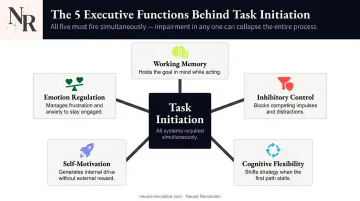
When any one of these is impaired — as is common across ADHD — the whole initiation process can collapse before it starts.
The Emotional Layer
Many adults with ADHD accumulate layers of negative emotion around tasks: past failures, harsh self-criticism, fear of doing it wrong. ADHD coach Brendan Mahan calls this the "Wall of Awful" — the emotional residue that makes initiating feel threatening rather than just effortful.
Research confirms how deep this layer runs:
- A 2023 systematic review found emotion dysregulation is altered in 34–70% of adults with ADHD
- A 2025 study found that baseline ADHD symptoms predicted more avoidant automatic thoughts, more severe task avoidance, and more negative emotion in daily life
For high-achievers, this compounds. The higher the stakes of a task — the more meaningful the goal — the harder initiation can become. Professionals who mask their struggles behind bursts of hyperfocus and last-minute urgency often carry the most accumulated shame, because their visible capability makes the freeze look inexplicable — to themselves and everyone around them.
This Isn't Procrastination: Understanding ADHD Task Paralysis
Procrastination involves choosing to delay. Task paralysis is different: it's a neurological freeze state where the person genuinely wants to start but cannot get the brain to engage.
This distinction matters because the "solutions" for procrastination — consequences, willpower, motivation — don't work for task paralysis. Applying them adds shame without adding momentum.
Telling an ADHD brain to initiate through willpower alone is like expecting a car to accelerate without fuel. The mechanism isn't broken; it needs a different input.
The inconsistency that confuses so many ADHD adults makes more sense through this lens:
- Can hyperfocus for four hours on an engaging design problem
- Cannot send a two-sentence email for three days
This isn't contradiction — it's evidence that initiation and sustained attention are separate executive functions. ADHD impairs the on-ramp, not necessarily the highway. Once the brain is engaged, continuation is often possible. The real challenge — and where the right strategies make all the difference — is getting it engaged in the first place.
How to Get Started: ADHD-Friendly Strategies That Actually Work
These strategies work because they're designed around how the ADHD brain actually operates — meeting its dopamine and activation needs instead of fighting them.
Strategy 1: The Micro-Start
Break the task down until it feels almost ridiculous in its smallness. The goal isn't to complete anything — it's to lower the activation threshold to near zero.
- "Write the report" → "Open a new document and type the project name"
- "Clean the inbox" → "Open the inbox and read the first email"
- "Start the proposal" → "Find last year's proposal and open it"
These count. Momentum builds naturally once the brain has engaged. The smallest possible action is the most powerful one.
Strategy 2: Create Artificial Urgency
ADHD brains activate under urgency, which is why deadline-induced hyperfocus is so common. Replicating that urgency intentionally is the point:
- Set a timer for 15–25 minutes (Pomodoro-style)
- Create a self-imposed "fake" deadline before the real one
- Frame the task as a race against the clock
Competitive framing activates the brain's dopamine reward system, generating the sense of stakes the ADHD brain needs to get moving.
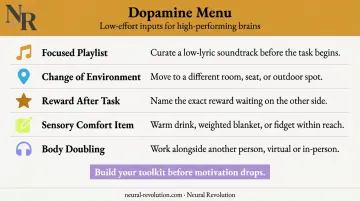
Strategy 3: Pair the Task with Dopamine
Stack a low-stimulation task with a dopamine-boosting input:
- A specific playlist or soundtrack reserved for focused work
- A preferred coffee shop or change of environment
- A pleasurable activity scheduled immediately after completion
- A special notebook or pen that signals "work mode"
This isn't distraction. It's giving the brain the input it needs to engage. Building a personal "dopamine menu" — a short list of quick, healthy stimulation options — means you have a toolkit ready instead of scrambling to improvise when motivation drops.
Strategy 4: Use Body Doubling
Body doubling means working in the physical or virtual presence of another person, both working in parallel, often silently. Even minimal ambient social presence improves task engagement for ADHD brains by providing external structure and a cue to stay oriented.
It works in person, on video calls, or through dedicated virtual co-working platforms. Neural Revolution's FOCUS Forward group coaching program includes a complimentary membership to Focused Space, a virtual co-working community, because body doubling is neurologically effective, not just psychologically comforting.
Strategy 5: Use If-Then Planning
Instead of "I'll work on the report later," pre-decide: "When I sit down with my coffee, I will open the document and write the first sentence."
The specificity of the trigger reduces the decision-making load at the moment of initiation. The brain doesn't have to figure out where to start in real time; it's already been decided.
Strategy 6: Start with What's Interesting First
Perfectionism often demands starting with the hardest or most important part first, which can paralyze initiation entirely. The reframe: start with whichever part of the task holds any genuine energy or interest right now.
Momentum from an engaging entry point can carry the brain into less engaging sections of the same task. Getting started anywhere beats not starting at all.
Why Some Strategies Work and Others Don't
Two people with ADHD can try the same strategy and get completely different results. Task initiation is affected by multiple interacting variables, and knowing your personal pattern is what makes the difference.
The Type of Barrier
| Barrier Type | What It Looks Like | What Helps |
|---|---|---|
| Emotional | Dread, perfectionism, shame, fear of failure | Micro-starts, self-compassion, reducing stakes |
| Dopaminergic | Boredom, low interest, no urgency | Dopamine pairing, artificial urgency, novelty injection |
| Executive Overload | Too many steps, unclear starting point, mental fog | Task clarification, if-then planning, external structure |
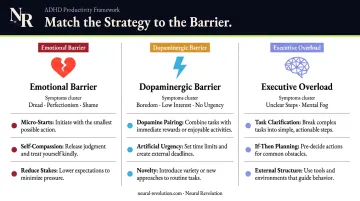
Using a body-doubling strategy on a task that's blocked by perfectionism anxiety often fails — not because the strategy is bad, but because it's mismatched to the barrier.
Time of Day and Energy State
Task initiation gets harder as cognitive resources deplete. Conditions that raise the barrier include:
- Later in the day, after energy has peaked
- Following heavy context-switching between tasks or meetings
- During periods of emotional activation or stress
- Off-peak medication windows (for those on stimulants — build initiation attempts around peak effectiveness)
High-demand tasks are best scheduled during your peak cognitive window, not squeezed into whatever time is left.
Task Clarity
Vague tasks create a double burden: the brain must first figure out what the task actually is before it can begin. "Work on the presentation" is much harder to start than "draft slides 1–3." Clarifying tasks in advance — breaking them into concrete, specific steps before the session — cuts the initiation barrier.
Environment and Sensory Conditions
ADHD brains are highly responsive to environmental cues. A workspace associated with distraction triggers distraction; a workspace associated with focused work supports engagement. Factors worth designing around deliberately:
- Noise level and type (some ADHD brains need ambient noise; others need silence)
- Visual clutter (relevant materials vs. irrelevant objects competing for attention)
- Presence or absence of other people
- Sensory comfort (temperature, lighting, seating)
Common Mistakes That Keep You Stuck
Most task initiation advice skips past the part where things actually go wrong. These three mistakes are where ADHD professionals most often get derailed:
Waiting to feel motivated. For ADHD brains, motivation follows action — not the other way around. Waiting to feel "ready" is a trap because that neurochemical state rarely arrives on its own. Action creates the dopamine; the dopamine doesn't create the action.
Solving initiation with more planning. Reorganizing the task list, researching tools, building elaborate systems — it all feels productive. It's often avoidance. Planning beyond the next smallest step can itself become the barrier.
Treating every block the same way. When a technique fails, the first question isn't "what should I try instead?" — it's "what type of barrier am I actually dealing with?" Strategy doesn't matter if the diagnosis is wrong.
When Self-Strategies Aren't Enough
Self-strategies are a starting point. But for many high-achieving adults, the patterns around task initiation are deeply ingrained, entangled with identity, and reinforced by years of inconsistent performance. When strategies start to feel like more things to fail at, that's useful information — not a referendum on your ability.
This is where structured support makes a meaningful difference. ADHD coaching goes beyond tips. It helps you understand your own activation profile, build systems that fit how your brain actually works, and address the emotional layers that make initiation harder over time.
That's the kind of work Neural Revolution is built for. Combining doctoral-level cognitive psychology with lived ADHD experience, the practice is designed specifically for high-achieving professionals. Coaching sessions go deeper than accountability check-ins — they identify what's driving your specific initiation patterns and build practical systems that hold up under real-world conditions.
For ADHD brains, external structure and accountability aren't workarounds. They're often how the brain functions most effectively — and building support around that reality is exactly where meaningful change starts.
Frequently Asked Questions
Do ADHD people struggle with initiating tasks?
Yes. Task initiation is a well-documented executive function challenge in ADHD, rooted in dopamine dysregulation and prefrontal cortex differences. The difficulty isn't a reflection of effort, motivation, or intelligence — it's a structural feature of how the ADHD brain processes reward and salience.
What helps with ADHD task initiation?
The most effective approaches include micro-starts, artificial urgency through timers, dopamine pairing, body doubling, if-then planning, and starting with the most interesting part first. Which strategy works depends heavily on the type of initiation barrier present — emotional, dopamine-related, or executive overload.
What is the difference between task paralysis and procrastination in ADHD?
Procrastination involves a conscious choice to delay; task paralysis is a neurological freeze state where the person wants to start but cannot activate. Procrastination responds to consequences and motivation; task paralysis requires structural and neurochemical support, not more willpower.
Why can I hyperfocus for hours but still struggle to start simple tasks?
Initiation and sustained attention are separate executive functions. ADHD impairs the on-ramp (activation) but not necessarily the highway (continuation). Once interest engages the brain, deep focus is possible — but getting there in the first place is where the barrier lives.
Can ADHD coaching help with task initiation?
ADHD coaching helps by building personalized strategies, creating accountability, and addressing the emotional patterns that make initiation harder over time. For adults with persistent or deeply ingrained initiation challenges, coaching is often a more effective intervention than self-directed strategies alone.