That's not laziness. That's not poor time management. That's ADHD analysis paralysis: the state of being genuinely frozen when faced with too many options, too much information, or the pressure of getting something "right."
For high-achieving professionals with ADHD, this experience is both common and deeply frustrating — particularly because intelligence and ambition don't protect against it. If anything, they raise the stakes of every decision, widening the gap between what you're capable of and what you can actually initiate on a given day.
This article explains what's happening neurologically when you freeze, distinguishes the three types of paralysis, and delivers eight evidence-informed strategies designed specifically for ADHD brains — not generic productivity advice that requires the executive function you're currently trying to access.
Key Takeaways
- ADHD analysis paralysis is brain-based — rooted in dopamine reward-pathway dysfunction and executive dysfunction, not a willpower or character problem
- It shows up in three distinct forms — mental, choice, and task paralysis — and which type you're stuck in determines which strategy actually works
- Standard productivity advice often fails because it requires the exact executive skills that paralysis disrupts
- Shame actively worsens paralysis by compounding emotional dysregulation — addressing it isn't optional
- Relief comes from reducing cognitive load and designing better systems — not from trying harder
What Is ADHD Analysis Paralysis?
Analysis paralysis in ADHD occurs when the brain becomes overwhelmed by options, outcomes, or task complexity — and responds with shutdown rather than decision. While anyone can experience decision fatigue, the ADHD brain is structurally more vulnerable to this kind of freeze due to differences in executive function and reward processing.
To be clear: "analysis paralysis" isn't a formal DSM diagnosis. It's widely used practitioner language for a real experience that peer-reviewed research does document — specifically as decision-making difficulty, executive dysfunction, and task initiation failure.
The Three Types
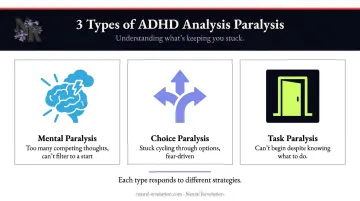
Naming which type you're in matters, because each responds to different interventions:
- Mental paralysis — overwhelmed by too many thoughts, stimuli, or emotions competing simultaneously; the brain can't filter to a starting point
- Choice paralysis — stuck between options, often fear-driven, cycling through possibilities without converging
- Task paralysis — inability to begin a task, especially when it's complex, boring, ambiguous, or high-stakes
How It Differs From Executive Dysfunction
Executive dysfunction describes a deficit in the cognitive skills needed to manage and initiate tasks. Analysis paralysis is what happens when you're frozen even though you know exactly what to do — the path is clear, but you can't move. Both can co-occur, and for most ADHD adults, they regularly do. That overlap is especially visible under professional pressure.
The Professional Compounding Effect
For driven professionals and entrepreneurs, paralysis tends to cluster around high-stakes moments: launching a project, making a business pivot, responding to a critical email, pricing a service, choosing a hire. The higher the perceived stakes, the more the ADHD brain loops without forward motion.
That looping creates pile-up, which increases overwhelm, which deepens paralysis. Research by de Graaf et al. found that adult ADHD is associated with 22.1 excess annual lost role-performance days — a direct measure of how executive dysfunction translates into professional derailment, not just personal frustration.
Why the ADHD Brain Gets Frozen
Understanding the mechanism is what makes the strategies below make sense — not as tricks, but as targeted responses to specific neurological realities.
Dopamine and the Motivation Gap
The ADHD brain processes reward and motivation differently due to differences in dopamine reward-pathway function. Volkow et al. (2010) concluded that motivation deficits in ADHD are associated with dysfunction of the dopamine reward pathway in adults. When a task lacks novelty, urgency, or perceived immediate reward, the brain doesn't generate enough activation to initiate — not because you don't care, but because the neurological signal required to start simply isn't firing.
This is why "just do it" fails so completely. The motivational signal isn't there to override.
Executive Dysfunction Under Load
The prefrontal cortex governs task initiation, prioritization, working memory, and cognitive flexibility — exactly the functions you need to move through a decision. In ADHD, these functions are less consistently available, especially under stress or cognitive load. Barkley and Murphy (2010) found that executive function ratings in adults with ADHD predicted all 11 occupational adjustment measures and explained 63% of clinician-rated functioning variance.
Paralysis is the output when these systems are taxed beyond their threshold. It's a capacity issue, not a character one.
Emotional Dysregulation as a Freeze Mechanism
ADHD is associated with heightened emotional reactivity, and the fear of making the wrong choice, disappointing someone, or failing can trigger an emotional response strong enough to override rational processing entirely. Surman et al. (2013) found that 55% of adults with ADHD had extreme deficient emotional self-regulation — and that emotional dysregulation was associated with worse outcomes across 14 of 16 quality-of-life domains.
This matters practically: when you're emotionally flooded, the executive function required to make decisions becomes even less accessible. The freeze isn't just cognitive — it's emotional first.
The Shame-Paralysis Loop
When someone freezes, self-judgment usually follows fast. Why can't I just do this? Everyone else manages. That internal criticism is itself an emotional load, and emotional load worsens the executive function deficit. Shame doesn't just feel bad — it actively narrows the cognitive bandwidth needed to get unstuck. Addressing the shame response is part of addressing the paralysis.

8 Ways to Overcome ADHD Analysis Paralysis
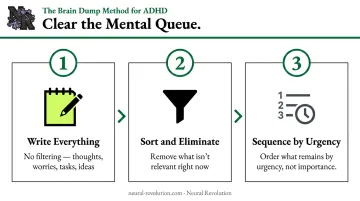
1. Do a Brain Dump to Clear the Mental Queue
When too many thoughts are competing for mental bandwidth, the brain can't prioritize — it just cycles. A brain dump offloads this competition to paper or a digital tool, reducing the working memory tax to a manageable level.
How to do it:
- Write everything without filtering — thoughts, worries, tasks, half-formed ideas
- Sort what you've written: eliminate what isn't relevant right now
- Sequence what remains by urgency, not importance
The reason this works for ADHD specifically: working memory is already compromised, and trying to hold everything simultaneously is precisely what creates the mental fog. Externalizing thoughts makes the invisible visible — and stops the brain from trying to juggle everything at once. Barkley's executive function model explicitly supports environmental modifications and externalizing self-regulation demands as compensation strategies for ADHD-related deficits.
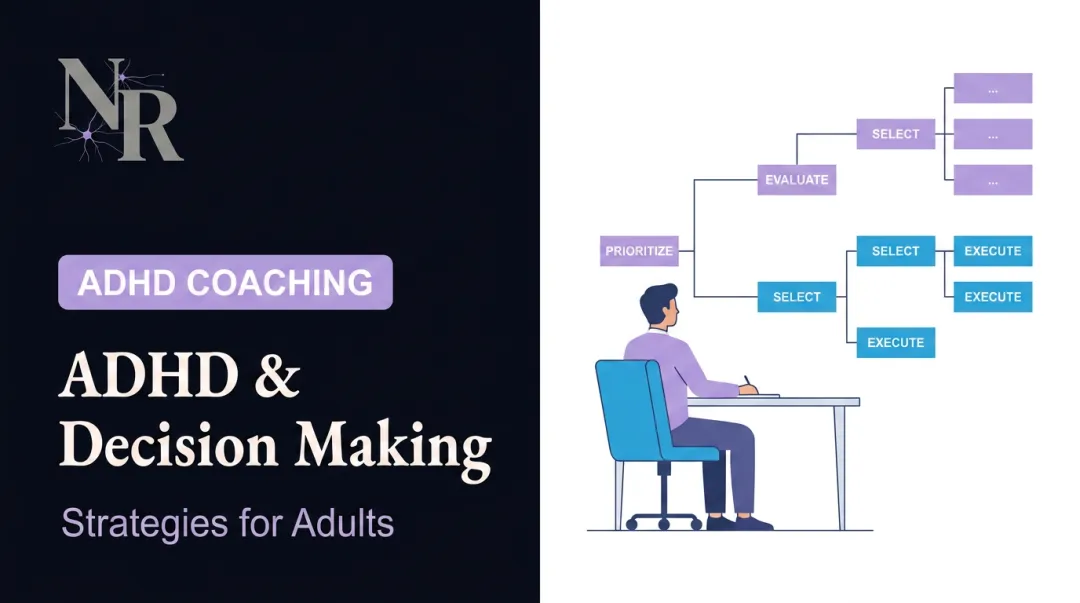
2. Shrink the Decision Down to One Micro-Choice
Analysis paralysis often comes from treating a multi-step task as a single, undivided thing. The antidote is radical scope reduction: not "write the proposal," but "open the document." Not "respond to the client," but "type the first sentence."
The goal isn't to solve the whole problem — just to lower the activation energy required to start.
This works neurologically because small, achievable actions produce reward-signal feedback that builds momentum. Research on delay aversion and reward sensitivity in ADHD adults supports the principle: the brain responds to immediate, near-term salience. A micro-action is concrete, imminent, and completable — which is exactly the profile the ADHD brain can respond to.
3. Set a "Good Enough" Threshold Before You Start
Many high-achieving ADHDers freeze because they're waiting for ideal conditions, the best possible answer, or the perfect plan. The perfectionism loop keeps the task in "preparation mode" indefinitely.
Pre-decide what done looks like before you start — and make that definition explicit, specific, and deliberately not perfect.
Professional example: "A good enough response to this email answers the core question in three sentences and gets sent before noon."
That single pre-decision removes the ambiguity about when to stop deliberating. There's no longer a question of "is this good enough?" — because you've already answered it. This short-circuits the loop by replacing an open-ended standard with a closed one.
4. Use a Time Box to Create Urgency Without Overwhelm
The ADHD brain struggles most with tasks that feel endless and open. Time-boxing — working in defined sprints with a clear end point, such as 25 minutes — makes tasks feel finite. That finitude activates a mild urgency signal the ADHD brain responds to, drawing on its sensitivity to immediacy and time pressure.
The Pomodoro Technique is the most widely known version, but the specific duration matters less than the principle: commit to a defined window, start the clock, and stop when it ends.
Time-boxing also serves a second function for professionals prone to hyperfocus: it creates a natural circuit breaker. If you tend to go deep on one element while the rest of the project stalls, a timer creates the interruption that willpower rarely does.
5. Try Body Doubling or External Accountability
Body doubling — working alongside another person, physically or virtually — activates social engagement systems in the brain that can offset the motivational deficit characteristic of ADHD. The presence of another person creates low-level accountability without requiring constant interaction.
Eagle et al. (2024) surveyed 220 neurodivergent people on body doubling and found it was consistently reported as a facilitator of focus and task engagement. The evidence is observational rather than clinical trial-level, but the reported benefits — improved focus and task completion — are consistent across neurodivergent populations.
For professionals, this can look like:
- Virtual co-working sessions (Neural Revolution's FOCUS Forward group program includes access to a virtual co-working community specifically for this purpose)
- An accountability partner check-in before a difficult task
- Dedicated virtual focus rooms
Intentionality matters: the body double should know what task is being worked on, and the duration should be set in advance.
6. Regulate Your Nervous System Before You Try to Think
Paralysis is often a dysregulated nervous system state, not just a cognitive one. Trying to think through a complex decision while emotionally flooded or physically depleted is unlikely to produce results — not because you're not smart enough, but because the executive function access needed for rational planning requires a regulated baseline first.
Mehren et al. (2019) tested a single 30-minute aerobic cycling session in adults with ADHD and found significant improvement in executive function measures — specifically reaction time and reaction-time variability — compared to controls.
Brief physiological resets to try before engaging a difficult task:
- A short walk (even 10 minutes)
- Intentional slow breathing for 2-3 minutes
- A change of physical environment
- Any movement that shifts your physical state
This step feels like avoidance. It isn't. It's a prerequisite.
7. Deliberately Limit Your Options
More options don't lead to better decisions — they lead to more processing, more looping, and a higher probability of no decision at all. This is well-documented in the general research on choice overload, and Oroian et al. (2025) directly connects overwhelming options to decision paralysis in adults with ADHD — with 82% of ADHD adults in their study reporting frequent decision difficulty.
The solution: constrain choices before you sit down to decide. Pre-select two or three concrete options, evaluate only those, and discard the rest.
Professional example: You're evaluating approaches to a strategy question. Instead of reviewing all possible directions, identify the two most viable and compare only those. The goal isn't to find the objectively best answer — it's to make a workable decision in a reasonable timeframe.
8. Build ADHD-Friendly Systems, Not Willpower Strategies
The most durable insight from cognitive psychology is also the least intuitive: sustainable relief from analysis paralysis doesn't come from trying harder. It comes from designing your environment and workflows so that good decisions and task initiation are built in rather than effortfully reconstructed each time.
This means:
- Reducing the number of decisions you need to make daily
- Creating defaults for recurring choices
- Structuring your day around your brain's natural activation patterns
- Externalizing planning into visible, frictionless systems
Generic productivity frameworks — SMART goals, time audits, habit trackers — tend to fail for ADHD adults because they require the precise executive function skills that are already compromised. They're built for a neurotypical decision architecture.
This is where personalized ADHD coaching adds concrete value. Neural Revolution's coaching — led by Dr. Eliza Barach, a cognitive psychologist with a PhD and Board Certified Coach credential — focuses on building individualized systems that reduce executive load from the start, rather than retrofitting generic frameworks onto an ADHD brain.
One practical example: Dr. Eliza's proprietary DREAMS™ framework replaces SMART goals with a structure designed around how ADHD brains actually process motivation, reward, and planning. It's flexible, emotionally resonant, and built for the way high-achieving ADHDers work.
When the Strategies Feel Impossible
Here's the honest version of this problem: many people with ADHD read a list of strategies and feel paralyzed by the strategies themselves. That's not failure. That's the condition expressing itself, because implementing any new system requires exactly the executive function that's currently offline.
The meta-problem is real, and it deserves a real response.
When you're already frozen, don't try to implement all eight strategies. Pick the single lowest-effort option that might shift your state — even by 10%. That might be:
- Standing up and changing rooms
- Writing one sentence about what you're avoiding
- Naming out loud what you're feeling
- Setting a two-minute timer and doing literally anything
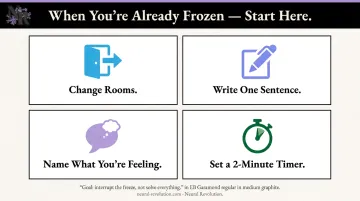
The goal isn't resolution. It's interrupting the freeze.
Those tactics work in the moment. But if analysis paralysis keeps coming back — affecting professional performance, relationships, or your sense of who you are — in-the-moment fixes aren't enough on their own. The issue isn't knowledge. Research by Durand et al. (2020) found that ADHD adults often know strategies but struggle with persistence and activation, not with understanding. The gap between knowing and doing is real, and it's neurological.
Structured ADHD coaching, like the 1:1 work offered at Neural Revolution, helps identify the specific triggers driving your particular paralysis and builds individualized systems that don't require constant willpower to maintain. The approach is grounded in cognitive psychology and designed for the way ADHD brains actually work — not in the way motivation-based advice assumes they should.
Frequently Asked Questions
What is task paralysis in ADHD?
ADHD task paralysis is a specific form where a person feels unable to begin a task — particularly new, complex, boring, or high-pressure ones — due to challenges with executive function and dopamine-driven motivation. It's a neurological initiation failure, not a reflection of capability or desire.
How do you overcome analysis paralysis with ADHD?
Working with the ADHD brain's wiring — not against it — is the core principle. In practice, that means:
- Reducing decision scope so fewer options compete for attention
- Externalizing thoughts to offload working memory
- Regulating your nervous system before expecting rational planning to kick in
- Building environmental structure that removes reliance on willpower in the moment
Is ADHD analysis paralysis the same as procrastination?
They look similar, but procrastination typically involves a choice to delay, while ADHD analysis paralysis is an involuntary freeze driven by overwhelm, emotional dysregulation, or dopamine deficit. The person genuinely cannot initiate — despite wanting to.
Why does the ADHD brain get stuck in analysis paralysis?
Dopamine signaling differences, working memory gaps, and executive function challenges make it harder to filter options, prioritize, and initiate — especially when stakes feel high. Decision-making becomes a loop rather than a linear process.
Can analysis paralysis affect successful, high-functioning people with ADHD?
Yes — it's especially common among high-achievers, because their intelligence and ambition raise the stakes of every decision while their executive function challenges remain. The result is a larger gap between what they're capable of and what they can initiate on any given day.
What's the difference between mental paralysis, choice paralysis, and task paralysis?
Each describes a different stuck point — and each responds to different strategies:
- Mental paralysis: overwhelm from too many competing thoughts or stimuli
- Choice paralysis: getting stuck weighing options out of fear of choosing wrong
- Task paralysis: inability to begin due to complexity, boredom, or unclear starting points
They often co-occur in ADHD.