If you're a high-achieving adult with ADHD, this isn't unfamiliar. And it's not a focus problem or a motivation problem. It's a working memory problem.
Working memory failures are one of the most disruptive — and least understood — aspects of adult ADHD. They're frequently misread as carelessness or poor listening, especially by high performers who've spent years compensating so effectively that no one (including themselves) recognized the underlying pattern.
This post covers what working memory actually is, why ADHD targets it specifically, the honest truth about whether it can be "improved," and the strategies that genuinely reduce the burden.
Key Takeaways
- Working memory is the brain's active mental workspace — and it's reliably weaker in ADHD brains due to differences in prefrontal cortex function
- These gaps are routinely misread as laziness or carelessness — not the structural cognitive difference they actually are
- Brain training apps do not produce meaningful real-world improvement for ADHD working memory
- The most effective strategies reduce the demand on working memory, not attempt to expand its capacity
- Sleep, stress, and exercise have a direct, measurable impact on working memory capacity day to day
What Is Working Memory and Why ADHD Makes It Harder
The Mental Workspace
Working memory isn't the same as remembering something. It's the brain's ability to temporarily hold and actively use information in real time (the cognitive workspace where active thinking happens).
The Baddeley and Hitch model, foundational in cognitive psychology, distinguishes working memory from simple short-term storage: short-term memory holds information briefly; working memory uses it. Holding a phone number while dialing it is short-term memory. Mentally calculating a tip while tracking the conversation around you — that's working memory.
For most people, this workspace operates well enough that they never notice it. For adults with ADHD, it's the source of constant friction.
The Neuroscience Connection
Working memory is primarily governed by the prefrontal cortex and the dopaminergic systems — the same neural pathways most disrupted by ADHD.
Neuroimaging research by Ko et al. (2013) found that adults with ADHD showed reduced activation across the left fronto-parietal network (including the dorsolateral prefrontal cortex) when working memory load exceeded capacity during fMRI tasks. The brain isn't just struggling; it's showing measurably different activation patterns under load.
Dr. Russell Barkley's executive function framework identifies two core working memory systems: verbal working memory (inner speech, self-directed instructions) and nonverbal working memory (mental imagery, visual-spatial processing). Per Barkley's model, these function as the brain's navigation — and when they're unreliable, planning, sequencing, and staying on course all break down.
Why ADHD Makes It Worse
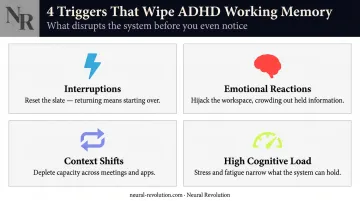
ADHD doesn't just reduce working memory capacity. It makes it more fragile. Any competing stimulus (an interruption, an emotional reaction, a context shift) can wipe the mental slate before information has been acted on or encoded. Adult ADHD groups show significant working memory weaknesses on tasks requiring rapid processing and active manipulation compared to neurotypical controls.
That fragility shows up in predictable ways:
- Interruptions reset the slate — returning to a task often means starting from scratch
- Emotional reactions hijack the workspace, crowding out what was being held
- Context shifts between meetings, apps, or conversations deplete available capacity
- High cognitive load (stress, decision fatigue) narrows what the system can handle
This is not a sign of low intelligence. Many high-achieving adults with ADHD compensate through hyperfocus, over-preparation, and elaborate workarounds for years before hitting a ceiling where compensation alone stops working.
What Working Memory Failures Look Like in Real Adult Life
At Work
The professional manifestations are specific and recognizable:
- Losing the thread of a point mid-meeting — not because you're distracted, but because the cognitive workspace cleared
- Forgetting a task the moment something else appeared
- Reading an email twice and retaining nothing
- Receiving three-item verbal instructions and arriving at your desk with one
- Starting Step 1 of a plan while the rest of the plan quietly dissolves
These aren't careless mistakes. They are the predictable output of a reduced working memory buffer operating in a high-demand professional environment. Research on adult ADHD and occupational functioning links executive function deficits — particularly working memory — to significantly higher rates of missed deadlines, workplace accidents, and chronic employment instability, with estimated productivity costs of $4,336 per ADHD worker per year.
The Emotional Weight
For high achievers, these failures carry disproportionate shame. Someone who handles complex intellectual work with ease but blanks on a colleague's name seconds after hearing it, or loses a meeting action item on the walk back to their desk, often concludes something is fundamentally wrong with them.
Working memory difficulties and emotional dysregulation tend to feed each other in adults with ADHD. The cycle compounds quickly: failures produce shame, shame produces stress, and stress directly impairs prefrontal cortex function — further degrading the working memory that's already under strain.
Time and the Working Memory Link
One less obvious manifestation: time blindness. Working memory is essential for tracking how long a task has taken, anticipating what comes next, and connecting the present moment to a future goal. Research on time perception in adults with ADHD identifies differences in time perception as a focal symptom — not a side effect. This is why ADHD adults can lose hours unexpectedly even when genuinely motivated and engaged.
The Truth About "Improving" Working Memory with ADHD
What Brain Training Actually Does
Brain training apps and working memory exercises are appealing in theory. In practice, the evidence is clear. A 2023 meta-analysis published in Molecular Psychiatry — the largest review of computerized cognitive training (CCT) in ADHD — found that while trained working memory tasks showed modest improvement, those gains did not transfer to other neuropsychological or academic outcomes. CCT is not supported as a stand-alone ADHD treatment.
Training a specific task makes you better at that task. It doesn't improve working memory in the board meeting, the client call, or the project handoff.
The More Useful Goal
That evidence points toward a more productive goal. Rather than trying to expand a limited buffer, the effective approach is reducing how much working memory is required in the first place — through offloading, routinization, and environmental design. Working with the ADHD brain, not against it.
What Actually Supports Working Memory
Certain factors do support working memory function at the neurological level:
- ADHD medication — stimulants increase dopamine and norepinephrine availability in the prefrontal cortex, and research supports meaningful improvement in executive function behaviors for many adults. Always consult a physician.
- Aerobic exercise — a study of adults with ADHD found that 30 minutes of moderate cycling improved executive task performance, likely through increased catecholamine activity in the prefrontal cortex
- Sleep — deprivation specifically impairs prefrontal cortex function, the region working memory depends on most
- Stress reduction — chronic stress disrupts prefrontal networks and can functionally take working memory offline
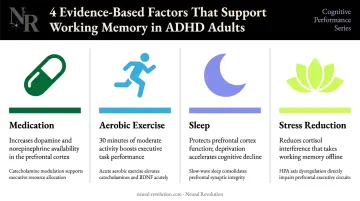
None of these are fixes — but they protect the working memory capacity you already have, and that matters.
Strategies That Actually Help: Externalizing and Offloading
The core principle: because the ADHD brain's working memory workspace is smaller and more easily disrupted, the goal is to move information out of the brain — into the external environment, where it can be visible, persistent, and retrievable without cognitive effort.
Build External Systems, Not Just To-Do Lists
There's a difference between a reactive to-do list (writing things down when you happen to remember them) and a proactive capture system (a consistent structure that collects information as it arises and surfaces it at the right moment).
The brain can release its grip on information when it trusts the system won't drop it. Concrete starting points:
- A single capture notebook — one place, used consistently, for everything
- A physical whiteboard visible during work that holds the current project state
- Meeting capture systems built to function in real time, not after the meeting ends — because the walk back to the desk is where action items disappear
That last point matters more than most people expect. Post-meeting context collapse is one of the most common working memory failure points for ADHD professionals — and one of the most preventable with the right capture structure.
Whether the tool is analog or digital matters less than whether you'll use it consistently. The best system intercepts information at the moment it exists, not the one you intend to check later.
Routinize to Free Up Capacity
Habits bypass working memory almost entirely. Once a behavior is sufficiently practiced, it shifts to the automatic system and requires minimal executive resources.
An ADHD professional who has routinized their morning workflow arrives at their desk with cognitive capacity intact. Someone managing constant transitions arrives already depleted — having spent working memory on decisions that shouldn't require it.
The practical implication: build one routine at a time. Overhauling everything simultaneously is a working memory demand in itself. Good targets for early routinization: morning startup sequences, end-of-day shutdown rituals, and meeting prep — decisions that repeat daily but feel like they require fresh effort every time.
Use Environment as a Memory Tool
Your environment can do cognitive work that your brain shouldn't have to:
- Keeping information visible means it doesn't need to be held in mind
- Designated spots for objects eliminate the retrieval demand entirely
- Clearing irrelevant items from your workspace reduces competition for limited working memory bandwidth
- A physical object placed near the door signals what needs to happen before leaving — no mental reminder required
The strategies above work because they stop treating working memory as the primary storage system. A coach who specializes in executive function and systems design — Neural Revolution's coaches work specifically in this space — helps you identify which approaches fit your brain, your work style, and your professional context. The goal is a system calibrated to how your brain actually operates, not a productivity experiment that runs until something sticks.
Lifestyle Factors That Amplify or Deplete Working Memory
Sleep
Sleep deprivation directly impairs prefrontal cortex function (the exact region working memory relies on). Research consistently shows sleep loss degrades prefrontal-dependent tasks more than any other cognitive domain. For adults with ADHD already operating with reduced capacity, even mild disruption produces outsized decline. Sleep isn't a performance bonus — it's baseline maintenance.
Stress
Chronic stress disrupts communication between the prefrontal cortex and the broader brain network, effectively putting working memory offline and locking the brain into reactive mode. High-achieving ADHD professionals often run at chronically elevated stress baselines, which compounds working memory challenges significantly. Mindfulness and physical movement both have research support for improving executive function — and they work through mechanisms that medication alone doesn't cover.
Exercise
Physical activity increases dopamine and norepinephrine (the same neurotransmitters targeted by ADHD medications) and research supports its role in improving executive task performance in adults with ADHD. A study using a 30-minute moderate aerobic protocol found improved reaction times and executive performance in adults with ADHD. Even when medication is part of the picture, exercise addresses the same neurochemical pathways through a different mechanism.
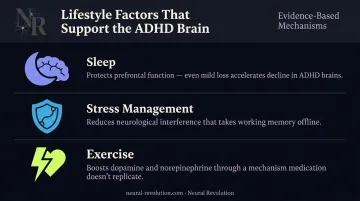
Quick reference — three lifestyle factors with the clearest working memory impact:
- Sleep — protects prefrontal function; even mild loss accelerates decline in ADHD brains
- Stress management — reduces the neurological interference that takes working memory offline
- Exercise — boosts dopamine and norepinephrine through a mechanism medication doesn't replicate
Frequently Asked Questions
Can people with ADHD improve working memory?
The underlying capacity is unlikely to expand through brain training. ADHD adults can significantly improve real-world functioning by reducing cognitive load, building external systems, and protecting the lifestyle factors that support prefrontal performance. The aim is practical: work with how your brain actually operates, not against it.
Does ADHD affect short-term memory?
ADHD primarily affects working memory — the active use of information — rather than short-term storage. Someone with ADHD may recall facts perfectly when prompted but struggle to deploy the right information at the right moment. That's a working memory issue, not a storage issue.
Why do I forget things seconds after thinking of them?
ADHD brains are especially vulnerable to working memory interference: any competing stimulus can displace information before it's been acted on. Capturing thoughts immediately in a trusted external system (a notebook, a voice memo) is critical because the thought needs to exit your head and land somewhere reliable before it vanishes.
What does working memory failure look like at work?
Common patterns include:
- Losing the thread mid-conversation
- Forgetting a task the moment something else appears
- Difficulty following multi-step instructions
- Struggling to track project progress without visual aids
These are the predictable outputs of a working memory system under load, not character flaws or simple inattention.
Do ADHD medications help with working memory?
Stimulant medications support working memory by increasing dopamine and norepinephrine availability in the prefrontal cortex, and research shows meaningful functional improvement for many adults. Medication works best alongside structural and behavioral strategies: it may raise the baseline, while external systems handle what remains. Always consult a physician for medication decisions.