This isn't laziness. It's not a character flaw. According to the CDC, 15.5 million U.S. adults currently have ADHD — and a staggering 55.9% of them weren't diagnosed until adulthood, which means decades of struggling without explanation. Many describe themselves, before diagnosis, as "lazy," "stupid," or just fundamentally broken.
They weren't. And neither are you.
This article moves past the myth of willpower and into what actually works: a realistic, brain-based approach to building discipline that works with your ADHD, not against it.
Key Takeaways
- ADHD discipline struggles stem from executive function differences — not effort or character
- External systems and scaffolding are more effective than willpower for ADHD brains
- Dopamine-informed strategies — novelty, rewards, gamification — work with the ADHD brain, not against it
- Chronic shame actively undermines the executive functions self-discipline depends on; self-compassion is a functional strategy
- Personalized coaching creates the structure generic productivity systems are built to skip
Why "Just Try Harder" Fails with ADHD
The problem isn't effort. It's architecture.
ADHD fundamentally affects the prefrontal cortex — the brain's planning and regulation center. Research by Amy Arnsten links ADHD to weaker prefrontal cortical circuits, particularly in the right hemisphere, the region that governs everything from organizing your day to resisting distraction mid-task.
Russell Barkley frames ADHD as primarily a disorder of self-regulation and executive function that affects sustained attention, goal persistence, distraction resistance, and behavioral inhibition. That's not a willpower problem. It's a neurology problem.
The Dopamine Factor
The ADHD brain's reward system works differently. A PET study by Volkow et al. found reduced dopamine markers in the brain's reward pathway, directly associated with inattention. A separate meta-analysis confirmed that delay discounting (choosing smaller, immediate rewards over larger, delayed ones) is significantly elevated in ADHD compared to controls.
Translation: the ADHD brain isn't broken. It's calibrated for now. Abstract future rewards don't generate the neurological signal needed to initiate action.
Three Executive Function Failures That Sabotage Discipline
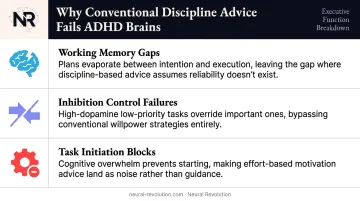
That reward-system wiring doesn't exist in isolation — it shows up directly in three executive function breakdowns that make conventional discipline advice nearly useless.
- Working memory gaps: The ADHD brain holds less information in active memory. Multi-step plans evaporate between the moment you make them and the moment you try to execute them.
- Inhibition control failures: When a low-priority but high-dopamine task (checking Instagram, reorganizing your desk) competes with an important but low-stimulation task, the ADHD brain consistently chooses stimulation. That's the salience system doing exactly what it's wired to do, not laziness.
- Task initiation blocks: Often called "ADHD paralysis," this happens when the brain sees all the steps in a task at once, gets overwhelmed by the cognitive load, and can't start. It has nothing to do with whether you care about the task.
Redefining Discipline: From Internal Battle to External System
Here's the core shift: for neurotypical brains, discipline is an internal resource. For ADHD brains, it has to be an external structure.
Neurotypical productivity systems assume you can rely on memory, motivation, and willpower to sustain a plan. CHADD defines executive function as the brain's ability to activate, organize, integrate, and manage other functions — and when that internal system is unreliable, the answer isn't to try harder. It's to build external infrastructure that does the work your internal system struggles with.
This is called external scaffolding: tools, routines, and people that provide the structure your brain doesn't generate on its own.
What External Scaffolding Looks Like
- Visual timers that make abstract time feel concrete
- Body doubling — working alongside another person (virtually or in person) to activate focus. CHADD describes body doubling as an accountability structure adults use to start and complete tasks
- Accountability partners who hold you to commitments externally
- Written plans that offload working memory so your brain doesn't have to hold the whole map at once
Why Rigid Systems Fail
Traditional productivity frameworks — SMART goals, rigid planners, hourly schedules — were designed for neurotypical cognitive defaults. They assume consistent energy across a day, reliable working memory, and motivation from delayed, abstract rewards. None of those assumptions hold for ADHD brains.
Dr. Eliza Barach of Neural Revolution addresses this directly through the DREAMS™ framework: a flexible, emotionally resonant alternative to SMART goals designed specifically for how ADHD brains process rewards, time, and priorities. Rather than asking "Is this goal measurable?", it asks whether the goal connects to something you genuinely care about — which is where ADHD motivation actually lives.
5 Realistic Strategies to Cultivate ADHD-Friendly Discipline
1. Outsource Your Executive Functions
Stop relying on internal resources to do what external tools can handle better.
- Physical planner placed where you can't miss it — offloads working memory entirely
- Multiple alarms (not one) for task transitions, appointments, and wind-down warnings
- App blockers (Freedom, Cold Turkey) that remove the temptation decision entirely rather than relying on impulse control
- Written "brain dumps" before every work session to externalize what's in your head
The goal is to reduce the cognitive load your brain has to carry — not to discipline yourself into carrying more of it.
2. Engineer Your Environment for Success
The principle: make the right thing easy, make the wrong thing hard.
Reduce friction for desired tasks:
- Put your running shoes by the door the night before
- Open the document you need to work on before you go to sleep
- Keep the guitar on a stand in the living room, not in a case in the closet
Increase friction for distractions:
- Put your phone in another room during focus blocks
- Log out of social media so opening it requires a password
- Use a different browser profile for work that doesn't have bookmarks to time-wasting sites
Small environmental changes consistently outperform willpower-based approaches.
3. Gamify Your Goals with Dopamine
The ADHD brain needs immediate feedback to stay engaged. Work with that instead of fighting it.
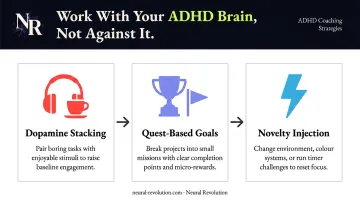
Dopamine stacking: Pair a boring task with something enjoyable. Listen to a podcast only while doing administrative work. Drink your favorite coffee only during the tasks you avoid most.
Quest-based goals: Break large projects into small "missions" with clear completion points and small rewards. Finishing a 2,000-word project feels distant. Finishing "Section 1" feels doable and earns a 10-minute break.
Novelty injection: Try a different work location, switch to a new color-coding system, or run a timer challenge ("Can I draft this in 20 minutes?"). The ADHD brain responds to novelty the same way it responds to reward — a quick hit of dopamine that keeps you in motion.
4. Separate Planning from Doing
Trying to plan and execute simultaneously overloads an already taxed working memory system.
Do your planning at a separate time, ideally during lower-energy hours when you're not in execution mode. Write out the exact next three steps for each project before your next work session. Not "work on proposal" — something like: "open the file, write the executive summary, send to client for feedback."
When your "doing brain" shows up the next morning, it doesn't have to make decisions. There's already a map.
5. Embrace the "Just Do Something" Principle
ADHD paralysis breaks with momentum, not motivation. The goal isn't to "clean the kitchen" — it's to put one dish in the dishwasher.
This isn't a metaphor. The minimum viable action is the actual target. Starting triggers its own neurological momentum, and what begins as one dish often cascades into the full kitchen. But even if it doesn't, one dish is still better than none. Your brain learns, incrementally, that starting is survivable.
Set your real task aside and ask: What is the smallest possible version of this action I could take right now? Do that. Only that. See what happens next.
The Missing Ingredient: Why Self-Compassion Is Non-Negotiable
Many adults with ADHD carry decades of shame — years of being told they weren't trying hard enough, weren't living up to their potential, were "smart but lazy." A 2023 systematic review of women diagnosed with ADHD in adulthood found they commonly described themselves before diagnosis as "different," "stupid," or "lazy," with chronic low self-esteem and self-loathing.
That shame isn't just painful. It's counterproductive. Research on chronic stress shows it directly impairs executive function — meaning the self-criticism designed to motivate you is actively making it harder to do the thing you're criticizing yourself for not doing.
A Simple Reframe That Works
When you notice the inner critic firing, try this:
"I'm so lazy" → "My brain is having a hard time initiating this task. That's a known ADHD experience. What's one small thing I can do to make it easier to start?"
This isn't toxic positivity. It's a functional shift: shame spirals deplete executive resources, while problem-solving mode uses them. Research confirms that self-compassion meaningfully supports mental health in adults with ADHD — and that mental health affects your capacity to use any strategy in this article.
Without some degree of self-compassion, accountability strategies tend to backfire — adding another layer of shame rather than creating forward movement.
Building Your Scaffolding: How Expert Coaching Creates Lasting Change
The strategies in this article are effective — but implementing them consistently is itself an executive function task. Which is exactly where many ADHD adults get stuck: they understand the system, they believe in it, and then life happens and it evaporates.
That's not failure. It means external accountability isn't optional — it's structural, the same way a cast isn't optional for a broken bone.
ADHD coaching — particularly from practitioners who understand the neuroscience — accelerates the process of building systems that actually hold. At Neural Revolution, Dr. Eliza Barach (PhD in Cognitive Psychology, Board Certified Coach, diagnosed with ADHD at seventeen) works with high-achieving professionals to design external systems built around how their brain actually works, not how neurotypical productivity culture assumes it should.
The coaching doesn't hand you a framework and send you home. Instead, it builds scaffolding calibrated to your brain and your professional context, then provides the accountability structure to make it stick. That typically looks like:
- Identifying which executive function gaps are driving your specific patterns
- Designing systems that work with your ADHD rather than against it
- Building in external accountability so follow-through doesn't rely on willpower alone
- Adjusting in real time as work demands and life circumstances shift
For professionals ready to explore this approach, Neural Revolution offers a Discovery Consult — a low-stakes first step to determine whether coaching is the right fit.
Frequently Asked Questions
Why is self-discipline so hard with ADHD?
ADHD creates structural differences in the prefrontal cortex and dopamine reward system — affecting planning, task initiation, impulse control, and working memory. These aren't willpower failures; they're neurological ones. Discipline feels harder because the internal architecture most people rely on operates differently in an ADHD brain.
What is neurodivergent burnout in ADHD?
It's a state of exhaustion that develops from years of white-knuckling performance through compensation strategies — masking, overworking, trying to meet neurotypical standards without the tools to do it sustainably. Executive function deficits are a documented driver of burnout in working adults with ADHD.
Is a lack of self-discipline in ADHD a character flaw?
No. It is a symptom of a neurodevelopmental condition that affects executive function and reward processing. The research is clear on this — and framing it as a moral failure actively harms the people carrying that belief.
What is the difference between motivation and discipline for ADHD?
Motivation is the desire to do something — and ADHD brains often have plenty of it. Discipline is the system that enables you to act on that desire consistently, especially when novelty fades. The gap is rarely about wanting to; it's about having the structure to follow through.
Can ADHD medication help with self-discipline?
Medication can improve focus, reduce impulsivity, and make executive functions more accessible — which means it may make behavioral strategies easier to use. But it doesn't build those external systems on its own — that's where structured coaching and behavioral strategies fill a different, complementary role.
How can I be more disciplined without being hard on myself?
Focus on building supportive systems rather than forcing willpower. Celebrate small wins genuinely — they register in the brain's reward system, not just on paper. And when you have an off day, treat it as data about what your system needs, not evidence of who you are.