Nothing is wrong with you. ADHD focus isn't random, even when it feels that way. It's situationally driven by neurobiology — and that means it can be influenced.
This article breaks down the science of ADHD flow, why your brain struggles to access it consistently, and what you can actually do to create the conditions that make it happen more often. Not through willpower. Through design.
Key Takeaways
- ADHD flow and hyperfocus are related but distinct — one works for you, the other can work against you
- The ADHD brain runs on an interest-based nervous system, not an importance-based one
- Flow is created through conditions (environment, task design, emotional state) — not summoned through willpower
- Disrupted flow doesn't erase the day — how fast you recover matters as much as how you enter
- Sustainable focus requires brain-aligned systems, not neurotypical productivity hacks
What Is ADHD Flow (And How It Differs from Hyperfocus)
The Gold Standard Focus Experience
Psychologist Mihaly Csikszentmihalyi introduced the concept of flow in 1975. Nakamura and Csikszentmihalyi's foundational 2002 work defines its core conditions: a balance between challenge and skill, clear proximal goals, and immediate feedback. When those conditions align, you get complete absorption — time disappears, distractions fade, output feels almost effortless.
For ADHD professionals, this experience is familiar. And maddening in its inconsistency.
Flow vs. Hyperfocus: Not the Same Thing
Both involve deep engagement. The distinction matters enormously.
Flow is intentional, skilled immersion in a task that's appropriately challenging. You remain aware of your surroundings and can exit when needed. It serves your priorities.
Hyperfocus, as described in Ashinoff and Abu-Akel's 2021 peer-reviewed review, is long-lasting heightened attention characterized by difficulty shifting away, what researchers call "locking on." You may lose track of time, miss obligations, and surface hours later having worked intensely on something completely unrelated to your actual priorities.
Sharon Saline, writing for ADDitude, puts it plainly: flow preserves situational awareness, while hyperfocus can involve being so absorbed that transitions and surroundings disappear entirely. Both feel productive in the moment. Only one reliably is.
The Interest-Based Nervous System
Understanding why flow is inconsistent starts with neurochemistry. ADHD involves dysregulation of dopamine and norepinephrine, the systems governing reward, motivation, and sustained attention. Del Campo et al. (2011) confirmed these neurotransmitters play critical roles in the executive functions most impaired in ADHD, while Arnsten (2009) linked ADHD to weaker prefrontal cortex circuit function. Flow requires hitting a precise activation window. For ADHD brains, that window doesn't open on demand.
This is the key reframe. William Dodson, writing for ADDitude, describes ADHD as an "interest-based nervous system": attention and motivation are regulated differently than in neurotypical brains. Rather than responding reliably to importance, logic, or deadlines, the ADHD brain activates around Interest, Novelty, Challenge, Urgency, and Passion (INCUP).
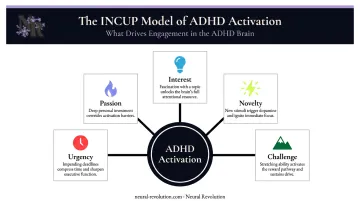
Flow becomes far more accessible when one or more of these factors are present. For high-achieving ADHD professionals, this reframes the pattern: extraordinary output on certain projects, complete paralysis on others. That gap isn't a character flaw — it's a neurologically predictable response you can design around.
Why the ADHD Brain Struggles to Enter Flow
The Activation Problem
The ADHD brain runs on a higher stimulation threshold. The prefrontal cortex — responsible for task initiation, planning, and self-regulation — needs more activation to engage than a neurotypical brain does. This is why getting started often feels disproportionately hard, even on work you genuinely care about.
Isaac et al. (2024) describe this through state-regulation theory: reduced ability to regulate arousal contributes directly to higher-level cognitive deficits in ADHD. The "warm-up" to flow isn't laziness — it's neurobiology.
Time Blindness Breaks the Flow Window
Weissenberger et al. (2021) identify differences in time perception as a focal symptom of adult ADHD. Without a felt sense of time passing, it's genuinely difficult to:
- Carve out meaningful focus windows
- Protect those windows from interruption
- Recognize when you've drifted off-task for 40 minutes
Protecting time you can't feel requires external structure — not willpower.
Emotional State Is a Neurological Gatekeeper
Shaw et al. (2014) found that ADHD with emotional dysregulation is associated with greater impairment across occupational, academic, family, and peer domains. A single critical email, a perceived slight, or ambient anxiety can trigger a threat response in the nervous system — a neurochemical state that blocks flow before it starts.
For ADHD professionals, emotional regulation is a prerequisite for focus, not a secondary concern.
The Novelty Trap and Working Memory Load
Two additional barriers compound the problem:
- ADHD brains need novelty to engage but habituate quickly. The environment or strategy that reliably triggered flow two weeks ago may stop working — not from lack of discipline, but from how the ADHD brain processes dopamine.
- Schweitzer et al. (2006) documented working memory deficits in adults with ADHD. Arriving at a task while holding ten open mental loops means arriving already partially depleted — and deciding what to work on can consume the cognitive resources needed to actually do it.
Creating the Conditions for ADHD Flow
Environment Does the Heavy Lifting
ADHD brains are highly sensitive to environmental cues. The right workspace — appropriate sensory stimulation, reduced visual clutter, comfortable temperature, clear signals that it's "work time" — can lower the activation threshold before you even open a file.
The goal isn't willpower over your environment. It's designing an environment that does the cognitive work of focus for you. This sits at the core of Neural Revolution's approach: Dr. Eliza Barach specializes in environmental and systems design, building external structures calibrated to how the ADHD brain actually functions, not how neurotypical productivity frameworks assume it should.
Practical starting points:
- Dedicate a specific physical space or chair to deep work only
- Use white noise or a consistent playlist to signal focus mode
- Clear visual clutter from your immediate sight line before starting
- Turn off non-essential notifications before sitting down
Once your environment is working with you, the next variable is the work itself.
Match Task Difficulty to Current Capacity
Flow requires a task challenging enough to engage the brain but not so overwhelming it triggers avoidance. On a high-resource day, that might mean tackling the complex strategic problem. On a low-resource day, a smaller, more bounded version of the same work may be the on-ramp. That's not failure; it's calibration.
This is where ADHD-friendly goal framing becomes critical. Vague goals create activation paralysis. Overly rigid goals create resistance. Dr. Barach's proprietary DREAMS™ framework was designed specifically for this gap, offering an alternative to SMART goals that builds in flexibility, emotional resonance, and actionable specificity: the combination the ADHD brain needs to sustain engagement.
Engineer INCUP Factors Deliberately
When interest, novelty, challenge, urgency, or passion aren't naturally present in a task, they can be created:
- Add novelty: Change your location, use a new format, switch tools
- Create urgency: Set an artificial deadline, use body doubling, schedule a coach check-in
- Inject challenge: Gamify the task, set a stretch target, time yourself
- Connect to passion: Reframe the task's link to a purpose you genuinely care about
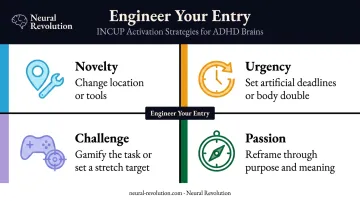
These aren't tricks. They're legitimate neurological inputs for a brain that requires dopamine activation to engage.
Map Your Energy to Your Schedule
Research from Gabay et al. (2022) found that 73–78% of adults with ADHD show an evening chronotype, with slower sustained-attention performance in morning hours. This has direct implications for scheduling.
Track your actual energy and focus quality over one to two weeks — a quick note at three points in the day is enough. Once patterns emerge, protect your highest-activation window for your most flow-dependent work. Neural Revolution even offers a free Energy Management Tracker to support this process.
Practical Day-to-Day Tactics for More Consistent Focus
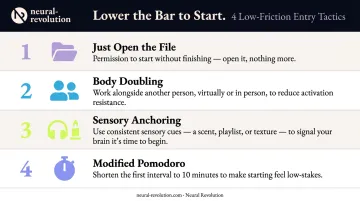
Four Low-Friction Entry Points
These tactics work specifically because they lower the barrier to starting, not because they require more discipline:
- The "just open the file" rule — Commit only to opening the document or tool, nothing more. Removing the pressure of full engagement often dissolves activation resistance entirely.
- Body doubling: Working alongside another person — virtually or in person — uses social presence to reduce initiation friction. A 2024 ACM study surveyed 220 neurodivergent participants and found body doubling is one of the most widely used focus supports among this group.
- Sensory anchoring — A consistent playlist, scent, or lighting setup that signals "focus time" to the brain's pattern-recognition system. Use it exclusively during deep work to build the association.
- Modified Pomodoro intervals: Work in timed blocks with real dopamine rewards built into breaks. Experiment with interval length — 25 minutes is a starting point, not a prescription. Find what your brain actually tolerates before attention starts to slip.
A Simple Weekly Planning Structure
The most sustainable focus systems for ADHD professionals are flexible enough for variable-energy days but consistent enough to provide external scaffolding. Each week:
- Identify 1–3 non-negotiable priorities — not a full task list, just what actually must move
- Protect one peak-energy focus block — guard it like a meeting you can't cancel
- Create a "parking lot" for everything else — capturing open loops reduces cognitive load before you sit down to work
None of this requires perfect execution. The goal isn't a perfectly productive day. It's building a structure flexible enough to bend without breaking — one that fits the actual shape of your week, not an idealized version of it.
When Flow Gets Disrupted: Recovery Without the Spiral
The Real Danger Isn't the Interruption
An unexpected Slack message. An emotionally charged email. Forty-five minutes lost down a rabbit hole you didn't see coming. These are the common flow disruptors — and by themselves, they're manageable.
The real danger is what happens next. For ADHD brains, the shame and self-criticism that follow a focus lapse can turn a brief derailment into hours of avoidance. A 2024 research review found that five of six controlled studies reported lower self-esteem in adults with ADHD, with symptoms correlating negatively with self-esteem — a pattern that makes the self-critical spiral distinctly ADHD-specific, not a general productivity problem.
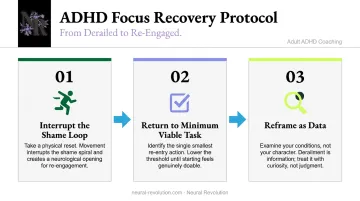
A Three-Step Recovery Protocol
- Interrupt the shame loop — Physically move. Stand up, walk to another room, do something for 2–3 minutes that breaks the mental pattern. A brief grounding exercise or a reset phrase you've chosen in advance works well.
- Return to a minimum viable task — The smallest possible action that re-engages with the work. Not the full project. One sentence. One decision. One file opened. Re-entry doesn't require re-immersion.
- Reframe the disruption as data — Ask "what in my environment or task design made me vulnerable to this?" rather than "why am I like this?" This is what it means to design systems that survive imperfection: the question after a failure isn't about your character, it's about your conditions.
Consistency Means Something Different Here
For ADHD, consistency isn't about never losing focus. It's about shrinking the gap between disruption and re-entry. A well-designed system makes returning to focus fast, low-shame, and nearly automatic — distraction-proofing is beside the point.
Frequently Asked Questions
What is the difference between ADHD flow and hyperfocus?
Flow is intentional, skilled absorption in a challenging task aligned with your goals — you remain aware of your surroundings and can exit when needed. Hyperfocus is compulsive fixation that's difficult to exit and often occurs on tasks unrelated to your actual priorities. Both involve deep engagement, but flow is sustainable and directed; hyperfocus can derail your day without warning.
Why is it so hard for people with ADHD to get into a flow state?
ADHD affects the dopamine and norepinephrine systems that govern motivation and sustained attention, raising the stimulation threshold needed to engage. Without interest, novelty, challenge, urgency, or passion present, the prefrontal cortex struggles to activate. Creating the right conditions intentionally is what makes flow more accessible.
Can you actually create a flow state with ADHD, or does it just happen randomly?
Flow can't be forced, but it can be made significantly more likely. Engineering the right environment, selecting appropriately challenging tasks, reducing cognitive load before you start, and deliberately activating INCUP factors all shift flow from random to more predictable with practice.
What are the most common things that break ADHD flow?
Key disruptors include unexpected interruptions, emotionally charged stimuli (a difficult message or perceived criticism), task ambiguity that triggers avoidance, environmental noise or clutter, and the internal critic that turns a brief lapse into a shame spiral.
Does ADHD medication help with entering flow states?
Stimulant medication can lower the activation threshold and reduce time blindness, making flow more accessible for some people. Medication alone doesn't build the environmental conditions or emotional regulation skills that make flow sustainable, which is where coaching and systems work fill the gap.
How much does an ADHD coach charge per hour?
A 2026 University of Washington survey found the median ADHD coaching rate is $150 per hour. Boutique practices with doctoral-level expertise — like Neural Revolution, which charges $150–$250 per 60-minute session — tend toward the higher end. Neural Revolution operates on a pay-as-you-go model with no long-term contracts, and discovery consultations are available for $0–$50.