This is the daily reality for many adults with ADHD. And it's not a motivation problem.
Research from Speyer et al. (2022) found that ADHD traits predicted significantly higher perceived stress and stronger stress carryover into negative affect — meaning stress doesn't just hit harder, it lingers longer. This article breaks down why that happens neurologically, how stress and ADHD feed each other, and what actually works to interrupt the cycle.
Key Takeaways
- ADHD involves real structural differences in the prefrontal cortex, making everyday cognitive demands more taxing
- Stress and ADHD symptoms worsen each other — a bidirectional relationship where each one amplifies the other
- ADHD burnout follows a predictable push-crash-recovery cycle that keeps repeating without structural change
- Effective stress management requires brain-aligned systems, not more discipline
- Sustainable progress depends on self-knowledge and support structures — not willpower alone
Why the ADHD Brain Experiences More Stress
The Prefrontal Cortex Problem
The prefrontal cortex (PFC) handles decision-making, working memory, and impulse regulation. In ADHD, this region operates differently — research by Schulz et al. (2017) found lower activation in the orbitofrontal cortex, inferior frontal gyrus, and anterior cingulate in adults with persistent ADHD during cognitive control tasks.
The practical implication: everyday demands like managing deadlines, switching between tasks, or navigating social friction require more cognitive effort for ADHD brains. That's not a willpower gap. It's a resource allocation reality — the brain is working harder to do what others do automatically.
How Dopamine and Stress Interact
ADHD involves differences in how dopamine and norepinephrine modulate PFC function. Arnsten (2011) describes this as an inverted-U relationship: these catecholamines support PFC function at moderate levels, but stress pushes signaling outside that optimal range — weakening the exact control systems ADHD already makes harder to recruit.
Stress, for ADHD brains, doesn't just feel worse — it actively degrades the cognitive functions they're already working hardest to maintain.
Emotional Dysregulation as a Stress Amplifier
Emotional dysregulation isn't a side effect of ADHD — research describes it as a core feature. Soler-Gutierrez et al. (2023) reviewed evidence that emotion dysregulation is central to adult ADHD presentation. This shows up as:
- Rapid, intense emotional responses that feel disproportionate to the situation
- Difficulty self-regulating once activated
- Heightened sensitivity to perceived rejection (sometimes called rejection sensitive dysphoria)
- Social and workplace friction landing harder than it would for neurotypical peers
The Time Blindness and Executive Function Tax
ADHD-related executive function deficits create chronic low-level stress through accumulated failures: missed deadlines, forgotten commitments, disorganized environments. Barkley (1997) frames ADHD primarily as a disorder of self-regulation and time — the inability to feel future time accurately.
The result is a perpetual state of playing catch-up: last-minute scrambling, procrastination-driven panic, recurring crises that feel preventable but keep happening. This isn't a character flaw.
Grinblat et al. (2025) found adults with ADHD showed poorer organization-in-time ability and lower quality of life than controls — a measurable outcome of a neurological pattern, not a personal failing.
The Bidirectional Stress-ADHD Cycle
Stress and ADHD don't just coexist. They actively worsen each other.
Arnsten (2009) describes how stress signaling pathways impair PFC function — weakening working memory, cognitive flexibility, and top-down control. For someone with ADHD, this means stress degrades the exact systems that are already operating with a disadvantage.
What Chronic Stress Does to the ADHD Brain
When stress becomes sustained, the downstream effects are significant:
- Elevated cortisol disrupts sleep, which directly impairs working memory and attention regulation
- Central fatigue — a cognitive and emotional exhaustion distinct from ordinary tiredness — becomes more severe (Yamamoto et al., 2022)
- Cognitive control deteriorates, making ADHD symptoms harder to manage at precisely the moment demands are highest
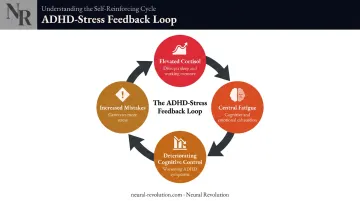
- The feedback loop tightens: worse symptoms → more mistakes → more stress → worse symptoms
ADHD and Anxiety: A Common Overlap
Anxiety and ADHD frequently co-occur. Fu et al. (2025) reports that 25–50% of adults with ADHD also experience anxiety disorders. The two conditions are distinct — but they amplify each other: anxiety worsens attentional symptoms, while ADHD-related impairment can trigger and sustain anxiety over time.
That clinical picture rarely captures what this cycle feels like from the inside. Both conditions often require independent treatment, and misidentifying one as a symptom of the other can mean years of incomplete support.
The Shame Layer
When the stress-ADHD cycle goes unrecognized, adults often attribute their chronic overwhelm to personal failure. Research by Pedersen et al. (2024) found lower self-esteem in adults with ADHD across five of six controlled studies, with ADHD symptoms negatively correlated with self-esteem.
The result: shame, overcompensation, masking, and eventually burnout. The symptoms are difficult enough. The self-blame that layers on top of them makes everything harder.
Recognizing ADHD Burnout Before It Derails You
What ADHD Burnout Actually Looks Like
ADHD burnout results when chronic stress, emotional labor, and the sustained effort of masking or compensating drain cognitive and emotional reserves. According to ADDA's clinical description, common signs include:
- Profound exhaustion that rest doesn't fix
- Sudden collapse in functioning — things that used to work stop working
- Emotional numbness or increased irritability
- Withdrawal from responsibilities and relationships
- Tasks that were previously manageable becoming impossible to initiate
The Push-Crash-Recovery Cycle
The ADHD burnout cycle follows a recognizable pattern:
- Push phase — hyperfocus, overcommitment, urgency-driven sprint (often adrenaline-fueled)
- Crash — cognitive and emotional resources depleted, functioning collapses
- Partial recovery — enough energy returns to re-enter obligations
- Cycle repeats — because the underlying systems haven't changed
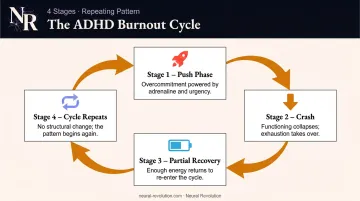
This pattern is especially common in high-achieving adults with ADHD who use performance to mask their struggles. The sprint sustains things — right up until the accumulated deficit makes it impossible to continue.
ADHD Burnout vs. Depression
When the crash phase lingers, it can be genuinely hard to tell what you're dealing with. Distinguishing burnout from depression shapes how you respond — and what actually helps:
- ADHD burnout tends to be situationally triggered, task-linked, and can lift more quickly when stressors are reduced or systems change. It often carries a sense of "I used to be able to do this."
- Depression is more pervasive, present across situations, and typically requires its own clinical treatment
When symptoms are severe or persistent, professional evaluation is warranted. The two can co-occur — and a clinician can assess whether what looks like burnout also involves a depressive episode that needs its own treatment plan, not just fewer obligations.
Practical Stress Management Strategies for ADHD Adults
Generic stress management often fails people with ADHD — not because the strategies are wrong, but because they're built for neurotypical brains. Effective strategies work with the ADHD brain's need for structure, novelty, external accountability, and reduced cognitive load.
Environmental and Systems Design
The single highest-leverage stress reduction strategy for ADHD adults is designing your environment to do the work your brain struggles to do automatically. This means:
- Visual cues and reminders that don't depend on working memory
- Automated systems that remove decision points from daily routines
- Simplified decision environments that reduce the number of choices to make
- External task structure (timers, cues, body doubling) that replaces internal regulation
At Neural Revolution, this is a core coaching specialty — Dr. Eliza Barach works with clients to build calendar architecture, working memory offload systems, and workflow infrastructure calibrated to ADHD energy patterns. The architecture is built around how your brain actually operates — not how a neurotypical productivity system assumes it should.
ADHD-Friendly Goal-Setting
Traditional goal-setting frameworks can feel punishing for ADHD brains. Rigid SMART goals don't account for fluctuating motivation, emotional investment, or novelty needs — and when they inevitably fail, they generate shame and self-blame.
Dr. Barach's DREAMS™ framework was built as a flexible, emotionally resonant alternative to SMART goals — one designed around how ADHD brains actually process goals, time, and rewards.
Where SMART goals create fixed targets that ADHD brains regularly miss, DREAMS™ anchors goal-setting in interest and emotion — the neurological drivers of ADHD motivation — and cuts the shame cycle that comes from failing frameworks designed for different brains.
Movement, Mindfulness, and Regulation
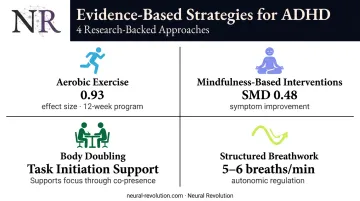
Each of the following has solid research support specifically for ADHD adults:
- Aerobic exercise is particularly effective for ADHD stress because it directly increases norepinephrine and epinephrine, targeting the same catecholamine systems implicated in ADHD. Svedell et al. (2025) found a 12-week structured exercise program improved ADHD symptoms with an effect size of 0.93 in adults aged 18–65 — a clinically meaningful result.
- Mindfulness-based interventions, when adapted for ADHD (shorter sessions, low-pressure formats), show solid evidence. Kim and Jung (2025) found improvements in self-rated ADHD symptoms (SMD = 0.48) and overall functioning (SMD = 0.56) across multiple adult ADHD trials.
- Body doubling — having another person present while you work — is a practical, low-barrier option for task initiation that CHADD recognizes as a productivity support.
- Structured breathwork (around 5–6 breaths per minute) supports autonomic regulation and can interrupt acute stress responses.
Boundary-Setting Through an ADHD Lens
Many adults with ADHD over-commit — driven by impulsivity, novelty-seeking, or fear of rejection. The key is creating decision-making rules before the impulsive "yes":
- Establish a personal policy: every non-urgent request gets a response within 24–48 hours, never immediately
- Build in time buffers when estimating capacity (ADHD brains consistently underestimate by significant margins)
- Identify your "auto-yes" triggers (enthusiasm, urgency, fear of disappointing someone) and create a pause protocol for each
Good boundaries mean making decisions based on your actual calendar and cognitive bandwidth — not in the middle of a spike of enthusiasm when everything feels doable.
Building Long-Term Stress Resilience With ADHD
Sustainable stress management for adults with ADHD is less about crisis response and more about designing a life that fits the brain.
Load Management as a Practice
Oscarsson et al. (2022) found working adults with ADHD had 8.4 excess sickness absence days per year compared to controls — a measurable sign that chronic overload compounds over time. Load management means regularly auditing which demands are genuinely necessary versus accumulated obligations that could be reduced, delegated, or restructured.
Questions worth asking:
- Which recurring tasks could be automated or eliminated?
- Where am I compensating for systems that don't fit my brain?
- What would my schedule look like if I designed it around my energy rhythms, not external expectations?
The Role of ADHD Coaching
Unlike therapy — which focuses on past experiences and clinical symptoms — ADHD coaching is forward-focused and skill-building. A qualified ADHD coach helps clients build personalized systems, anticipate stress cycles, and create accountability structures that reduce the chronic cognitive load of managing ADHD alone.
That kind of structural support is exactly what load management requires in practice. Neural Revolution's coaching does this by building external infrastructure that compensates for executive function gaps — starting with an intake process that assesses stress load, burnout patterns, and cognitive demands specific to each client's situation.

Reframing the ADHD Narrative
Adults who understand the neurological basis of their ADHD consistently report lower shame and greater self-compassion. When adults understand that their struggles are neurological — not moral — they can approach stress management with curiosity rather than self-blame. Psychoeducation doesn't eliminate ADHD challenges, but it changes what those challenges mean. That shift is often what makes every other strategy in this guide actually stick.
Frequently Asked Questions
Can stress make ADHD symptoms worse?
Yes. Stress impairs prefrontal cortex function — which is already a vulnerability in ADHD — reducing working memory, cognitive flexibility, and emotional regulation. Speyer et al. (2022) found ADHD traits were linked to significantly stronger stress carryover into negative affect, confirming the relationship runs in both directions.
What is the burnout cycle of ADHD?
It follows a push-crash-recovery pattern: a period of intense effort or overcommitment, followed by a depletion crash where functioning collapses, then partial recovery before the cycle repeats. It keeps recurring because the underlying structural conditions haven't changed.
What does ADHD fatigue feel like?
ADHD fatigue is often described as deep cognitive and emotional exhaustion — not just physical tiredness — that persists even after rest. It results from the sustained mental effort required to manage ADHD symptoms throughout the day.
Is living with ADHD exhausting?
Yes — and this is measurable. Adults with ADHD carry a significantly higher cognitive and emotional load than neurotypical peers, not from lack of effort, but because every day involves compensating for neurological differences in systems not built for ADHD brains.
Can ADHD medication help with anxiety?
For some adults, treating ADHD symptoms with medication can reduce anxiety that was secondary to ADHD-related impairment. When anxiety is a separate comorbid condition, it typically requires its own treatment. A prescribing clinician should assess each individual's situation.
How do I know if my stress is from ADHD or anxiety?
ADHD-related stress tends to be linked to specific functional struggles (missed tasks, disorganization, time pressure) and often eases when those demands are reduced. Anxiety tends to be more pervasive, present even without a clear trigger. Both can co-occur, and a professional evaluation is the most reliable way to tell them apart.