
That's not a discipline problem. It's a format mismatch.
Journaling does have real value for ADHD brains — but only when the approach accounts for impaired working memory, emotional dysregulation, and the very real initiation barriers that derail even well-intentioned habits. Generic advice skips all of that.
This article covers the cognitive science behind why journaling helps, how to set up a practice that actually sticks, which techniques address which ADHD challenges, and what tends to derail the whole thing.
Key Takeaways
- Journaling works as external working memory — it reduces cognitive load, not as a productivity ritual
- Format, timing, and friction level matter more than which journal you buy
- A 3-minute entry on a hard day beats a skipped 30-minute "ideal" session — consistency wins over perfection
- Different techniques address different symptoms — match the tool to the problem
- When journaling builds clarity but action still stalls, that's a signal to add external accountability — like coaching
Why the ADHD Brain Responds to Journaling
The Working Memory Connection
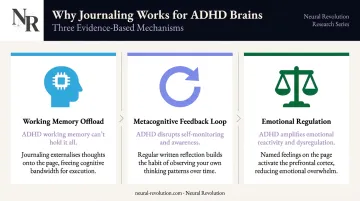
ADHD isn't low intelligence. It's a working memory architecture problem. Research by Tolonen et al. (2024) found that adults with ADHD show decreased functional connectivity during working memory tasks compared to neurotypical controls — affecting fronto-parietal, temporal, and subcortical networks.
That breakdown is what produces the familiar experience of mental overwhelm, lost ideas, and decision paralysis. The ADHD brain struggles to hold, organize, and act on information simultaneously.
Journaling functions as an external working memory system. Moving thoughts from the cognitive buffer onto paper reduces the load on prefrontal systems that are already taxed. As ADDitude magazine notes, citing Russell Barkley, externalizing information with paper and pencil is a concrete way to reduce working memory demand — it's a legitimate cognitive offloading strategy, one that works because it matches how ADHD brains actually process information.
Metacognition and the Writing Feedback Loop
Butzbach et al. (2021) found that adults with ADHD show impaired self-awareness of their own attentional functioning — they often overestimate how well their attention is working compared to objective measures. This gap matters: if you can't accurately observe your own cognitive state, self-correction becomes much harder.
Writing activates self-monitoring processes that ADHD brains don't engage automatically. Handwriting, specifically, produces widespread brain connectivity that typing doesn't — slowing the thought-to-output loop in a way that deepens reflection.
Emotional Dysregulation
Shaw et al. (2014) reports that emotional dysregulation affects 30–70% of adults with ADHD and represents a major source of functional impairment. Journaling addresses this not by eliminating the emotion, but by creating distance from it. Externalizing emotional content — naming it, writing it down — reduces the likelihood of impulsive reaction and builds pattern awareness over time. This is supported by affect-labeling research showing that putting feelings into words can reduce amygdala reactivity through prefrontal pathways.
These three mechanisms — working memory offload, metacognitive feedback, and emotional regulation — explain why structured journaling isn't just helpful for ADHD. It's calibrated to it.
Setting Up Your ADHD Journaling Practice
Getting the setup right matters more than choosing the "correct" technique. The most sophisticated prompts in the world won't help if the journal is buried in a drawer.
Format: Paper vs. Digital
Neither is better. The question is which one gets opened most.
- Paper slows the thinking process in ways that aid reflection and avoids the distraction pull of notifications
- Digital is searchable, always available, and easier to maintain across devices
- Hybrid (paper for brain dumps, digital for structured prompts) works well for many ADHD brains
Test both for a week. Don't choose based on which looks more organized.
Time-Anchoring: Attach It to Something Existing
Starting a journaling habit from scratch every day requires initiation on demand — the exact condition ADHD brains struggle with most. Habit stacking solves this by pairing journaling with something already in your routine.
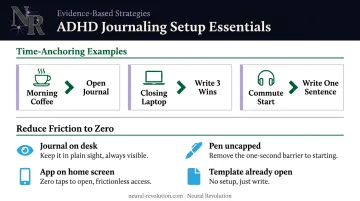
James Clear's formula is direct: "After [CURRENT HABIT], I will [NEW HABIT]." Applied examples:
- After making morning coffee → open the journal
- After closing the laptop at end of day → write three wins
- After sitting down on the commute → write one sentence about the day ahead
CHADD recommends when-then planning specifically for ADHD prospective memory problems. Reduce the initiation cost by eliminating the decision.
The Length and Perfectionism Problem
Set this expectation now: entries don't need to be long, coherent, or grammatically correct. Bullet points count. Sentence fragments count. A single sentence counts.
Three minutes of writing on a hard day produces more benefit than a skipped session you were saving for when you had a "proper" 30 minutes. Consistency at low volume beats perfection at high volume — and habit formation research confirms that missing the occasional session doesn't seriously impair the habit, as long as you return.
Reduce Friction to Near Zero
For ADHD brains, out of sight is reliably out of mind:
- Journal on the desk, not in a drawer
- App on the home screen, not buried in a folder
- Pen already uncapped if you're using paper
- Digital template already open if you're using an app
The fewer decisions standing between you and the first word, the more likely you are to write.
ADHD Journaling Techniques for Focus and Clarity
Different techniques address different problems. The goal isn't to pick the "best" one — it's to match the tool to what's actually causing the lack of focus or clarity right now.
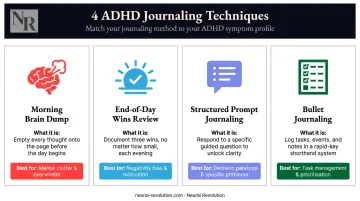
Morning Brain Dump
What it is: First thing after waking, write continuously for 2–5 minutes without editing or filtering. Julia Cameron's Morning Pages framework extends this to three longhand pages. The goal is to clear the mental queue before the day begins — not to produce anything useful.
Why it works for ADHD: Overnight, the ADHD brain accumulates mental content — worries, half-formed ideas, things that surfaced at 2am. Carrying that load into the day taxes every task that follows. The brain dump externalizes it, reduces morning decision fatigue, and primes more sustained attention for the hours ahead.
Keep the bar low: a napkin, a phone note, or three pages in a proper journal all count.
End-of-Day Wins Review
What it is: Close the workday by writing 2–3 specific things that went well — however small. "Answered the email I'd been avoiding for a week" counts equally to closing a deal.
Why it works for ADHD: CHADD's clinical literature documents a negativity bias in ADHD: a tendency to fixate on failures while discounting successes. That pattern gets reinforced by years of criticism and underperformance relative to perceived potential. Deliberately logging wins retrains attentional filters toward evidence of competence.
The framing matters. "I got through the day" is too vague to be useful. "I finished the proposal draft even though I kept losing focus" is specific enough to register as real evidence.
Structured Prompt Journaling
What it is: Use a targeted question to focus the entry. The key distinction: effective ADHD prompts are specific and bounded, not open-ended.
Compare:
- ❌ "How are you feeling today?"
- ✅ "What is the one task I've been avoiding, and what's the real reason?"
Effective prompts for high-achieving professionals:
- What are the three things competing for my attention right now, and which one actually matters most?
- What happened in that conversation that's still bothering me — and what did I actually want to say?
- What drained me most this week, and is that drain avoidable?
- What's one thing I said I'd do that I haven't done, and what's actually in the way?
Prompt journaling works best when there's a specific problem to work through. For general mental clutter, the brain dump is a better fit — which brings us to a different kind of tool entirely.
Bullet Journaling for ADHD
What it is: Rapid logging with symbols (tasks, events, notes, priorities) in a flexible, portable external system. Ryder Carroll, who created the Bullet Journal method, developed it specifically because he needed it growing up with ADHD — including distraction, procrastination, and overwhelm.
Strengths:
- Reduces mental load by externalizing task lists and schedules
- Adapts to changing priorities rather than breaking under them
- Creates a searchable, indexed record
Watch out for: The system can become an avoidance activity. Over-decorating, elaborate color-coding, and redesigning spreads are compelling to ADHD brains — and have nothing to do with actually using the journal. Keep it simple enough to maintain on a Tuesday when everything is on fire.
What Makes ADHD Journaling Work — or Derail
Why ADHD Journaling Succeeds (and Where It Breaks Down)
The Variables That Determine Success
- Timing consistency: Three times a week at the same anchor beats daily at random times
- Low friction setup: Everything immediately accessible, no steps between you and the page
- Format flexibility: Willingness to modify the approach when life changes, rather than abandoning the practice entirely
The Most Common Failure Patterns
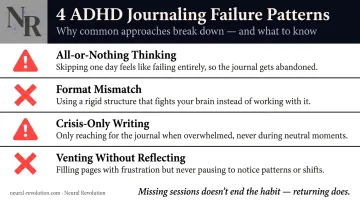
- All-or-nothing thinking: Missing a week and declaring the whole practice dead. Pan et al. (2023) links this pattern directly to emotional dysregulation in ADHD adults. Missing sessions doesn't undo the habit — returning does.
- Format mismatch: Choosing a highly structured format that feels like homework. If opening the journal feels like a chore, the format is wrong.
- Crisis-only writing: Using journaling only when overwhelmed rather than as a maintenance tool. Reactive writing helps, but it builds less pattern awareness than consistent use.
- Venting without reflecting: Emotional dumping without any observation or follow-up question doesn't build self-awareness. It just amplifies the feeling.
The practices that support journaling — time-blocking, planning rituals, accountability structures — are what give it traction over time. Without that surrounding system, even a good journaling habit tends to drift.
When Journaling Alone Isn't Enough
Journaling is a high-value self-management tool. For many high-achieving professionals and entrepreneurs with ADHD, though, clarity on paper doesn't automatically translate into sustained action, prioritization under pressure, or follow-through on complex goals.
That gap is real — and it's not a journaling failure. It's an infrastructure problem.
The ADHD brain can generate excellent self-awareness through writing and still lose those insights between the journal and the next task. Working memory leaks, initiation friction, and RSD spirals don't respond to reflection alone. They respond to structural change.
Coaching addresses that structural layer directly. At Neural Revolution, the model is built around what self-directed tools can't reach: external cognitive infrastructure, real-time regulation tools, and goal-setting frameworks designed for how ADHD brains actually work — not borrowed from neurotypical productivity systems.
Dr. Eliza Barach's DREAMS™ framework is one example. It was developed as a direct alternative to SMART goals, which tend to trigger avoidance and shame cycles in ADHD brains rather than momentum.
Journaling and coaching work well together. Regular entries create self-observation data — patterns, recurring friction points, emotion triggers — that accelerates coaching progress. What you notice in your journal becomes the raw material your coach helps you act on.
Frequently Asked Questions
Does journaling actually help with ADHD?
Research supports journaling's benefits for working memory load, emotional regulation, and metacognitive awareness in ADHD adults — but the format has to fit the ADHD brain. Low friction, flexible structure, and prompt support are the variables that determine whether it produces clarity or just guilt.
What should I write about in my ADHD journal?
Start with the goal: brain dumps for clearing overwhelm, wins reviews for rebuilding motivation, structured prompts for working through a decision or difficult interaction. There's no wrong topic — if it's occupying mental space, externalizing it is worthwhile.
How long should I journal if I have ADHD?
Three to five minutes is enough to produce meaningful benefit. Consistency and cognitive offloading matter more than length. Short entries written regularly outperform long entries written occasionally.
What is the 24-hour rule for ADHD?
The 24-hour rule is a coaching convention, not a clinical protocol — it refers to waiting 24 hours before responding to emotionally charged situations, as a strategy for reducing impulsive reactions. Using that window to journal is an effective way to process the emotion and gain perspective before responding.
What is ADHD fatigue, and can journaling help?
Rogers et al. (2017) found that 62% of adults with ADHD met criteria for significant fatigue — driven largely by the constant effort of compensating for executive function deficits. Journaling reduces one source of that load by externalizing cognitive content rather than holding it all internally, meaningfully cutting daily mental overhead over time.