This isn't a character flaw. It's a predictable pattern rooted in ADHD brain chemistry, years of criticism for things that felt outside your control, and the psychological weight of constantly compensating. Research confirms that perfectionism is the most frequently endorsed cognitive distortion among adults diagnosed with ADHD — and for high achievers, it's often the very mechanism that kept the diagnosis hidden for years.
This article unpacks why ADHD and perfectionism are so tightly linked, how to recognize the cycle in your own life, and what actually works to interrupt it.
Key Takeaways
- Perfectionism in ADHD adults is a coping mechanism, not a personality trait
- The cycle (impossible standards → overwhelm → avoidance → self-criticism → higher standards) is neurologically driven, not a personal failing
- Rejection Sensitive Dysphoria (RSD) turns ordinary high standards into paralyzing fear
- Breaking the cycle means building systems that work with your ADHD brain — not against it
- Sustainable progress comes from structure and self-compassion, not sheer willpower
Why High-Achieving ADHD Brains Are Wired for Perfectionism
It Starts With the "Not Good Enough" Narrative
Perfectionism in ADHD rarely comes from vanity. It develops as a protective response, a kind of psychological armor, built over years of being corrected, falling short, and trying harder without consistent results. The core narrative that forms is simple and brutal: I'm not good enough. Perfectionism becomes the attempt to prove that narrative wrong before anyone else can prove it right.
This is psychological overcompensation, not conscientiousness. And it tends to be especially pronounced in high achievers who learned early that intelligence and effort could compensate for what the ADHD brain struggled to deliver consistently.
The Dopamine Connection
ADHD involves dopamine dysregulation: specifically, reduced availability of dopamine receptors in the brain's reward pathways. Two landmark PET studies found that non-medicated adults with ADHD showed lower dopamine transporter and D2/D3 receptor availability in reward-pathway regions, directly linked to motivation deficits.
When the brain's reward system isn't firing reliably, it's hard to feel genuinely satisfied with completed work. It's easy to fixate on what's still wrong with it.
Finishing something rarely feels like enough. The dopamine signal for "done, well done" is muted — and the internal critic fills that silence.
Rejection Sensitive Dysphoria Amplifies Everything
RSD is an intense emotional response to perceived or anticipated criticism. According to ADDitude's clinical commentary by Dr. William Dodson, approximately one-third of his adult ADHD patients report it as the most impairing aspect of their condition.
For high achievers, RSD rarely looks like obvious emotional fragility. It shows up as:
- Avoiding feedback conversations entirely
- Over-ruminating after critical meetings
- People-pleasing to pre-empt any possible disapproval
- The post-decision spiral — compulsively second-guessing choices already made
Perfectionism becomes the prevention plan: if the work is flawless, there's nothing to criticize, and the RSD response never gets triggered. Many high-achieving professionals have built entire career strategies around RSD avoidance without ever naming it as such.
Three Perfectionism Types — and How They Show Up in ADHD Adults
Hewitt and Flett's multidimensional model identifies three distinct forms of perfectionism, each with a different ADHD expression:
| Type | What It Looks Like in ADHD Adults |
|---|---|
| Self-oriented | Relentless self-criticism; standards that move the moment you meet them |
| Socially prescribed | People-pleasing, masking, over-delivery driven by fear of others' judgment |
| Other-oriented | Impatience with colleagues' standards; strained professional relationships |
Most high-achieving ADHD adults cycle through all three, often in the same workday.
The All-or-Nothing Trap
CHADD notes that all-or-nothing thinking is common in adults with ADHD, where anything less than perfect registers as total failure. This leaves no psychological room for "good enough," "done enough," or "good progress." Work is either perfect or worthless. There is no middle.
Recognizing the ADHD-Perfectionism Cycle in Your Own Life
The Six-Step Loop
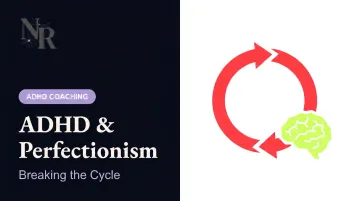
The cycle tends to follow a predictable pattern:
- Set impossibly high standards — the bar is aspirational at best, paralyzing at worst
- Feel overwhelmed and unsure where to begin — the task feels too large to approach imperfectly
- Overthink or delay — the brain stalls rather than risk an imperfect start
- Procrastinate or burn out — avoidance becomes the path of least resistance
- Harshly self-criticize — "I failed again" reinforces the not-good-enough narrative
- Raise the bar even higher — to compensate for the perceived failure
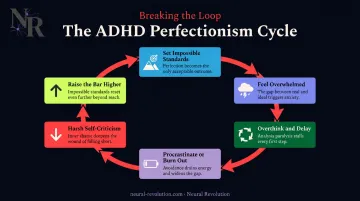
Each step feeds the next — and for ADHD brains, the dopamine hit of a fresh, high standard makes starting over feel more appealing than finishing.
Warning Signs the Cycle Is Active
These show up in everyday behavior:
- Spending disproportionate time on low-stakes tasks
- Repeatedly restarting work rather than finishing it
- Waiting until conditions feel "right" before beginning
- Deflecting genuine compliments or dismissing positive feedback
- Feeling perpetually behind — even when you're performing well by any objective measure
The Masking Dimension
The harder part: for high-achieving professionals, this cycle is invisible from the outside. The meticulous preparation, the over-delivery, the color-coded systems — these look like competence. Underneath, they're driven by fear of being found out.
Research supports this. A 2018 study found that adults diagnosed with ADHD in adulthood had above-average childhood IQ and executive functioning that masked their symptoms for years. CHADD also confirms that girls are diagnosed at just under half the rate of boys — with that gap closing in adulthood, often after decades of compensatory perfectionism kept the diagnosis hidden.
A Simple Self-Check
Here's a useful distinction: healthy ambition energizes you, even when the work is hard. ADHD perfectionism creates dread before the work even begins.
Ask yourself: Does thinking about this task make me want to lean in — or find a reason to avoid it? The answer usually tells you which kind of standard you're working under.
What the ADHD-Perfectionism Cycle Is Really Costing You
The Mental Health Cost
Research shows that as many as 80% of adults with ADHD have at least one coexisting psychiatric condition — with anxiety among the most common. The perfectionism cycle doesn't just coexist with anxiety; it actively generates it.
For ADHD adults already managing executive dysfunction, perfectionism adds a crushing cognitive load on top of existing strain. The mental energy spent monitoring, self-criticizing, and pre-empting failure is energy that cannot go toward actual performance. Perfectionism creates the very failures it was built to prevent.

The Career and Productivity Cost
For entrepreneurs and executives, the costs are concrete:
- Hyperfocus on refining rather than launching
- Abandoned projects once the interesting phase is over
- Over-investment in preparation at the expense of execution
- Missed windows because the work never felt ready
Neural Revolution's coaching consistently identifies this pattern in founders: the same person who thrives in the novelty-rich early phase of a business stalls in execution because the output needs to be perfect before it ships.
The Identity Cost
The most insidious cost is what the cycle does to self-trust over time. When your sense of worth is entirely outcome-dependent — when "good" only counts if it's "perfect" — you never accumulate evidence that you're actually capable. Each cycle reinforces the original wound. Without external intervention, the loop tightens: each near-miss becomes more proof that the standard needs to go higher, not lower.
Strategies to Break the ADHD-Perfectionism Cycle
Breaking this cycle isn't about lowering your standards. It's about replacing a neurologically counterproductive strategy with one your brain can actually use.
Challenge the "Not Good Enough" Inner Narrative
When the inner critic fires, the goal isn't to silence it — it's to interrogate it with curiosity. Ask:
- What standard is being applied here?
- Whose voice is this actually?
- Is this threshold required by the actual situation, or is it a phantom inherited from years of past criticism?
Research links self-compassion to better physiological flexibility during fear responses, and a separate study found it meaningfully contributes to mental health outcomes in adults with ADHD. One practical technique: write down what a trusted, compassionate mentor would say about the work. Not a cheerleader. An honest, experienced advisor who also knows what it costs you to produce it.
Use ADHD-Friendly Goal-Setting Instead of Perfectionist Standards
Rigid, outcome-only goal frameworks create a binary: you either hit the target perfectly or you've failed. For ADHD brains already prone to all-or-nothing thinking, that structure is kindling for the perfectionism cycle.
Dr. Eliza Barach at Neural Revolution developed the DREAMS™ framework as a brain-based alternative: flexible, emotionally resonant, and designed to reduce the shame-and-avoidance loops that rigid goals trigger. Where traditional frameworks measure success in fixed outcomes, DREAMS™ accounts for how ADHD brains actually process motivation, time, and reward.
Working with an ADHD coach to apply this framework can directly address the planning paralysis that perfectionism creates.
Work With Your Executive Function, Not Against It
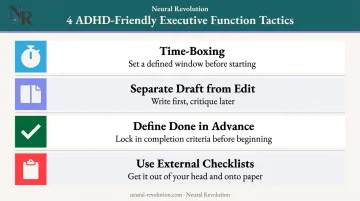
External structure removes the "I need to do this perfectly before I can start" trigger. Practical tactics:
- Time-box tasks: set a defined window before you begin, not after you've stalled
- Separate drafting from evaluating: write the rough version first, critique it later. Conflating the two modes accelerates perfectionism
- Define "done" before you start: decide what completion looks like in advance, so you're not chasing a moving internal target
- Use visible, external checklists: what stays in your head becomes a perfectionism loop; what's written down becomes a boundary
Build Distress Tolerance for Imperfect Outcomes
The ADHD brain's emotional intensity makes tolerating imperfection uncomfortable in a way that goes beyond cognitive inconvenience. Brief mindfulness check-ins and grounding practices reduce the emotional charge that makes "good enough" feel unacceptable.
Then, practice intentional imperfection exposure: submit something at 90%, publish before it feels ready, ask for feedback earlier than feels safe. Each small exposure builds evidence that the feared consequences are less catastrophic than perfectionism predicts. A 2024 randomized controlled trial found that exposure-based treatment for perfectionism outperformed a stress-management comparison — and works best when scaffolded carefully to avoid triggering avoidance in ADHD brains.
Building Long-Term Habits That Sustain the Shift
Breaking the cycle once isn't the goal. The goal is making it structurally harder for perfectionism to operate as your brain's default mode.
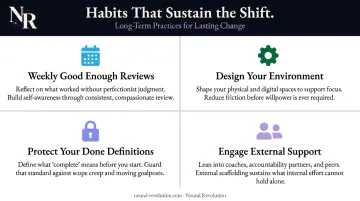
Four ongoing habits that support this:
Schedule weekly "good enough" reviews — once a week, identify one area where you accepted imperfect progress and note what actually happened. This builds a personal evidence base that slowly challenges catastrophic thinking over time.
Design your environment to reduce perfectionism triggers — set explicit time limits before starting any task; keep a "done list" alongside your to-do list; remove tools and habits (endless revision loops, infinite browser tabs) that let perfectionism masquerade as productivity.
Protect your "done" definitions — revisiting standards mid-task is a perfectionism entry point. Lock in your completion criteria before you start and treat them as fixed for that session.
Engage ongoing external support — ADHD brains cannot reliably self-monitor the perfectionism cycle from inside it. External perspective — through peer accountability, therapy, or ADHD coaching — is what catches the pattern before burnout sets in.
If you recognize this dynamic in yourself, Neural Revolution's coaching — grounded in cognitive psychology and built around the lived experience of ADHD — is designed for exactly this work.
Frequently Asked Questions
What does high-functioning ADHD look like?
High-functioning ADHD typically involves using perfectionism, over-achievement, and elaborate compensatory systems to mask executive dysfunction. The person appears capable and organized externally while experiencing significant internal struggle, exhaustion, and self-doubt that rarely shows up in their professional output.
Is perfectionism actually a symptom of ADHD?
Perfectionism isn't a formal diagnostic criterion, but it's one of the most common cognitive patterns associated with ADHD. It develops as a psychological response to years of ADHD-related mistakes, criticism, and the felt need to overcompensate — a consequence of the condition, not a core feature of it.
Why does ADHD perfectionism lead to procrastination instead of action?
Perfectionism sets an internal threshold for "good enough to start" that the ADHD brain can rarely meet — especially under executive dysfunction. Avoidance becomes the brain's rational response: if you never start, you never produce something imperfect, and the feared shame response never fires.
What is rejection sensitive dysphoria and how does it fuel perfectionism?
RSD is an intense, often overwhelming emotional response to perceived or anticipated criticism that is especially common in ADHD. Perfectionism becomes a preventive strategy — if the work is flawless, there's nothing to criticize, and the painful emotional reaction never gets triggered.
How is ADHD perfectionism different from just having high standards?
Healthy high standards are energizing and proportional to what the situation actually requires. ADHD perfectionism is driven by fear, shame, and all-or-nothing thinking — and typically increases anxiety and avoidance rather than motivation and follow-through.
Can ADHD coaching help with perfectionism?
ADHD coaching addresses both the behavioral patterns — procrastination, over-planning, avoidance — and the underlying brain dynamics driving them. A good ADHD coach helps clients build systems and thinking patterns that replace fear-driven striving with sustainable momentum.