Neither version is the full picture. And understanding why both happen — in the same brain — is where real progress starts.
This guide is for driven adults who want to stop white-knuckling their way through work and start understanding the actual science behind how their brains engage. We'll cover the neuroscience of ADHD attention regulation, the strengths that are neurologically real (not just reframes), why the research on ADHD and entrepreneurship is more compelling than most people realize, and what ADHD-friendly productivity actually looks like when you stop forcing neurotypical systems on a non-neurotypical brain.
At Neural Revolution, the goal has never been to "fix" the ADHD brain. It's to understand how it's wired — and build systems that work with it.
Key Takeaways
- ADHD is a regulation difference, not an attention absence — the brain engages intensely when tasks are novel, urgent, or meaningful
- Hyperfocus, creative thinking, high energy, and risk tolerance are neurologically grounded strengths — documented in research, not just reframing
- Research shows ADHD hyperactive-impulsive traits align directly with entrepreneurial orientation dimensions
- Conventional productivity systems fail ADHD brains by ignoring motivation architecture — effective systems build in interest and urgency instead
- Workspace and digital environment design are legitimate cognitive tools, not soft preferences
The ADHD Brain at Work: Wired Differently, Not Broken
Attention Regulation, Not Attention Absence
The most persistent misconception about ADHD is that it involves simply "not paying attention." Russell Barkley's framework reframes this entirely: ADHD is better understood as a self-regulation deficit disorder, where executive functions are impaired in their development and consistency, not in their existence. These are the self-directed actions that guide behavior over time.
Underlying this is a dopamine story. Research published in JAMA by Volkow et al. found reduced dopamine synaptic markers in the reward pathway of adults with ADHD, including dopamine transporters and D2/D3 receptors. The implication: ADHD isn't a willpower failure. It's a motivational architecture difference rooted in how the brain's reward system signals engagement.
The Interest-Based Nervous System
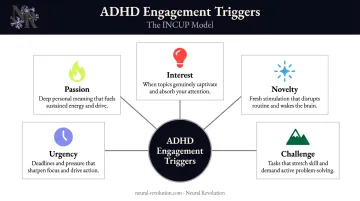
Dr. William Dodson describes ADHD attention as "interest-based" rather than importance-based. Where neurotypical brains can activate on demand (because a task is important, expected, or requested) the ADHD brain is wired to engage most intensely when tasks are novel, urgent, challenging, or personally meaningful.
Dr. Eliza Barach at Neural Revolution uses Dodson's INCUP model alongside the Cognitive Energetic Model of ADHD to help clients design work that actually triggers engagement. INCUP maps the conditions the ADHD brain needs to activate:
- Interest — genuine curiosity or personal investment
- Novelty — something new enough to hold attention
- Challenge — a problem worth solving
- Urgency — a real or perceived deadline
- Passion — work tied to identity or deep values
This is why so many ADHD professionals know the pattern: can't push through a routine email, but will spend six hours on a problem nobody asked them to solve.
The 30% Rule and What It Actually Means
Barkley's research includes a widely referenced finding: ADHD appears to delay executive function development by roughly 25–40%, averaging around 30%. In practical terms, a 35-year-old with ADHD may be operating closer to their mid-20s in self-regulation capacity — not in intelligence or talent, but in the specific machinery of planning, self-monitoring, and emotional regulation.
This reframe matters enormously for self-compassion. It also matters for systems design: if you've been building productivity structures sized for a neurotypical adult, you may have been setting yourself up to fail.
Strengths Are Real, But Context-Dependent
Research supports a strengths-informed lens. Sedgwick et al. found that successful adults with ADHD demonstrated cognitive dynamism, courage, energy, resilience, and transcendence — showing up differently in ways that functioned as genuine assets. A 2025 study in Psychological Medicine found that adults with ADHD endorsed hyperfocus, humor, and creativity as real strengths, and that strengths awareness correlated with positive life outcomes.
The same trait that creates friction in a rigid corporate structure can be a force multiplier in the right environment.
Core ADHD Strengths That Drive Professional Success
Hyperfocus: High-Performance State or Liability?
When an ADHD brain locks onto something intrinsically motivating, the result can be extraordinary. Hupfeld et al. developed an Adult Hyperfocus Questionnaire and found that adults with ADHD frequently report long-lasting, highly focused attention, despite distractibility being a core diagnostic feature.
Dr. Eliza has presented on this directly, including a 2024 ADDA TADD Talk titled "Leveraging ADHD Hyperfocus While Preventing Hyperfocus Mishaps and Hangovers." The coaching framing: hyperfocus isn't automatically an asset. It becomes one when deliberately directed. Scheduled during peak energy windows, protected from interruption, and bounded by external cues, it's a genuine competitive advantage. Left unmanaged, it consumes time allocated elsewhere without warning.
Creative and Divergent Thinking
The ADHD brain's tendency toward non-linear, associative idea generation is backed by neuroscience. Adults with ADHD show reduced sustained default-mode network suppression during task performance, meaning the part of the brain that generates spontaneous ideas stays more active. Research also finds that adults with combined-presentation ADHD report higher self-rated creativity and produce more original work.
Studies on divergent thinking (the capacity to generate multiple solutions from a single starting point) show consistent associations with ADHD symptom profiles. In practice, this shows up as:
- Greater fluency, flexibility, and originality in generating ideas
- Pattern recognition that connects concepts across unrelated domains
- Brainstorming performance that regularly surprises neurotypical colleagues
High Energy, Risk Tolerance, and Resilience
Three additional strengths emerge consistently across the research:
- High energy and momentum: The dopamine-seeking drive in ADHD brains translates to high output in dynamic environments. Sales, creative industries, change management, and startup contexts are natural fits
- Risk tolerance and decisiveness: Sedgwick et al. identified courage and adventurousness as consistent traits in successful ADHD adults; the research on ADHD and entrepreneurship (covered next) puts numbers to this
- Resilience through adversity: Many adults with ADHD have spent years solving problems neurotypical peers never had to face, developing creative workarounds, flexible thinking, and a high tolerance for ambiguity that becomes a real asset in high-uncertainty environments
That research foundation shapes how Neural Revolution works with clients. The intake process asks clients to identify which traits they consider strengths, with options including creativity, hyperfocus, out-of-the-box problem solving, adaptability, high energy, risk tolerance, pattern recognition, crisis management, and empathy. The goal isn't to hand someone a flattering list — it's to map what's already there so coaching can build on it.
ADHD and Entrepreneurship: Why This Pairing Makes Scientific Sense
What the Research Actually Shows
The connection between ADHD and entrepreneurship has moved from anecdote to data. Yu, Wiklund, and Perez-Luno published research in Entrepreneurship Theory and Practice (2021) examining ADHD symptoms and entrepreneurial orientation (EO) across three dimensions: innovativeness, proactiveness, and risk-taking.
Their finding: hyperactive-impulsive ADHD traits were largely conducive to firm performance through entrepreneurial orientation. Impulsivity drove action under uncertainty, and the EO dimensions mapped cleanly onto what hyperactive-impulsive traits produce in behavior.
A replication study by Wismans et al. (2020) confirmed that hyperactivity symptoms positively related to EO, primarily through proactiveness and risk-taking.
On prevalence: Freeman et al. found that 29% of entrepreneurs self-reported ADHD in their sample — compared to general adult prevalence estimates of roughly 2.5–3%. These are self-reported figures, not clinical diagnoses — but the pattern holds across multiple studies.
Why Entrepreneurship Fits the ADHD Brain
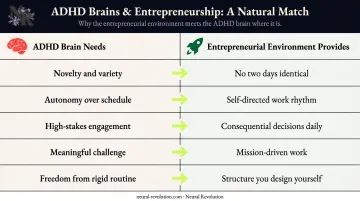
The fit between ADHD neurology and entrepreneurial environments isn't coincidental:
| ADHD Brain Needs | Entrepreneurial Environment Provides |
|---|---|
| Novelty and variety | No two days identical |
| Autonomy over schedule | Self-directed work rhythm |
| High-stakes engagement | Consequential decisions daily |
| Meaningful challenge | Mission-driven work |
| Freedom from rigid routine | Structure you design yourself |
Compare this to rigid corporate environments where the same ADHD professional may spend enormous energy just managing administrative compliance, sitting through low-stimulation meetings, and performing visibility in open-plan offices. The exhaustion isn't a character flaw — it's a structural mismatch.
The Dark Side, Honestly
The same traits that fuel entrepreneurial momentum create real execution risks:
- Impulsivity tends toward overcommitting before evaluating actual capacity
- Novelty-seeking pulls toward new projects before existing ones are finished
- Inattention — notably, not the hyperactive-impulsive symptoms — showed a negative link with proactiveness in the Wismans replication
These aren't disqualifiers. They're design problems.
Dr. Eliza works specifically with ADHD entrepreneurs navigating this tension — helping clients build around their weaknesses rather than fight them. That often means hiring for detail management, operational follow-through, and consistent execution: the exact functions where inattentive traits create drag.
ADHD-Friendly Productivity: Systems That Work With Your Brain
Why Conventional Systems Fail
SMART goals assume a neurotypical motivational system: that clearly defined, measurable targets generate sufficient activation to drive consistent behavior. For ADHD brains, they often don't, because motivation is interest-driven, not importance-driven. A goal can be perfectly specified and still completely inert.
Barkley's point-of-performance framework is instructive here: for ADHD brains, support needs to exist at the moment of behavior, not as an abstract plan made in a calm moment. The gap between knowing what to do and actually doing it is an executive function gap, not a knowledge gap.
The DREAMS™ Framework
Neural Revolution's proprietary DREAMS™ framework was built from this recognition: SMART goals were designed for neurotypical brains and systematically fail neurodivergent ones. Dr. Eliza Barach developed DREAMS™ as a flexible, emotionally resonant alternative that accounts for motivation, emotional engagement, and the way ADHD brains actually initiate action.
Dr. Eliza is currently writing a book on this topic, covering why rigid goals trigger shame and perfectionism cycles, the science of emotional motivation in ADHD decision-making, and practical tools for setting goals that feel good and actually get done. Neural Revolution's coaching is built around the DREAMS™ framework from the first session.
Practical ADHD-Specific Productivity Tools
The DREAMS™ framework shapes the goal-setting approach, but day-to-day execution also benefits from concrete environmental tools. No single system works for every ADHD brain — treat these as a menu to experiment with:
- Time-blocking with variety: Vary block types across the week — deep work, communication, admin, creative tasks. Matching task type to energy state outperforms uniform time slices
- Body doubling: Another person present while working, even silently or virtually, reduces activation barriers for many ADHD adults
- Visual task management: External, visible representations of priorities reduce working memory load and deliver point-of-performance cues that abstract to-do lists can't
- External cues for transitions: Timers, alarms, and accountability partners provide the environmental scaffolding that compensates for weak internal time-tracking
Neural Revolution's FOCUS Forward group coaching program includes complimentary access to Focused Space, a virtual co-working community designed around the body-doubling principle.
Managing Hyperfocus Strategically
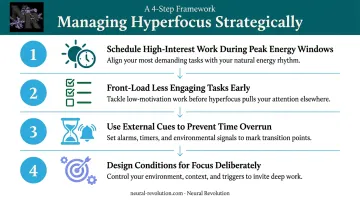
The hyperfocus management strategy, in brief:
- Schedule high-interest work during peak energy windows — protect that time from low-demand obligations
- Front-load less engaging tasks early when motivation is freshest and before it deteriorates
- Use external cues (timers, accountability check-ins) to prevent hyperfocus from consuming time allocated to other priorities
- Design the conditions for focus — interest, challenge, urgency — deliberately, so hyperfocus gets triggered on the right work
Designing Your Work Environment for ADHD Success
Environment is not a soft consideration — it's a hard system.
Research confirms that adults with ADHD are more susceptible to auditory distraction under cognitive load than neurotypical peers. Barkley's point-of-performance framework supports environmental aids as legitimate executive function supports, not accommodations for weakness.
The Job Accommodation Network (JAN) lists ADHD-specific workplace accommodations including quiet workspaces, noise-canceling options, visual reminders, flexible scheduling, and uninterrupted work time.
Key Environmental Levers
Dr. Eliza Barach's coaching specialties explicitly include Environmental & Systems Design — helping clients create ADHD-friendly structures that reduce friction and support consistent follow-through. The core levers:
- Notification architecture — which apps interrupt when, and how — is an executive function issue, not a discipline issue. Default-off notifications and app-specific boundaries reduce context-switching
- Visual clutter competes directly for attention resources. Visible cues for priority tasks (physical or digital) surface important work without requiring active recall
- Body doubling and open-office versus private focus time aren't personality preferences — they're legitimate productivity variables. Knowing which conditions activate your focus is part of the work

There's no universal ADHD environment. The goal is finding your configuration through deliberate experimentation, not adopting someone else's optimal setup.
Workplace Accommodations and Disclosure
Under the ADA, ADHD can qualify for reasonable workplace accommodations — meaning a change in the work environment or how a job is performed so a qualified individual can have equal employment opportunity. Common accommodations include:
- Flexible or modified scheduling
- Noise-reducing tools (headphones, quiet workspaces)
- Adjusted deadline structures or chunked task assignments
- Remote work options where the role allows
Accommodations are tools, not concessions. For ADHD entrepreneurs, self-accommodation is built into the structure — you design the environment from scratch.
Frequently Asked Questions
What are the strengths of ADHD in the workplace?
The most consistently documented strengths are hyperfocus, creative and divergent thinking, high energy in engaging environments, risk tolerance, and pattern recognition. These reflect real neurological differences in dopamine signaling and executive function architecture — not reframes of deficits.
Do people with ADHD make good entrepreneurs?
Research from Yu, Wiklund, and Perez-Luno links hyperactive-impulsive ADHD traits directly to entrepreneurial orientation — innovativeness, proactiveness, and risk-taking. The autonomy, variety, and high-stakes decisions of entrepreneurship often fit the ADHD brain better than structured corporate roles.
What is the 30% rule in ADHD?
Attributed to Dr. Russell Barkley, the 30% rule holds that ADHD delays executive function development by roughly 25–40% — affecting self-regulation and planning, not intelligence or skill. For ADHD professionals, this reframes the need for external support systems as neurologically grounded, not a personal failure.
What type of work environment is best for someone with ADHD?
Environments offering variety, autonomy, meaningful challenge, and reduced rigid routine tend to support ADHD brains best. Minimizing sensory and digital distractions, having flexibility in how work gets done, and having access to body doubling or collaborative focus structures matters more than the specific industry.
How can I turn hyperfocus into a productivity tool instead of a trap?
Schedule high-interest work during peak energy windows and use timers or accountability partners to manage duration. Deliberately design conditions — interest, challenge, urgency — to trigger focused states on your actual priorities, rather than letting hyperfocus land wherever it wants.
Can ADHD coaching help with workplace performance?
Yes — research shows ADHD coaching improves executive function and symptoms with effect sizes that can rival stimulant medication. Neural Revolution's coaching combines cognitive psychology research with lived ADHD experience, designed for high-performing professionals and entrepreneurs who need systems built around how their brains actually work.