Introduction
You've probably tried it. You sat down, closed your eyes, tried to focus on your breath — and within 30 seconds your mind was planning dinner, replaying an awkward conversation from 2019, or wondering whether you left the stove on. You opened your eyes, decided you were doing it wrong, and gave up.
If that sounds familiar, you're not alone. And you're not bad at meditating. You're just an ADHD brain trying to follow instructions designed for a different kind of brain.
So here's the honest question: does meditation actually help ADHD, or is it another wellness trend that quietly assumes everyone's nervous system works the same way?
The short answer is that the research is genuinely encouraging — with real caveats. Meditation can be a meaningful tool for ADHD adults. But the way most people approach it sets them up to fail before they even start.
This article covers what the evidence actually shows, why the practice feels so hard, and how to adapt it for the way your brain works. This is not a "meditation will fix your ADHD" piece — it's a grounded look at a specific tool with specific, bounded value.
Key Takeaways:
- Research supports meditation as a helpful complementary tool for ADHD, not a cure or replacement for medication
- The mind wandering during meditation isn't failure — it's the actual training mechanism
- Structured techniques (breath-counting, body scan) work better for ADHD brains than open-ended approaches
- Consistency over time matters more than session length — start with just 3–5 minutes daily
- Building the habit is usually harder than the practice itself, and that's where structured support makes a difference
Why Standard Meditation Advice Often Fails People With ADHD
Most mainstream meditation guidance starts from a neurotypical baseline: sit still, clear your mind, sustain focus for 20 minutes. For someone with ADHD, those instructions don't just feel difficult — they actively set up failure.
This isn't a motivation or effort problem. ADHD involves genuine neurological differences in attention regulation, dopamine signaling, and executive function. Research by Arnsten and Pliszka describes ADHD as involving structurally weaker prefrontal cortex circuits — specifically the right PFC networks that govern attention, behavioral regulation, and emotion.
PET imaging studies by Volkow et al. add another layer: adults with ADHD show lower dopamine receptor availability in reward-pathway regions, which directly affects motivation and sustained focus.
When a person with ADHD attempts unstructured, open-form meditation, they're asking the very brain region responsible for maintaining attention to hold a vague, low-stimulation task with no clear endpoint and no immediate reward. That's a neurological mismatch — not a mindset problem.
The failure compounds the shame most ADHD adults already carry. "I can't even do the easy thing" is a common reaction — and it keeps people from returning to a practice that, with adaptations, could actually help.
What the evidence does support is a different approach — one built around how the ADHD brain actually works, not against it.
What the Research Actually Says
The Evidence Base for Adults With ADHD
The research on mindfulness-based interventions (MBIs) for adult ADHD is more substantial than most people realize , though it comes with honest limitations.
A 2019 systematic review by Poissant et al. analyzed 13 studies involving 753 adults with ADHD (mean age 35.1). Every included study showed improvement in ADHD symptoms, with additional gains in executive function and emotion regulation. The same researchers published a meta-analysis in 2020 confirming that MBIs reduced ADHD symptoms, depression, and executive dysfunction in adults.
More recently, a 2025 adult-only meta-analysis by Kim and Jung reviewed 10 studies and found meaningful effect sizes across self-rated symptoms (SMD 0.48), observer-rated symptoms (SMD 0.32), and functional outcomes (SMD 0.56).
What the research doesn't yet tell us:
- The optimal session frequency or length for adults
- Which specific meditation modality works best
- How MBIs compare head-to-head to other non-pharmacological interventions
- Whether benefits differ significantly between adults with different ADHD presentations
Study quality remains an ongoing concern. Many trials have small samples, no control groups, or inconsistent blinding. The findings are promising, not definitive.
The UCLA Mindful Awareness Research Center Study
One of the most cited ADHD-specific programs was tested by Zylowska et al. at UCLA's Mindful Awareness Research Center. The program enrolled adults with ADHD in an 8-week structure: weekly 2.5-hour group sessions paired with daily home practice, starting at 5 minutes and building to 10–15 minutes.
Results included significant improvements in self-reported ADHD symptoms and performance on neuropsychological attention tasks. The protocol used structured techniques — breath awareness with counting, body scan, and mindful walking — rather than open, formless sitting. That structure matters, and we'll return to why.
The Brain Change Mechanism
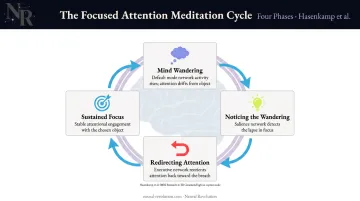
Those results raise an obvious question: what's actually happening in the brain? fMRI research by Hasenkamp et al. mapped the four-phase cycle of focused attention meditation: mind wandering, noticing the wandering, redirecting attention, and sustained focus. That cycle directly exercises the prefrontal and attentional networks that ADHD affects.
The structural evidence points the same direction. Long-term meditation practitioners show measurably different activity patterns in frontal brain regions, suggesting meditation functions as active cognitive training rather than simple stress relief.
What Meditation Can — and Can't — Do for ADHD
What It Can Realistically Help With
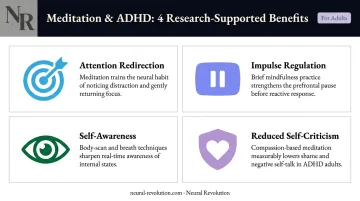
Research supports several specific benefits for ADHD adults:
- Attention redirection — improved ability to notice when focus has drifted and return to the task
- Impulse regulation — creating a brief pause between urge and action (the Mitchell et al. 2013 pilot found improvements in emotion dysregulation, including impulse-control difficulty)
- Self-awareness — Janssen et al. (2016) found that symptom improvements in adults were partly mediated by increased "acting with awareness"
- Reduced self-criticism — adults with ADHD show significantly lower self-compassion and higher perceived criticism than non-ADHD adults; mindfulness practice directly targets non-judgmental awareness
What It Cannot Do
Meditation is not a replacement for medication, behavioral therapy, or structured ADHD support. NICE guidelines recommend stimulant medication as first-line pharmacological treatment for adults with ADHD. CHADD classifies mindfulness as a complementary intervention, not a primary treatment.
Meditation does not rewire ADHD out of existence. It does not eliminate executive function deficits or time blindness. What it can do is add one meaningful layer to a broader toolkit.
Where the Practice Actually Breaks Down
For many high-achieving adults with ADHD, meditation isn't the problem — sustaining the habit is. The intention is there. The practice falls apart because there's no structure to hold it.
This is where ADHD coaching becomes directly relevant. At Neural Revolution, the coaching philosophy is grounded in environmental and systems design — building the external scaffolding that makes sustainable habits executable for ADHD brains. That means designing routines around how the brain actually operates, not relying on motivation or willpower to fill the gaps.
Attentional control develops through consistent repetition over weeks and months. For ADHD brains, that consistency usually requires infrastructure — not a better attitude.
Why the Wandering Mind Is the Point, Not the Problem
When your mind wanders during meditation and you notice it and bring it back, that is the meditation. You haven't failed. You've just done one rep.
Hasenkamp et al.'s fMRI research identified mind-wandering and return as a natural cycle in focused attention meditation — not an interruption to it. The act of noticing distraction and redirecting is the attentional training. It's the cognitive equivalent of a bicep curl — and it only builds strength through repetition.
For ADHD brains, this reframe is critical. The brain that struggles most with voluntary, sustained attention is also the brain that gets the most practice doing exactly that exercise — because it wanders more often and has more opportunities to redirect.
The Self-Compassion Dimension
Research on adults with ADHD (Beaton et al., 2020, 2022) consistently shows lower self-compassion and higher perceived self-criticism than non-ADHD adults — and that these deficits contribute meaningfully to poorer mental health outcomes.
The non-judgmental quality of mindfulness practice directly addresses this. The instruction isn't "don't wander." It's "notice that you wandered, without judgment, and return." For adults who have spent years accumulating a shame narrative around their attention, that non-judgmental quality may be one of the most therapeutically significant aspects of the practice.
Struggling during meditation isn't a sign the practice isn't working. For ADHD brains, frequent redirection isn't failure — it's the mechanism through which the training actually happens.
Meditation Techniques That Work Better for ADHD Brains
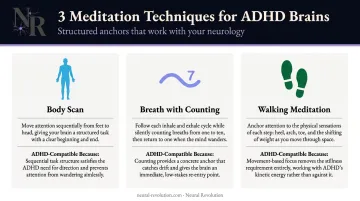
The evidence on which specific technique is "best" for ADHD is limited — no head-to-head adult ADHD trials exist comparing body scan versus breath-counting versus walking meditation. What the research does support is that structured techniques with a clear anchor outperform open, formless approaches for ADHD brains.
Body Scan Meditation
Body scan gives the mind a sequential task: scan attention from feet to head, noticing physical sensations in order. This structure is more compatible with how ADHD brains process — they need a job to do, not an open invitation to "clear your mind." The MAPs for ADHD protocol (used in UCLA's adapted program) includes body scan as a core component.
Mindfulness of Breath With Counting
The basic practice: breathe naturally, notice the physical sensation of the breath. When attention drifts, label it "thinking" and return. Adding a counting anchor (inhale-exhale = 1, up to 10, then restart) gives the ADHD brain an additional layer of structure that reduces cognitive drift.
A few things that make this easier to stick with:
- Start with 3–5 minutes — not because that's the proven therapeutic dose, but because it's sustainable
- The MAPs protocol uses 5 minutes daily as its entry point for exactly this reason
- Reset the count without judgment when attention drifts (this is the practice, not a failure)
Movement-Based Practices
Walking meditation and grounding techniques (like 5-4-3-2-1 sensory grounding) work well for people who find stillness genuinely impossible. In walking meditation, the attention anchor shifts to the physical sensation of each step rather than the breath. The meditative quality comes from where attention is directed, not from stillness of the body.
The original Zylowska et al. study and subsequent MAPs protocols included mindful walking as a full component. It's not a fallback option — it operates on the same underlying mechanism as seated practice.
How to Build a Practice That Actually Sticks
Start Small and Be Specific
Vague intentions fail ADHD brains. "I'll meditate more" is not a plan. A 3-minute session at a specific time, anchored to an existing routine, is.
What works:
- Right after morning coffee, before opening email
- Immediately after brushing teeth at night
- Before starting the workday, while still at your desk
The key is specificity and routine-anchoring. Three minutes every morning will outperform thirty minutes whenever you remember.
Use External Structure Deliberately
ADHD brains thrive with external scaffolding. This isn't a workaround — it's how ADHD brains build new behavior:
- Guided audio apps (Insight Timer, Headspace, Calm) remove decision-making about what to do next
- Calendar reminders compensate for working memory gaps so sessions don't vanish from the day
- Accountability partners or meditation buddies increase follow-through by adding social stakes
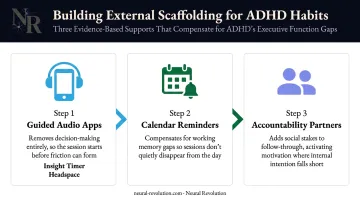
None of these are training wheels. They're the architecture that makes the habit viable.
Manage Expectations About Consistency
Missing a day is not failure. The practice compounds over weeks and months — well-designed ADHD mindfulness programs run 8 weeks for a reason, and meaningful outcomes show up at the end of the program, not after day five.
A few things worth remembering:
- Benefits build gradually and don't vanish after one missed session
- A soft, imperfect streak holds more than a rigid one that breaks
- Tracking loosely beats tracking obsessively
The goal isn't flawless attendance. It's cumulative exposure.
Frequently Asked Questions
Does meditation help ADHD?
Yes — research supports mindfulness-based interventions as a helpful complementary tool for ADHD adults, with improvements documented in attention, impulse control, and emotional regulation across multiple reviews and trials. It works best alongside other evidence-based interventions, not as a standalone treatment.
What type of meditation is best for ADHD?
Structured techniques — breath-focused meditation with counting, body scan, and movement-based practices like walking meditation — tend to work better than open, formless approaches. ADHD brains respond well to having a specific anchor or sequential task to follow.
How long should someone with ADHD meditate?
Start with 3–5 minutes daily and increase gradually — consistency matters far more than session length. The MAPs for ADHD protocol follows this same logic, building slowly from 5 minutes and still producing measurable results over 8 weeks.
Can you meditate if you can't sit still?
Absolutely. Walking meditation and grounding practices (like 5-4-3-2-1 sensory grounding) are fully valid options for people who find stillness difficult. Meditative quality comes from where attention is directed — not from keeping the body still.
Is meditation a replacement for ADHD medication?
No. Meditation is a complementary practice, not a replacement for medication or other prescribed treatments — stimulant medication remains the first-line pharmacological option for adults with ADHD. Meditation supports attention regulation and stress reduction as part of a broader management plan.
Why does meditating feel so hard when you have ADHD?
Because it directly exercises the skill the ADHD brain struggles with most — sustained, voluntary attention. That difficulty is also what makes it worth doing. Struggling isn't failure — it's evidence the practice is doing exactly what it's supposed to.