Nothing is wrong with you. The advice was built for a different brain.
Adults with ADHD are often highly motivated to build better habits. The problem isn't desire or intention — it's that the standard playbook relies on neurological systems that ADHD disrupts at a structural level. Research on dopamine reward pathways in adults with ADHD shows the brain's motivation circuitry works differently, making habit formation genuinely harder — not because of laziness, but because of neuroscience.
This article covers the brain-based reasons habits don't stick with ADHD, a step-by-step process for building them anyway, the variables that determine success, and the most common mistakes to avoid.
Key Takeaways
- Habit difficulty with ADHD stems from executive dysfunction, time blindness, and dopamine dysregulation — not character flaws
- Habits take significantly longer than "21 days" to form — often months, even for neurotypical adults
- ADHD-friendly habit design works with the brain's need for novelty, low friction, and immediate reward
- Habit stacking on existing routines outperforms willpower-driven starts
- External accountability structures are neurologically appropriate support — not a workaround for self-directed strategies that haven't clicked yet
Why the ADHD Brain Struggles with Habit Formation
Habit formation isn't about discipline — it's about the brain automating repeated behaviors through a loop involving the basal ganglia. When you do something consistently in the same context, the brain shifts control away from conscious decision-making toward automatic response.
ADHD disrupts this process at its foundation.
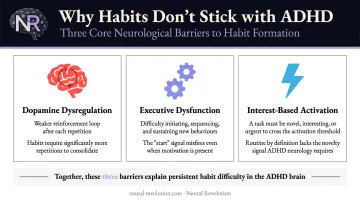
A PET study of 45 never-medicated adults with ADHD found lower dopamine D2/D3 receptor availability in reward-pathway regions including the nucleus accumbens — directly linking dopamine dysregulation to motivation deficits in adults with ADHD. Without adequate dopamine signaling, the reinforcement loop that builds automaticity is weaker, meaning habits take more repetitions and more effort to encode.
Executive Dysfunction: The Routine Breaker
Executive dysfunction affects the ability to initiate, sequence, and sustain new behaviors — even when the person genuinely wants to follow through.
Picture this: You plan to exercise every morning. Your intentions are real. But when morning arrives, you can't find your headphones, the coffee runs long, you check one email — and suddenly it's 9:15 and the window is gone.
This isn't poor planning. Thomas Brown's executive function model calls it "activation difficulty": the ADHD brain's documented struggle with organizing, prioritizing, and initiating tasks.
Time Blindness and Inconsistency
Russell Barkley's foundational research on ADHD and self-regulation describes ADHD as returning behavioral control to the "temporal now" — creating what he calls time blindness. Without a reliable sense of time, habits never occur in the stable, consistent context habit science requires for automaticity to develop — and without that repetition, nothing becomes automatic.
Task Paralysis and the Interest-Based Nervous System
Dr. William Dodson, a psychiatrist specializing in adult ADHD, describes the ADHD nervous system as interest-based: a person must find a task personally interesting, novel, challenging, or urgent — or, as he puts it, "nothing happens."
A habit can be objectively useful and still produce paralysis. The ADHD brain doesn't weigh importance — it weighs salience. If a habit isn't interesting, novel, or urgent, it doesn't cross the activation threshold, no matter how much you want it to.
How to Build Habits with ADHD: Step-by-Step
Success with ADHD habits comes from designing the process intentionally — not just deciding to try harder. Each step below reduces the cognitive load your brain has to carry.
Step 1: Understand Your Brain Before You Set a Habit
Self-awareness is the foundation. The habit has to match how your ADHD brain actually works — not how you think it should.
Before choosing a habit, ask yourself:
- When is my focus genuinely sharpest during the day?
- Is this habit something I find interesting, or purely obligation-driven?
- What conditions (environment, mood, time) help me start things vs. derail me?
Habits built around your natural rhythms have a much higher survival rate than habits assigned to arbitrary times. An obligation-driven habit — one you think you should do — is significantly more likely to fade than one with genuine emotional resonance.
Step 2: Choose One Small, Specific Habit
One habit. Not three.
The specificity matters as much as the singularity. "Exercise more" is not a habit — it's an aspiration. "Do 10 minutes of movement after my morning coffee" is a habit. The more concrete and bounded, the less mental friction to start.
This is where ADHD-friendly goal-setting frameworks offer real value. Neural Revolution's DREAMS™ framework, developed by Dr. Eliza Barach (PhD in cognitive psychology, Board Certified Coach), was built specifically because SMART goals — rigid, metric-heavy, emotionally flat — trigger the shame and perfectionism cycles that derail ADHD brains. The DREAMS™ framework prioritizes flexibility and emotional resonance, making habits feel achievable rather than oppressive.
Step 3: Stack It and Anchor It
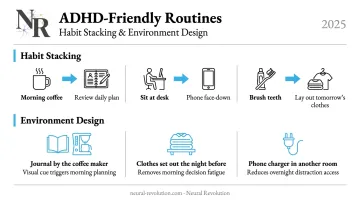
Habit stacking links a new habit to an already-established routine, so the existing behavior acts as the cue. This reduces initiation load because the decision of when to start is already made.
ADHD-friendly habit stacking examples:
- After I pour my morning coffee → I write three things I want to accomplish today
- After I sit down at my desk → I put my phone in a drawer
- After I brush my teeth at night → I lay out tomorrow's clothes
Redesigning your physical space takes this further. Make the habit easier; make the competing behavior harder:
- Keep your journal on top of your coffee maker
- Set out workout clothes the night before
- Put your phone charger in another room
Step 4: Build in Reward and Recovery
Environmental design handles the start — reward handles the return. The ADHD brain runs on immediate feedback, and the long-term payoffs of most habits (better health, more productivity, improved relationships) rarely generate enough dopamine to sustain consistent behavior. You need a shorter feedback loop.
Attach a small, immediate reward to habit completion. It doesn't need to be elaborate — five minutes of a favorite show, a good song, a specific coffee drink. The brain just needs to associate habit completion with something pleasurable right now.
Build a miss-recovery plan before you need one.
Lally et al.'s habit formation research found that missing one opportunity did not materially affect the habit-formation process. One missed day does not break a habit — but treating it as total failure often does. The "never miss twice" principle isn't about perfection; it's about shortening the gap between a slip and a return.
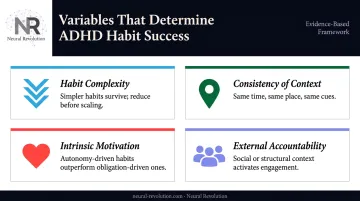
Key Variables That Affect Habit Success with ADHD
Even with the right strategy, outcomes vary. These are the levers that most often separate habits that stick from habits that fade.
Habit Complexity
Simpler habits succeed far more often. Complexity amplifies executive dysfunction — more steps, more decisions, more things that can go wrong before you've even started.
Before scaling up a habit, put energy into reducing it. A five-minute version of a habit done consistently beats a thirty-minute version done sporadically.
Consistency of Context
Habits form faster when performed in the same environment, at the same time. Wood and Neal's habit research identifies stable context cues as the mechanism through which behavior becomes automatic — the environment triggers the behavior without conscious decision-making.
For ADHD adults, who are especially sensitive to environmental change, protecting context matters. Strategies:
- Time-block the habit in your calendar as a non-negotiable appointment
- Designate a specific location for the habit when possible
- Reduce variables (same music, same space, same cue sequence)
Intrinsic Motivation vs. External Pressure
Habits assigned by others or driven purely by "should" rarely survive with ADHD. Ryan and Deci's Self-Determination Theory identifies autonomy and intrinsic motivation as central to sustainable behavior — and this is especially relevant for ADHD, where externally imposed systems frequently trigger resistance rather than compliance.
That's not a character flaw — it's a documented feature of how the ADHD brain responds to control. Neural Revolution's coaching is grounded in SDT precisely because autonomy isn't a compliance problem to manage around; it's a neurological reality to design with.
External Accountability Structures
The ADHD brain generates motivation inconsistently for tasks that aren't urgent or inherently interesting. External accountability — an accountability partner, body doubling, or an ADHD coach — compensates for this by creating a social or structural context that activates engagement.
External accountability is a neurologically sound support — one that directly addresses a documented gap in the ADHD brain's internal motivation system, not a sign that someone is struggling harder than they should be.
Common Mistakes ADHD Adults Make When Building Habits
Most ADHD habit-building attempts fail for the same handful of reasons.
Building Multiple Habits at Once
Executive function is a finite resource. Spreading it across three new habits at once means none of them get enough consistency to stick. Pick one and protect it.
Relying on Motivation and Reminders
Motivation is unreliable for ADHD brains by definition. Phone reminders lose salience within days — they become part of the noise. Environment design and habit stacking are more durable because they don't depend on you feeling motivated when the moment arrives.
Treating a Missed Day as Failure
All-or-nothing thinking runs especially high in high-achieving ADHD adults. A missed day gets interpreted as proof that the system doesn't work, or that they don't have what it takes — and the habit gets abandoned.
The evidence says otherwise: one missed day doesn't reset the process. What breaks habits is the story told about the missed day, not the miss itself.
When Standard Habit Advice Fails — and What to Try Instead
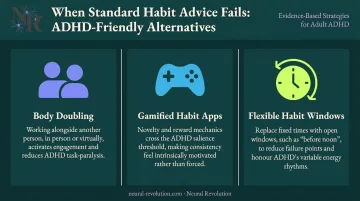
Most mainstream habit advice was designed for neurotypical brains. "Just be consistent." "Track your streak." "Build a morning routine." When these strategies stall for you, the problem is almost always fit, not effort.
Alternative approaches worth trying:
- Body doubling — working alongside another person (in person or virtually) creates social accountability that activates engagement for low-salience tasks
- Gamified habit apps — some ADHD adults respond well to game mechanics; the novelty and reward structure cross the salience threshold in ways plain trackers don't
- Flexible habit windows — instead of "exercise at 7am," use "exercise sometime before noon." Fixed times create more failure points; windows create recovery room
When self-directed strategies consistently fall short — particularly for high-achieving professionals managing complex work and lives — the gap is usually not more information. It's external scaffolding: someone who designs systems with you, not for you, and holds the structure steady while you build momentum.
That's where ADHD-specialized coaching comes in. Neural Revolution, led by Dr. Eliza Barach (PhD in cognitive psychology, Board Certified Coach), works specifically with high-performing adults to build individualized systems grounded in how the ADHD brain actually operates — drawing on both research and lived ADHD experience.
Frequently Asked Questions
What are common ADHD habits?
ADHD adults typically benefit most from habits around consistent sleep routines, environmental organization, time-blocking, and regular exercise. The most effective habits, though, are ones designed around the individual's specific ADHD profile — peak energy windows, dopamine triggers, and executive function patterns — rather than one-size-fits-all approaches.
Why can't I stick to habits with ADHD?
Difficulty sticking to habits with ADHD is rooted in executive dysfunction, dopamine dysregulation, and time blindness — not lack of effort. Standard habit strategies assume neurological systems that ADHD disrupts. Habit strategies need to be ADHD-specific to work consistently.
How long does it take to form a habit with ADHD?
General habit research suggests automaticity develops over an average of 66 days, with a wide range of 18–254 days depending on the habit and the person. No verified ADHD-specific timeline exists, but inconsistency challenges mean the process may take longer. Missing days doesn't reset progress.
Does habit stacking work for ADHD?
Habit stacking is one of the most ADHD-friendly strategies available. By linking a new habit to an existing one, it removes the need to generate fresh initiation each day — which directly addresses the executive function activation problem.
What is high-functioning ADHD in adults?
High-functioning ADHD typically describes adults who appear to manage well externally but experience significant internal struggle. Many high-achieving adults have gotten there through years of compensation — working harder, masking more — rather than systems calibrated to their actual brain. The performance is real; the internal cost usually isn't visible.
Can you be calm with ADHD?
Yes. Calm and consistency are genuinely achievable with ADHD — not by fighting the brain's nature, but by building systems, environments, and routines that reduce cognitive load. When the brain isn't constantly compensating for friction, there's capacity left over for steadiness.