Introduction
You're delivering at a high level. Projects get done, clients are happy, and from the outside, everything looks fine. But behind that performance, you're skipping meals during hyperfocus spirals, canceling plans with people you care about, and lying awake wondering why you can't just stop working.
This isn't a discipline problem. It's a neurological one.
According to the CDC, an estimated 15.5 million U.S. adults — roughly 6% — had a current ADHD diagnosis in 2023. Many of them are high-performing professionals who have built successful careers largely by outworking the system. The trouble is, that strategy has a ceiling.
Standard work-life balance advice — prioritize better, use a planner, just say no — was designed for neurotypical brains. For ADHD professionals, these strategies often fail not because of poor effort, but because they target the wrong operating system entirely.
The fix isn't more willpower or better habits. It's understanding how your brain actually works — and building around that instead of against it.
Key Takeaways
- ADHD professionals face distinct neurobiological barriers to work-life balance that generic advice doesn't address
- Hyperfocus, time blindness, dopamine-driven workaholism, and rejection sensitive dysphoria actively disrupt balance
- Sustainable balance means designing rhythms around your neurology, not splitting time 50/50
- Effective strategies rely on environmental design and external structure — willpower isn't the missing ingredient
- Professional ADHD coaching directly targets the executive function gaps that keep professionals stuck
Why Standard Work-Life Balance Advice Fails ADHD Professionals
Most balance advice assumes a particular kind of brain: one that can activate on importance, estimate time accurately, transition between tasks smoothly, and decide to stop working when "enough is enough." ADHD brains don't reliably do any of those things.
The Interest-Based Motivation System
Russell Barkley frames ADHD as fundamentally a disorder of self-regulation and executive functioning — including self-motivation. Clinician William Dodson, MD, describes ADHD attention as activated not by importance or logic, but by interest, challenge, novelty, urgency, and passion.
This means that telling an ADHD professional to "just prioritize" is neurologically misaligned. If the task isn't interesting, urgent, or novel, the brain won't fire — regardless of how important the task actually is. And if the work is interesting, the brain may lock onto it for six hours straight.
Time Blindness
Time blindness is a genuine impairment in how the ADHD brain perceives the passage of time. Research on adult ADHD time perception shows effect sizes from d = 0.42 to d = 0.97 — a significant, documented deficit.
In practice, this looks like:
- Chronically underestimating how long tasks take
- Starting work "quickly" at 7 PM and surfacing at midnight
- Missing personal commitments not out of neglect, but because time simply didn't register
- Feeling perpetually behind, even when working constantly
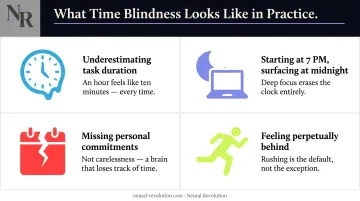
That's not carelessness — it's a structural difference in how the ADHD brain processes time, and no amount of willpower changes the underlying wiring.
Dopamine Dysregulation and the All-or-Nothing Pattern
Research by Volkow et al. found reduced dopamine markers in adult ADHD reward pathways, including lower D2/D3 receptor availability. The practical result: ADHD brains are constantly seeking stimulation to regulate dopamine. Work either completely absorbs attention or feels impossible to start. There's little stable middle ground.
This is why "balanced daily routines" rarely survive contact with an ADHD brain. Moderation isn't neurologically available in the same way.
Why Planners and Productivity Systems Backfire
Traditional time-blocking and productivity systems assume:
- Consistent executive function across the day
- Predictable motivation
- The ability to transition between tasks on schedule
ADHD brains don't meet any of these assumptions reliably. Without modification, these systems become evidence of failure rather than tools for success — which brings us to the shame spiral.
The Shame Spiral
A systematic review of 6,085 ADHD adults found that five out of six controlled studies reported lower self-esteem scores in ADHD groups compared to controls. When standard strategies fail repeatedly, many professionals internalize that as a personal character flaw rather than a system mismatch.
That shame doesn't stay contained. It compounds executive dysfunction, triggers avoidance, and tends to produce a predictable overcorrection: working weekends to catch up, taking on more to prove competence, burning out — then repeating the cycle.
The ADHD Balance Traps: Why High Performers Burn Out
Hyperfocus and the Crash Cycle
Hyperfocus is complete task absorption — a state where the ADHD brain locks onto something and tunes out essentially everything else. Research by Oroian et al. found that 68% of ADHD adults experience frequent hyperfocus, with work tasks as the most common trigger at 35%. 40% reported neglected responsibilities as a consequence.
In professional life, hyperfocus produces extraordinary results. It also produces missed meals, canceled plans, and partners who feel invisible — not because the professional doesn't care, but because the brain literally stopped registering anything outside the task.
What follows is the crash: cognitive fog, depleted emotional regulation, and an inability to engage with much of anything. The professional output looks impressive. The personal life is quietly falling apart.
The Workaholism-ADHD Link
This isn't just about being driven. A PLOS ONE study of 16,426 workers found that 32.7% of workaholics met the clinical ADHD cutoff, compared to 12.7% of non-workaholics. ADHD symptoms were positively associated with workaholism (beta = .20, p < .001).
The mechanism is dopamine. High-pressure, novel professional environments provide a near-constant stimulation source that personal life rarely matches. The ADHD workaholic isn't more ambitious — they're more regulated at work than anywhere else. The office is where the brain finally feels calm.
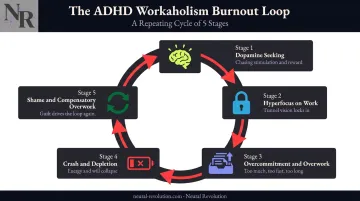
That pattern has a distinct endpoint: burnout. Research by Turjeman-Levi et al. found that executive function deficits mediate the relationship between ADHD symptoms and job burnout — with self-organization deficits specifically driving emotional exhaustion and cognitive weariness.
Rejection Sensitive Dysphoria and Overcommitment
Rejection sensitive dysphoria (RSD) — an intense emotional response to perceived rejection or failure — is strongly associated with ADHD. It isn't a formal DSM diagnosis, but emotional dysregulation is well-documented: Shaw et al.'s review found it affects approximately 30% to 70% of adults with ADHD.
In professional contexts, RSD shows up as an inability to say no. When a request arrives, the fear of disappointing someone triggers an immediate "yes" — before there's any chance to evaluate actual capacity.
The result looks like ambition from the outside. The root cause is an emotional regulation gap. Chronic overcommitment is the predictable outcome — and it compounds the burnout cycle already set in motion by hyperfocus and dopamine-driven workaholism.
Common signs this pattern is active:
- Agreeing to projects before checking bandwidth
- Apologizing for boundaries before the boundary is even stated
- Volunteering for tasks specifically to avoid seeming unhelpful
- Feeling genuine dread — not just discomfort — when declining requests
Redefining What Balance Actually Means for the ADHD Brain
The 50/50 work-life split model assumes relatively stable energy, predictable motivation, and a brain that can disengage from work at will. None of that applies to ADHD.
Sustainable balance for ADHD professionals looks more like intentional rhythms: periods of high-intensity focus with structured recovery built in, rather than a uniform daily moderation that the ADHD brain will never consistently maintain.
Three reframes that change how ADHD professionals approach balance:
- Downtime that restores executive function and emotional regulation is what makes sustained performance possible — not a reward for finishing, but a structural requirement. Schedule it the same way you'd schedule a client call.
- When work and personal life connect to what genuinely matters, motivation is easier to sustain and decisions feel clearer. Sustainable balance starts with knowing your direction, not just managing your hours.
- The goal isn't to try harder — it's to design systems that make the right behaviors easier. Balance is an architecture problem, not a willpower problem.
ADHD-Friendly Strategies for Sustainable Work-Life Balance
Design Your Schedule Around Your Brain, Not a Template
ADHD is associated with delayed sleep-wake timing: research reports delayed sleep and wake cycles in 73% to 78% of ADHD individuals. Many ADHD professionals are working against their chronotype every day by defaulting to a standard 9-to-5 structure.
Where possible:
- Identify your peak cognitive hours and protect them for demanding work
- Schedule lower-stakes tasks — email, admin, routine calls — outside those windows
- Build explicit transition time between tasks and meetings; the ADHD brain pays a real cost for context-switching
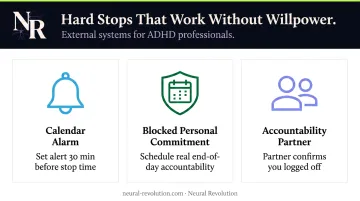
Hard stops are the second non-negotiable. ADHD professionals cannot rely on an internal signal to stop working — because for most, that signal either doesn't fire or fires too late. Hard stops have to be external:
- Calendar alarms set to trigger 30 minutes before your intended stop time
- A blocked personal commitment at the end of the day (dinner, a class, a call) that creates real accountability
- An accountability partner who checks in on whether you actually logged off
Use Goals That Actually Fit Your Brain
Rigid outcome-only goal frameworks like SMART goals tend to fail ADHD professionals for a consistent reason: they don't account for motivation variability, interest-dependency, or the emotional and values-driven nature of ADHD engagement. A goal that made perfect sense on Monday can feel completely inert by Wednesday.
ADHD-compatible goal frameworks prioritize:
- Flexibility — room to adapt when motivation, energy, or circumstances shift
- Meaning and emotional resonance — connection to what actually matters, not just what logically should
- Incremental structure — smaller milestones that the ADHD brain can engage with now rather than a distant outcome
Dr. Eliza Barach at Neural Revolution developed the DREAMS™ framework specifically to address this gap — a brain-based alternative to SMART goals designed around how ADHD cognition actually works, detailed in her book ADHD DREAMS: A Brain-Based Guide to Setting Goals That Actually Work.
The framework's central premise is straightforward: engagement drives execution. A goal that doesn't activate the ADHD brain won't get done, no matter how well-constructed it looks on paper.
Build Structural Boundaries (Not Willpower Ones)
Willpower-based boundaries fail ADHD professionals. The right approach is to make the desired behavior the path of least resistance.
Practical structural boundary tools:
- Closing a door or moving your laptop to another room creates a physical, sensory signal that work is done — your environment does the work your willpower won't
- App blockers and work account log-outs during personal hours remove the temptation entirely — no decision required
- Calendar-first personal commitments. Block personal time before work commitments are scheduled — not the other way around
- A default response for new requests. Rather than making in-the-moment decisions where RSD causes reflexive agreement, use a script: "I need to check my schedule and get back to you." This creates a pause between the request and the answer, which is where ADHD professionals need protection most
How ADHD Coaching Can Help You Build a Life That Works
ADHD coaching is distinct from generic productivity coaching and from therapy. CHADD describes it as a practical intervention targeting planning, time management, goal setting, organization, and problem solving — focused on present functioning and future goals, not clinical symptom treatment.
The evidence base supports it as a meaningful intervention. A 2026 study published in the American Journal of Lifestyle Medicine found that after 12 coaching sessions, ADHD symptom improvement produced effect sizes rivaling — and in some measures exceeding — stimulant medication outcomes. Neural Revolution explicitly positions its work on this basis: coaching as a precision intervention, not a soft alternative.
That research foundation shapes how Neural Revolution works. Dr. Eliza Barach, a PhD in cognitive psychology and Board Certified Coach, built the practice at the intersection of academic research and lived ADHD experience — because she found that studying the brain and helping people actually function better in their lives required two different skill sets. Her own ADHD diagnosis, her research career, and her coaching practice each informed the other.
Coaching at Neural Revolution addresses the specific gaps that undermine work-life balance:
- Executive function infrastructure — external systems for time, planning, and task management calibrated to ADHD neurology
- Hyperfocus channeling — directing deep focus toward high-leverage work and building recovery into the schedule
- RSD-driven overcommitment — developing real-time regulation tools and boundary systems that don't depend on saying no in the moment
- Calendar architecture — designing a schedule around ADHD energy rhythms, not neurotypical defaults
- Values-aligned goal-setting — through the DREAMS™ framework, connecting goals to what genuinely matters so the ADHD brain stays engaged

If you're a high-performing professional who has tried the generic strategies and keeps ending up in the same place — overwhelmed, overcommitted, running on empty — the problem isn't effort. Generic strategies are built for neurotypical brains. A Discovery Consult with Neural Revolution ($50 deposit, credited to your first session) is where building systems that fit your actual brain begins.
Frequently Asked Questions
What do people with ADHD struggle with?
ADHD in adults typically involves executive function impairments across planning, prioritization, task initiation, and working memory — alongside time blindness and difficulty with emotional regulation. These challenges vary significantly by individual and context, which is why generic strategies rarely work consistently.
Can people with ADHD keep a job?
Yes, and many ADHD professionals reach senior leadership, found companies, and build highly successful careers. Without the right supports and environment, however, challenges like inconsistent output, overwhelm, and RSD-driven workplace conflict can create real friction.
Why is work-life balance so hard with ADHD?
The neurobiological factors make disengagement structurally difficult: the interest-based nervous system keeps the ADHD brain locked onto stimulating work, time blindness prevents accurate judgment of how long things take, and dopamine-driven compulsive engagement makes "enough" genuinely hard to feel.
What is the ADHD burnout cycle?
The pattern typically runs: intense hyperfocus or overcommitment → depletion and cognitive crash → reduced capacity → shame and compensatory overwork → repeat. Recognizing the cycle matters — but awareness alone rarely breaks it. Structural intervention, whether through coaching, systems design, or accountability, is what actually shifts the pattern.
Can ADHD coaching help with work-life balance?
Yes. ADHD coaching directly targets the executive function gaps, systems design needs, and self-awareness deficits that undermine balance. Unlike therapy, it focuses on present functioning and practical implementation — not clinical treatment.
How do ADHD professionals set better boundaries at work?
Structural strategies outperform willpower every time: default response scripts for incoming requests, hard-stop calendar alarms, calendar-blocked personal time scheduled before work commitments, and an accountability partner or coach to maintain those systems consistently.