For high-achieving adults with ADHD, this experience is both common and deeply confusing. It looks like laziness from the outside, but internally it's accompanied by guilt, frustration, and a creeping sense that something is fundamentally broken. That feeling is wrong. ADHD procrastination isn't a character flaw — it's a neurological pattern rooted in how the ADHD brain processes motivation, time, and emotion.
This article breaks down the brain-based mechanisms behind ADHD procrastination, what happens when it's left unaddressed, and evidence-backed strategies that actually work — not by demanding more willpower, but by working with how your brain is actually wired.
Key Takeaways
- ADHD procrastination stems from dopamine dysregulation, executive function deficits, and emotional dysregulation — not laziness
- The ADHD brain activates around interest, novelty, urgency, and challenge — not importance or deadlines alone
- Chronic procrastination creates a shame-avoidance cycle that compounds over time, affecting careers, relationships, and mental health
- Generic productivity advice fails because it ignores the neurological and emotional roots of ADHD procrastination
- Effective strategies reduce the activation cost of starting, inject interest or urgency, and address emotional friction directly
Why the ADHD Brain Procrastinates: The Neuroscience Behind It
Most "just do it" advice fails ADHD adults because it assumes the problem is behavioral. It isn't. ADHD procrastination arises from multiple intersecting neurological mechanisms — and understanding them changes everything about how you approach the problem.
Dopamine Dysregulation and the Motivation Gap
The ADHD brain doesn't generate dopamine signals the way neurotypical brains do. Research by Volkow et al. published in Molecular Psychiatry found that adults with ADHD showed significantly lower dopamine receptor and transporter binding in the brain's reward pathways, and that motivation scores correlated directly with these dopamine markers.
What this means practically: when a task feels unexciting or the reward feels distant, the ADHD brain simply doesn't generate the neurochemical signal needed to start. This isn't a decision — it's a physiological gap.
This is what's sometimes called a motivation gap: tasks that feel low-stimulation fail to register as worth starting, even when the person knows the task matters. Knowing and feeling the motivation to act are two very different things for the ADHD brain.
Executive Function Deficits: Time Blindness and Task Initiation
ADHD impairs the executive functions most critical to getting started:
- Task initiation — the brain's ability to activate and begin
- Working memory — holding a plan in mind long enough to act on it
- Time perception — accurately sensing how much time has passed or remains
Dr. Russell Barkley describes this last deficit as "temporal myopia" — behavior governed by events in the immediate context rather than future ones. Deadlines that are two weeks away feel abstract and unreal; the task only becomes urgent when the deadline arrives. CHADD identifies task initiation as a core executive function impaired by ADHD, noting that adults may struggle significantly with getting started and managing time around completion.
The result: even a single-step task can feel impossible to launch — not because the person lacks ability, but because the brain's activation system isn't firing reliably.
Emotional Dysregulation and the Avoidance Cycle
ADHD is strongly linked to difficulty regulating emotions. Boredom, frustration, anxiety, or fear of failure around a task become overwhelming faster and more intensely than for neurotypical people — and avoidance genuinely feels like relief.
Shaw et al. found that emotional dysregulation occurs in 30–70% of adults with ADHD, identifying it as a major source of impairment across relationships, work, and self-efficacy. That pattern drives a predictable cycle:
- Task feels aversive
- Person avoids it → temporary emotional relief
- Guilt and shame build
- Task feels even more aversive
- Avoidance deepens
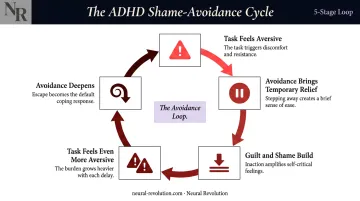
Shame alone cannot break this cycle — it accelerates it. Which is why understanding the neurology underneath matters more than trying harder.
The Interest-Based Nervous System
Psychiatrist Dr. William Dodson describes the ADHD nervous system as interest-based rather than importance-based. The conditions that activate ADHD engagement are: interest, novelty, challenge, and urgency — not rational priority or responsibility.
This is why an ADHDer can hyperfocus for six hours on something captivating while finding it nearly impossible to start a five-minute task that feels boring. It's the same brain, responding to different neurochemical conditions.
Procrastination, in this frame, isn't willful — the brain genuinely cannot engage with tasks that don't activate these triggers.
The Real Cost of Chronic ADHD Procrastination
ADHD procrastination doesn't stay contained. Left unaddressed, it compounds across every area of life.
Professionally, the costs are measurable. Research by de Graaf et al. found that adults with ADHD experienced an average of 21.7 days of reduced work quantity and 13.6 days of reduced work quality per year. For high-achieving professionals and entrepreneurs, this typically shows up as inconsistent output — bursts of brilliance followed by paralysis — that doesn't reflect actual capability.
The mental toll is harder to measure but often more damaging. Every missed deadline, every avoided task, every last-minute scramble adds another layer of "what's wrong with me?" — a question most ADHD adults already ask too often. Research links ADHD procrastination to lower self-efficacy and a weakened sense of personal coherence. The procrastination itself becomes evidence against you.

Beyond work, the damage shows up in relationships:
- Delayed responses to texts and emails that pile into silence
- Avoided conversations that harden into distance
- Unfulfilled promises that chip away at trust — including trust in yourself
That isolation feeds directly back into avoidance. The harder it gets to start, the more you avoid — and the cycle tightens.
Warning Signs Your ADHD Procrastination Is Getting Worse
ADHD procrastination often escalates gradually. What starts as occasional delays can become a persistent pattern that needs more intentional intervention. Watch for these signals:
- Task paralysis is spreading — routine tasks (emails, small decisions, admin) now feel as impossible to start as major projects. The circle of "too hard to begin" keeps getting wider.
- The shame spiral is accelerating — time previously spent procrastinating is now dominated by intense self-criticism and rumination about unfinished tasks, crowding out the mental space you need to actually function.
- Avoidance is creating compounding consequences — deadlines are being missed rather than just cut close; professional standing or relationships are being affected; the backlog of avoided tasks has grown so large it now feels impossible to assess what even needs doing.
When procrastination reaches this point, willpower-based fixes stop working. The pattern calls for a different kind of intervention — one built around how your brain actually operates, not how you think it should.
Proven Strategies to Beat ADHD Procrastination
Effective strategies for ADHD procrastination don't demand willpower — they reduce the cost of starting, inject the interest or urgency the brain needs, and address the emotional friction that keeps the avoidance cycle spinning.
Work With Your Brain's Interest System, Not Against It
Rather than fighting the brain's need for novelty and stimulation, artificially inject it into tasks:
- Create urgency with timers — a countdown timer (Pomodoro-style intervals) manufactures the urgency signal the ADHD brain needs to engage
- Gamify — assign points, race against a clock, or frame the task as a challenge
- Change environments — a coffee shop, a standing desk, or even a different room can shift the brain's engagement level enough to lower the initiation barrier
- Pair boring tasks with stimulation — background music, a podcast, or a specific sensory cue can raise a task's interest signal enough to get started
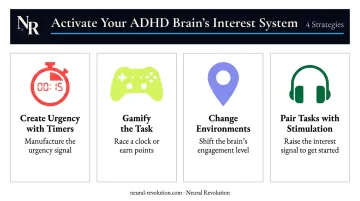
The key is treating this as self-discovery, not formula-following. What activates one ADHD brain may do nothing for another. Experimentation is the method, not the problem.
That activation piece connects directly to the initiation barrier — and sometimes the most effective way through it is to make the task smaller than feels reasonable.
Shrink the Task Until Starting Feels Almost Effortless
This isn't just "break it into steps." That still requires sustained working memory and future-orientation — both ADHD weak points. Instead, identify the absolute minimum physical action that generates any forward momentum at all:
- Open the document
- Write one sentence
- Set a two-minute timer and just look at the task
The point isn't to plan the whole path — it's to lower the initiation barrier just enough that the brain can cross it. Once in motion, continuation is neurologically easier than starting.
This is also where goal-setting frameworks matter. Traditional systems like SMART goals were built for neurotypical brains: rigid, memory-heavy, and emotionally disconnected in ways that consistently backfire for ADHD adults. The DREAMS™ framework, developed by Dr. Eliza Barach at Neural Revolution, takes the opposite approach — prioritizing emotional resonance and flexibility over rigid metrics so that goals feel worth pursuing, not just worth planning.
Use External Structure and Accountability
The ADHD brain struggles to generate self-regulation internally. External structure compensates for that gap:
- Work near another person, even virtually. Body doubling activates mild alerting signals that help sustain engagement — CHADD describes it as a practical tool for helping people start, focus, and finish work.
- Keep a visible timer running. Externalizing time counters the time blindness problem directly.
- Tell someone your deadline. Commitment devices make due dates neurologically real in a way that internal reminders rarely do.
- Join a structured co-working community. Neural Revolution's FOCUS Forward group coaching program includes access to the Focused Space virtual co-working community, providing built-in body-doubling support between sessions.
These tools don't require discipline to maintain — they outsource the self-regulation the ADHD brain can't generate reliably on its own.
Address the Emotional Root: Break the Shame-Avoidance Loop
No productivity strategy works long-term if the emotional layer is untouched. Shame is itself a procrastination accelerant. When someone believes they're lazy or broken, avoidance becomes a way of protecting self-esteem from further confirmation of that belief.
ADHD procrastination is a neurological pattern, not a verdict on character.
Practical tools for the emotional layer include:
- Self-compassion practices — research links self-compassion to reduced ADHD-related emotional dysregulation
- Cognitive reframing of shame-based self-talk ("I'm broken" → "My brain's activation system works differently")
- Working with an ADHD coach or CBT-trained therapist who understands the neurological roots — not just the behavioral symptoms
Neural Revolution's coaching approach explicitly reframes avoidance as neurological rather than moral, drawing on what Dr. Barach calls the "Worth-It Threshold" — the ADHD brain's real-time weighing of perceived effort against perceived reward. Once clients understand that mechanism, a significant amount of the shame tends to lift on its own.
Building Systems That Keep Procrastination in Check
Long-term management isn't about one-time fixes — it's about environmental and behavioral design that reduces the ongoing activation cost of important tasks.
Design for low friction. Make important tasks easier to start: keep the document open, lay out materials the night before, keep tasks visible rather than buried in a to-do app. Reducing activation cost is as effective as increasing motivation.
Schedule during peak energy windows. Track when focus and motivation are naturally highest and protect those windows for high-initiation-cost work. Use lower-energy periods for routine tasks. ADHD adults often know their peak windows but rarely act to protect them.
Build in weekly reflection, not just planning. A brief review of what got done, what got avoided, and what pattern is emerging builds the self-awareness needed to adjust systems before procrastination compounds. More to-do items are rarely the answer.
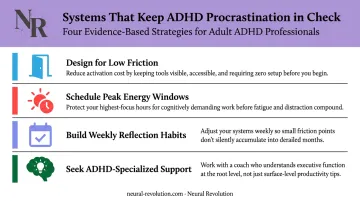
Consider ADHD-specialized support. For high-achievers whose procrastination is tied to perfectionism, entrenched executive function challenges, or years of masking and over-functioning, standard productivity coaching and general therapy typically address the wrong mechanism. Neural Revolution's 1:1 ADHD coaching works at the level of how the ADHD brain actually evaluates effort — surfacing the worth-it threshold for specific tasks and restructuring them to cross it, using ADHD-specific techniques rather than willpower-based advice.
Frequently Asked Questions
Is procrastination a symptom of ADHD?
Procrastination isn't listed as a named criterion in the DSM-5, but it's one of the most commonly reported functional impairments associated with ADHD. It emerges directly from underlying ADHD symptoms — inattention, emotional dysregulation, poor task initiation, and executive function deficits — not as an independent behavior.
Why do people with ADHD procrastinate even on things they want to do?
ADHD procrastination isn't about disinterest in the conventional sense. Even desired tasks require the brain to generate enough neurochemical activation to initiate — and if the task doesn't feel immediately interesting, urgent, or novel enough, that activation simply doesn't happen, regardless of how much the person wants to do it.
What is the difference between ADHD procrastination and laziness?
Laziness implies not caring. ADHD procrastination typically occurs alongside intense guilt, frustration, and anxiety about the unfinished task — often for hours or days. People with ADHD usually care deeply; their brain's activation system just doesn't reliably respond to caring alone.
What is ADHD task avoidance, and how do I break the cycle?
Task avoidance follows a predictable loop: a task feels aversive → avoidance brings temporary relief → guilt builds → the task feels even harder. Breaking the cycle means tackling both sides — practical initiation strategies and the shame that makes avoidance feel necessary in the first place.
Does ADHD medication help with procrastination?
Stimulant medications can improve the dopamine signaling and executive function deficits that contribute to procrastination. As CHADD notes, however, "pills do not substitute for skills" — medication alone rarely eliminates it. Behavioral strategies and coaching work best alongside appropriate treatment.
How do I stop procrastinating with ADHD when I feel completely overwhelmed?
Start with the smallest possible physical action — open the document, write one sentence, set a two-minute timer. Overwhelm often signals emotional dysregulation that needs addressing before any productivity strategy will work. The goal is to lower the barrier enough that the brain can cross it, not to plan the whole path first.