Introduction
It's 11:30 pm. You're exhausted. You've been exhausted since 3 pm. But the moment you lie down, your brain decides it's the ideal time to replay that awkward conversation from Tuesday, draft a business email, and generate seventeen ideas for a project due next month.
This isn't a discipline problem. It's not poor sleep hygiene. It's a neurological pattern that affects the majority of adults with ADHD — and it's one of the most underrecognized parts of living with this brain.
Research on adults with ADHD found that 44.4% met full criteria for insomnia disorder and 63.9% reported insomnia symptoms — compared to a general adult insomnia prevalence of just 6–15%. That gap points to something structural: the ADHD brain operates on a different circadian clock, with disrupted dopamine signaling that makes powering down genuinely harder.
What follows breaks down the mechanisms behind that disruption — and offers strategies built around how your brain actually works, not generic wind-down checklists designed for a neurotypical sleep architecture.
Key Takeaways
- ADHD sleep struggles are neurobiological — the ADHD brain has a delayed internal clock and disrupted dopamine-melatonin signaling
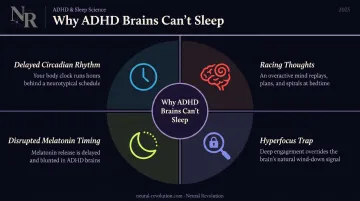
- Four mechanisms drive the problem: delayed circadian rhythm, racing thoughts, hyperfocus traps, and disrupted melatonin timing
- Poor sleep worsens ADHD symptoms the next day, creating a self-reinforcing cycle
- Effective strategies work with ADHD neurology: anchoring wake time, building off-ramp routines, and externalizing mental clutter
- Sustainable improvement comes from building the right systems — not from trying harder
Why the ADHD Brain Struggles to Sleep
Sleep difficulties in ADHD aren't random or a willpower problem. They trace back to specific neurobiological differences — circadian timing, dopamine regulation, and the way the ADHD brain responds (or doesn't) to the cue that it's time to wind down.
Four mechanisms drive most of the trouble:
- Delayed circadian rhythm — the body clock runs 1-2 hours behind conventional schedules
- Racing, generative thoughts that surface the moment external demands disappear
- Hyperfocus that makes disengaging from an absorbing task neurologically difficult
- Disrupted melatonin timing tied to dopaminergic differences in the ADHD brain
Delayed Circadian Rhythm
The ADHD brain's internal clock runs late. Research on adult ADHD clinical samples found that 33.3% of adults with ADHD met criteria for delayed sleep phase disorder — a condition where the body's sleep-wake cycle is shifted significantly later than conventional schedules demand.
This means that at 10 pm, when many neurotypical adults feel genuinely sleepy, the ADHD brain simply hasn't received that signal yet. A 2025 Delphi consensus on delayed sleep onset in adult ADHD summarizes prior research finding the dim light melatonin onset (DLMO) is delayed by an average of 1.5 hours in adults with ADHD.
The practical consequence: an adult with ADHD whose body clock signals sleep at 1 am, but whose job requires a 7 am alarm, is perpetually running a sleep debt — even when total sleep hours look "fine" on paper.
Racing Thoughts and the Quiet of Night
During the day, external demands — meetings, deadlines, conversations — provide enough input to keep the ADHD brain's internal noise from surfacing. But at bedtime, those anchors disappear.
What floods in often isn't catastrophic worry. For many ADHD adults, the nighttime mental stream is neutral to positive — ideas, plans, half-formed projects, things to remember. It feels productive. That's exactly what makes it so hard to stop.
This is distinct from anxiety (though the two can co-occur). It's the ADHD brain, finally uninterrupted, doing what it naturally does: generating and connecting.
Hyperfocus and the "Just One More Thing" Trap
Hyperfocus is one of the ADHD brain's genuine strengths — and one of its most common sleep disruptors. Once the ADHD brain locks onto something engaging, disengaging requires an external interrupt signal — it doesn't happen through willpower alone.
Without that signal, midnight becomes 2 am.
This also intersects with what's sometimes called revenge bedtime procrastination — a pattern particularly common in high-achieving ADHD adults who spend their day managing obligations they didn't choose. Late night becomes the only period of unstructured, self-directed time. Going to bed feels like surrendering the one part of the day that actually belonged to them.
Dopamine Dysregulation and Disrupted Melatonin Signals
ADHD is associated with differences in dopaminergic regulation, and dopamine plays a role in circadian functioning. Studies measuring salivary melatonin in adults with ADHD and chronic sleep-onset insomnia found significantly delayed melatonin onset compared to both ADHD adults without sleep-onset insomnia and healthy controls — with the delay in DLMO statistically significant at p = .000 versus healthy controls.
The "it's bedtime" signal arrives late and may register less strongly. The body isn't failing to produce melatonin; it's producing it on a different schedule.
What Chronic Sleep Loss Does to the ADHD Brain
The relationship between ADHD and sleep runs in both directions. ADHD disrupts sleep, and sleep deprivation worsens ADHD symptoms in return — a cycle that compounds itself daily.
That cycle has measurable consequences. Research links sleep disturbances in ADHD to functional impairment across mood, attention, behavior, work performance, and quality of life. Adults who don't obtain recommended sleep are more likely to report worsening ADHD symptoms, while ADHD-related inefficiency and irregular schedules further erode sleep timing.
For high-performing ADHD professionals, the downstream effects are specific:
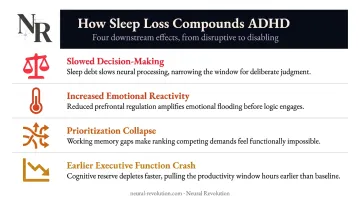
- Decision-making slows and options feel equally unappealing
- Emotional reactivity increases — the threshold for frustration drops significantly
- Prioritization collapses — everything feels equally urgent or equally irrelevant
- The mid-afternoon executive function crash hits harder and earlier
Adults who are already masking or compensating for ADHD in demanding roles rely on a cognitive buffer to manage the gap. Sleep deprivation removes that buffer. What felt manageable yesterday becomes genuinely unworkable today — not because anything changed at work, but because the prefrontal cortex is running on insufficient rest.
For ADHD brains already operating at the edge of their executive function capacity, lost sleep doesn't just cause fatigue — it narrows the margin that makes high performance possible.
Sleep Strategies That Actually Work for ADHD Adults
Standard sleep hygiene advice fails most ADHD adults — not because they haven't tried it, but because it's designed for neurotypical sleep architecture. Telling an ADHD brain to "just wind down" at 10 pm ignores everything above.
The strategies below work with ADHD neurology: they reduce decision load, use external structure, and account for the reality that the ADHD brain needs different scaffolding.
Work With Your Chronotype, Not Against It
Forcing a 10 pm bedtime when your body clock signals sleep at 1 am isn't discipline — it's fighting biology, and biology usually wins.
A more effective approach:
- Identify your actual natural sleep window (often midnight–8 am for many ADHD adults)
- Anchor primarily on a consistent wake time, not a strict bedtime — wake time is more achievable and equally powerful for circadian regulation
- Maintain that anchor on weekends — even a 30–45 minute drift can meaningfully disrupt the circadian rhythm for someone already prone to phase delay
Consistency on the wake end of the schedule is where ADHD adults tend to have more traction. It's one anchor point, not two — which matters when two feels impossible. Once that anchor holds, building a reliable wind-down routine becomes the next lever.
Build an "Off-Ramp" Routine
The ADHD brain doesn't transition smoothly from "active" to "winding down" without external cues. An off-ramp routine provides those cues — not because routines are inherently calming, but because they reduce the cognitive load of deciding when and how to stop.
It doesn't need to be long — it needs to be repeatable. Effective elements include:
- Dimming lights 60–90 minutes before your target sleep window (supports melatonin production)
- Switching from screen-based to low-stimulation activities — anything that reduces visual and cognitive intensity
- A defined "last thing before bed" anchor — one specific action that marks a clear endpoint (a specific playlist, a particular herbal tea, five minutes of stretching)
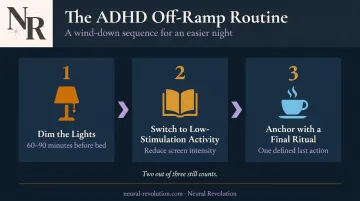
The goal is a predictable sequence, not a perfect routine. If you complete two out of three steps, the routine still worked.
Offload Racing Thoughts With a Brain Dump
The ADHD brain holds onto unfinished thoughts because its working memory is unreliable — mentally rehearsing tasks feels necessary to avoid losing them. A pre-sleep brain dump externalizes that function, reducing the urgency to keep thoughts active.
A simple, low-effort format that works:
- 3 concrete actions for tomorrow — specific and bounded, not a full task list
- Real but not urgent — things you don't need to hold onto tonight
- Ideas and observations — things worth filing, not acting on
This isn't journaling. It takes five minutes and removes the cognitive "holding" work the brain was going to do anyway — just at 1 am instead.
Use Sensory and Body-Based Tools
When the mind resists slowing down, the body can lead the way. Physical sensation bypasses the mental loop:
- Weighted blankets — proprioceptive input that can calm nervous system arousal
- Slow breathing with extended exhale — a 4-count inhale, 6-count exhale activates the parasympathetic nervous system
- Gentle stretching — shifts attention from thought to physical sensation
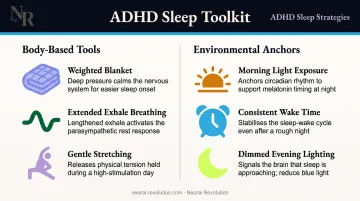
Morning light exposure is worth adding here, even though it's not a nighttime tool. Getting outside within an hour of waking — even 10–20 minutes of natural light — reinforces the circadian anchor and supports earlier melatonin release the following evening. Better sleep tonight starts with how you begin tomorrow morning.
Manage Caffeine and Medication Timing
On caffeine: The mean plasma half-life of caffeine is approximately 5 hours, with a range of 1.5 to 9.5 hours depending on individual metabolism. Research found that caffeine consumed 6 hours before bedtime still significantly disrupted sleep, leading researchers to recommend avoiding caffeine for a minimum of 6 hours before the target sleep window. For a midnight sleep target, that means cutting off caffeine by around 6 pm.
For ADHD adults who rely heavily on caffeine for daytime focus, this is worth taking seriously — the same substance supporting afternoon productivity may be meaningfully narrowing the sleep window.
On stimulant medication: FDA labeling for Adderall XR recommends administration on awakening and explicitly advises avoiding afternoon doses due to potential insomnia. Ritalin labeling similarly notes that patients who can't sleep when medication is taken late should take the last dose before 6 pm.
If sleep onset consistently tracks with afternoon doses, bring it up with your prescriber. It's a concrete, actionable data point — not something to troubleshoot alone.
Building a Sustainable Sleep System for Your ADHD Brain
The most important reframe: sustainable sleep improvement for ADHD adults is less about willpower and more about environmental and systems design.
This means:
- Reducing the number of daily decisions required to execute a sleep routine
- Building in external prompts — alarms, ambient lighting timers, app reminders — that substitute for internal regulation
- Designing a setup that accounts for low-motivation nights, not just optimal ones
The goal isn't a perfect routine performed identically every night. It's a "good enough" default that the brain can slip into with low friction. On nights where only two of five steps happen, that's not failure — that's the system working at reduced capacity, which is still better than no system.
That distinction matters, because many ADHD adults have tried building sleep habits before, fallen apart after one imperfect night, and written off the entire effort. All-or-nothing thinking is part of the ADHD pattern — not evidence that sleep systems can't work.
For adults who have cycled through attempts without lasting traction, working with an ADHD coach who specializes in systems design and executive function can make a genuine difference. The value isn't accountability — it's having someone help you design structures that fit how your brain actually works, rather than retrofitting neurotypical frameworks onto a brain they were never built for.
That's the focus at Neural Revolution. Dr. Eliza Barach — a cognitive psychologist, Board Certified Coach, and ADHD adult herself — founded the practice specifically to build that kind of external structure: calendar architecture, working memory offloads, environmental design calibrated to how the ADHD brain actually operates, not how it's supposed to.
Conclusion
ADHD-related sleep struggles are real, neurologically grounded, and not a reflection of character or effort. The same brain that resists winding down also brings creative intensity and depth — qualities genuinely worth protecting with rest.
The goal isn't to become a different kind of sleeper. It's to design a sleep environment and approach that works with your ADHD brain — and to recognize that small, consistent changes to timing, routine, and environment can shift the pattern over time.
That structure is easier to build when you're not doing it alone. Whether through self-experimentation or working with someone who understands how ADHD brains actually operate, the path forward starts with working with your neurology — not against it.
Frequently Asked Questions
Do people with ADHD take longer to fall asleep?
Yes. Controlled sleep studies found adults with ADHD took an average of 26.1 minutes to fall asleep versus 17.4 minutes in matched controls — and 17% of ADHD adults took over an hour, compared to just 4% of controls. Delayed circadian timing and racing thoughts at night are the primary drivers, not an inability to relax.
Do people with ADHD function better with less sleep?
No — this is a myth. ADHD adults are not less affected by sleep deprivation; poor sleep directly worsens core symptoms including working memory, impulse control, and emotional regulation — removing the cognitive buffer that high-performing professionals depend on most.
Why does ADHD make you tired during the day?
ADHD-related fatigue comes from the sustained mental effort of managing attention, compensating for executive function gaps, and regulating emotions all day (sometimes called masking load). Add poor sleep quality or shortened sleep duration, and the resulting exhaustion feels disproportionate to what was actually accomplished.
Why do adults with ADHD stay up so late?
Two connected reasons: a biologically delayed circadian rhythm means genuine sleepiness arrives later, and "revenge bedtime procrastination" — where late nights represent the only unstructured, autonomous time in an otherwise obligation-driven day — makes going to bed feel like a loss rather than a choice.
Can ADHD medication affect sleep?
Stimulant medications taken in the afternoon or evening can delay sleep onset — FDA labeling for both amphetamine and methylphenidate formulations specifically addresses this timing concern. If sleep onset consistently follows afternoon doses, discussing timing or formulation adjustments with a prescriber is the right next step, not self-managing medication changes.
What is the best sleep routine for adults with ADHD?
Anchor on a consistent wake time rather than a strict bedtime, build a short repeatable off-ramp sequence (dimmed lights, low-stimulation activity, one defined "last thing"), and use external tools — brain dump, sensory cues, light management — rather than relying on willpower alone. Consistency matters more than perfection — low-friction routines are easier to sustain.