Introduction
You've tried the color-coded planner. The productivity app with the satisfying checkboxes. The perfectly organized to-do list you built on Sunday night that you'd stopped using by Tuesday. And yet, the week still ends with undone tasks, mounting guilt, and the familiar internal verdict: I just don't have the discipline for this.
That verdict is wrong — and it's costing you.
Research on adult ADHD occupational functioning found that 53% of adults with ADHD reported job performance difficulties, compared to just 5% of community controls. This isn't a willpower gap. It's a design gap: the systems were never built for how your brain actually works.
Effective task management for ADHD adults requires working with the brain's neurochemistry — its drive toward interest, novelty, and urgency — not forcing it into frameworks built for a different kind of brain.
This guide covers:
- Why standard productivity systems fail ADHD brains (the neuroscience)
- Four foundational principles for ADHD-friendly task management
- Specific rules that cut overwhelm before it starts
- Strategies for the hardest part — actually getting started
- How to choose tools that help rather than frustrate
Key Takeaways
- Standard productivity systems assume linear thinking and sustained attention that ADHD brains don't reliably produce
- ADHD-friendly systems treat capture, prioritization, initiation, and review as four distinct problems — not one
- Rules like 1-3-5 and the 30% buffer reduce overwhelm — they aren't extra structure, they replace bad defaults
- The right tool matters far less than the right system design for your specific ADHD profile
Why Standard Task Management Systems Fail ADHD Brains
Executive Function Is the Real Issue
ADHD directly impairs the executive functions that productivity systems rely on most: working memory, inhibition, and cognitive flexibility. When working memory is unreliable, tasks don't stay "in mind" between the moment you commit to them and the moment you need to act. GTD, SMART goals, and standard to-do lists all assume that the gap between "I'll do this" and "doing this" is simply a matter of remembering and choosing.
For ADHD brains, that gap is a neurological obstacle — not a willpower problem.
CHADD documents that executive function impairments adversely affect the ability to begin, work on, and complete tasks — and that self-regulation deficits are central to how ADHD presents in adults.
The Interest-Based Motivation Problem
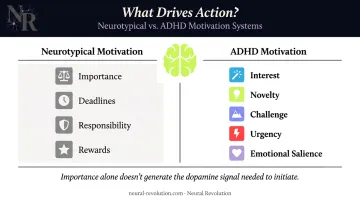
The ADHD brain isn't driven primarily by importance or deadline — it's driven by interest, novelty, challenge, urgency, and emotional salience. Volkow et al.'s PET study of 45 never-medicated adults with ADHD found decreased function in the brain's dopamine reward pathway, with dopamine markers correlating directly with motivation and achievement scores.
This is why a task can feel genuinely impossible one hour and effortless the next — that's not mood variability, it's reward-system neurochemistry. Strategies that say "just do the important thing" consistently fail because importance alone doesn't generate the dopamine signal the ADHD brain needs to initiate.
Time Blindness and Task Paralysis
Two additional patterns break most standard systems:
Time blindness: A 2023 review of adult ADHD time perception research confirms that adults with ADHD show measurable impairments in time estimation, reproduction, and duration discrimination. Future deadlines feel abstract until urgency spikes — which is why "I have two weeks" provides almost no motivational traction until it becomes "this is due tomorrow."
Task paralysis: The Cleveland Clinic distinguishes this clearly: procrastination is a conscious choice to delay, while executive dysfunction means the brain systems for self-motivation, planning, and inhibition simply aren't functioning typically. Task paralysis is not laziness. It's an intention-to-action gap with a neurological basis.
Neurotypical frameworks — GTD, SMART goals, standard to-do lists — were never designed to address any of these patterns. The question isn't whether you're using the system correctly. It's whether the system was built for a brain like yours.
The Four Foundations of an ADHD-Friendly Task System
A task management system for ADHD adults must cover the full lifecycle of a task: from capture through completion. A system that organizes well but doesn't support initiation will collapse within weeks.
Capture Everything Externally
Working memory in ADHD is unreliable as a neurological feature. The system must function as an external brain: any task, idea, or obligation goes into one trusted location immediately before it disappears.
The critical word here is frictionless. Capture should require the minimum possible effort. Organization comes later — losing the task comes now if capture is complicated. Quick options include:
- A voice memo recorded on the spot
- A single tap into a dedicated capture app
- A notepad kept within arm's reach at all times
Prioritize by Engagement, Not Just Importance
Standard urgency/importance matrices ignore a variable the ADHD brain actually responds to: current activation energy. High-importance, low-interest tasks don't get done through sheer willpower — they need additional scaffolding:
- A body double or accountability partner
- An environmental cue that signals "this is the time for this task"
- Time-boxing with a visual timer
- A clear, concrete first action that reduces the neurological cost of starting
Prioritization for ADHD should factor in importance and current energy, cognitive load, and emotional friction.
Design for Task Initiation, Not Just Organization
A well-organized list doesn't solve the initiation problem. ADHD-friendly systems include:
- A physical, concrete first action for every task (not "work on report" — "open document and type the date at the top")
- Environmental conditions that make the right action the path of least resistance
- Reduced friction through pre-arranged materials, consistent task zones, and notification management
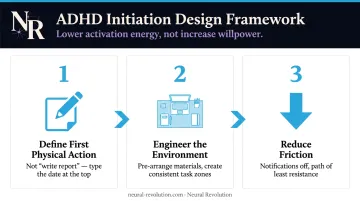
The goal is to make starting require less activation energy, not more willpower.
Build In Regular Review and Reset
ADHD task systems require short, consistent review cycles to prevent task pile-up and the shame-driven "system abandonment" pattern. Two review rhythms work well together:
- Daily scan (5 minutes): Check what's active, flag anything that's stalled, and confirm the next concrete action for top priorities
- Weekly reset (15–20 minutes): Clear completed tasks, re-evaluate what's still relevant, and set up the coming week's focus
Both only work if the review itself stays simple enough to do every single time.
ADHD Task Management Rules That Actually Work
These rules don't have strong peer-reviewed validation as ADHD-specific interventions — but they're useful calibration tools grounded in what adult ADHD research does support. Treat them as testable defaults, not fixed protocols.
The 1-3-5 Rule
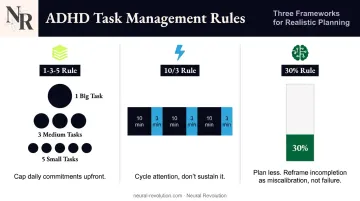
Each day, commit to: 1 big task, 3 medium tasks, 5 small tasks — no more.
Why it helps for ADHD brains:
- Creates a bounded, cognitively manageable daily scope
- Prevents the overwhelm of an endless list
- Guarantees visible wins at multiple task sizes throughout the day
- Forces a prioritization decision before the day begins, rather than in the moment
The 10/3 Rule
Work in short concentrated bursts (roughly 10 minutes) with brief breaks (roughly 3 minutes), deliberately cycling attention rather than demanding sustained focus.
The exact ratio matters less than the principle: adult ADHD research consistently shows that sustained-attention deficits worsen over time on continuous tasks, and that shorter work blocks can help.
That said, research by Tucha et al. cautions that more task segments mean more restarts — and restarts carry their own initiation cost. Adjust the ratio to your own initiation patterns.
The 30% Planning Rule
Plan to accomplish roughly 30% of what you instinctively estimate you can complete in a given time block.
This isn't pessimism — it's calibration. Adult ADHD time-perception research shows consistent estimation errors across multiple time-reproduction tasks. ADDA recommends building in explicit time buffers, while noting that too much buffer can backfire. The 30% figure is a personal heuristic to calibrate against your own patterns, not a validated benchmark.
Reframe an incomplete task list as inaccurate initial planning, not failure. That reframe cuts the shame spiral that typically leads to system abandonment.
ADHD-Friendly Goal Framing
Standard SMART goals tend to fail ADHD brains because they're static, emotionally neutral, and rely on long-term motivation the ADHD brain doesn't sustain. Goals work better when they're:
- Connected to something that genuinely matters to you, not just what's objectively important
- Visible daily — not buried in a planning doc you open twice a year
- Adjustable without triggering the shame of "failure"
- Aligned with who you are, not just what you need to accomplish
Dr. Eliza Barach, PhD, developed the DREAMS™ framework at Neural Revolution as a research-grounded alternative to SMART goals — built on cognitive psychology findings about motivation, reward processing, and how ADHD brains actually set and pursue goals.
Getting Past the Hardest Part: Task Initiation and Follow-Through
Micro-Tasking and the Next Physical Action
Break every task down to its smallest possible concrete first step. Not "write the report" — but "open the document and type the first sentence." The narrower and more physical the first action, the smaller the neurological gap between intention and start.
Implementation intention research (Wieber et al.) shows that specifying when, where, and how to act significantly reduces the gap between intention and behavior. For ADHD brains, where that gap is structurally wider due to executive function differences, this specificity isn't optional — it's the mechanism.
Body Doubling and External Accountability
Body doubling — working alongside another person, physically or virtually — is one of the most widely used ADHD strategies, and Cleveland Clinic describes it as a form of external executive functioning in which another person serves as an anchor for task engagement.
A survey of 220 neurodivergent participants found body doubling is a community-driven phenomenon used for task initiation, focus, and completion. Controlled trial evidence is still emerging, but the practical impact for many ADHD adults is substantial — and the options are more varied than most people realize:
- In-person or virtual co-working sessions (Focusmate is a popular platform)
- Scheduled accountability check-ins with a partner or coach
- Shared task logs or progress reports sent to someone you trust
Neural Revolution's FOCUS Forward group coaching program includes a 3-month membership to Focused Space, a virtual co-working community, specifically because the social facilitation effect supports task engagement in ways solo productivity tools can't replicate.
Environment as a Follow-Through Strategy
Reducing friction is a high-leverage, one-time effort that compounds over time:
- Pre-arrange materials for recurring tasks
- Create consistent task zones (same desk, same time, same setup)
- Use visual task cues — physical objects that signal "this task is next"
- Manage notifications proactively, not reactively
Designing the environment to do work the brain can't reliably do alone isn't a workaround — it's the evidence-based approach to ADHD support. Neural Revolution's coaching methodology treats Environmental & Systems Design as a formal specialty precisely because structural change outperforms willpower as a long-term strategy.
Task Management Tools and Apps for ADHD Adults
What Makes a Tool Actually ADHD-Friendly
Ignore tools that require extensive setup before they're useful. The setup burden itself can trigger avoidance and tool abandonment. Prioritize these features:
- Fast, frictionless capture — adding a task should take under 10 seconds
- Visual layouts — tasks stay visible, not buried in menus
- Persistent, customizable reminders — the tool resurfaces tasks so you don't have to remember to check it
- Subtask capability — breaks tasks into concrete next steps
- Calendar integration — tasks and appointments in the same view
- Minimal configuration required to start
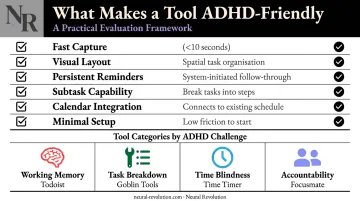
Tool Categories by ADHD Challenge
| ADHD Challenge | Tool Type | Examples |
|---|---|---|
| Working memory / capture | Task list apps | Todoist, basic notes app |
| Task breakdown | AI-assisted breakdown | Goblin Tools |
| Time blindness / initiation | Visual timers | Time Timer |
| Focus and accountability | Body doubling platforms | Focusmate |
These examples are starting points, not endorsements — no named app has peer-reviewed validation as an adult ADHD intervention. Pick based on which challenge costs you the most, not which app has the best reviews.
Tool Fatigue Is a Real Pattern
Cycling through apps and abandoning systems is itself a recognizable ADHD behavior — driven by the novelty dopamine hit of setup followed by inconsistent follow-through once the tool becomes familiar.
The fix: Start with a single tool in one category. Use it for at least 2-3 weeks. Only add a second tool once the first is genuinely stable. The system you actually use is the one that works — even if it's just a sticky note.
When You Need More Than a Task App
Apps and frameworks address the surface mechanics of task management. They don't touch the deeper patterns driving avoidance, shame, perfectionism, and chronic system abandonment in high-achieving ADHD adults.
For many professionals, the blocks are less about organizational skill and more about the emotional, motivational, and identity-level dimensions of ADHD — which require a different category of support.
ADHD coaching provides what self-directed tools can't: external structure, accountability, and system design built around your specific brain and professional context.
Coaches trained in ADHD neuroscience address initiation failures and follow-through breakdowns at the root — not by adding more structure on top, but by building systems that work with how your brain actually operates.
That's the work Neural Revolution was built to do — for high-achieving professionals who have already cycled through every conventional productivity tool. Dr. Eliza Barach, PhD in Cognitive Psychology and Board Certified Coach, applies cognitive psychology research directly to ADHD system design, offering a coaching model grounded in how the ADHD brain processes motivation, time, and task initiation.
Frequently Asked Questions
What are the 1-3-5, 30%, and 10/3 rules for ADHD task management?
Each targets a different ADHD challenge:
- 1-3-5 rule: Limit each day to 1 big task, 3 medium, and 5 small — prevents overwhelm by capping commitments upfront
- 10/3 rule: Alternate short focused work bursts with brief breaks to match ADHD attention patterns
- 30% rule: Plan only ~30% of your estimated capacity to account for time blindness and executive function variability
All three are practical heuristics, not clinically validated protocols.
What is the best task management app for ADHD?
There's no single best tool — the right one matches your primary ADHD challenge and is one you'll actually use consistently. Capture-focused users often prefer Todoist; those who need task breakdown may benefit from Goblin Tools; those struggling with initiation may find a body-doubling platform like Focusmate more useful than any to-do app.
Why do ADHD-friendly task systems stop working after a few weeks?
System abandonment is a recognizable ADHD pattern driven by novelty wear-off and the dopamine drop after initial setup excitement. The fix is usually simplification — not a new app — combined with regular system reviews and added external accountability rather than a complete overhaul.
How do I prioritize tasks when everything feels equally urgent?
Feeling urgent about something doesn't make it objectively important — but the ADHD brain often can't tell the difference. A practical approach: identify the single task that would create the most relief or downstream ease if completed first, then use the 1-3-5 rule to cap daily commitments rather than trying to rank an open-ended list.
Is body doubling actually effective for ADHD?
Yes. Body doubling is a well-recognized ADHD strategy supported by clinical observation and a survey of 220 neurodivergent participants. The presence of another person — even silently and virtually — reduces initiation resistance and supports task engagement, likely because an outside presence helps anchor attention and activate a sense of being observed.
How is ADHD task management different from standard productivity advice?
Standard productivity advice assumes consistent attention, intrinsic motivation from importance, and reliable time perception — none of which are guaranteed with ADHD. ADHD-specific task management accounts for the interest-based nervous system, time blindness, variable executive function, and the need for external structure built directly into the system rather than relying on internal discipline.