Introduction
You're running a leadership team, managing a packed calendar, and fielding decisions all day. You're also the person who's been 20 minutes late to your own meeting — not because you don't care, but because time genuinely disappeared.
For executives with ADHD, this is a brain architecture problem — not a discipline one.
ADHD disrupts the precise cognitive machinery that executive roles demand most: working memory, task initiation, time perception, and prioritization. A 2023 review in the International Journal of Environmental Research and Public Health confirmed that adults with ADHD show consistent deficits in time estimation, time reproduction, and time management at the neuropsychological level — not just behaviorally.
The good news: the right tools can externalize what the brain can't hold internally. This guide covers the best ADHD time management tools for executives, why each one works neurologically, and how to avoid the app-hopping trap that derails so many otherwise solid systems.
Key Takeaways
- ADHD executives need external scaffolding that matches how their brains actually process time and priority
- The most effective tools reduce decisions and make time visible, rather than demanding more mental bandwidth
- Implement one tool at a time; building a full system at once almost always fails
- Match tools to your specific executive function gap, not to what worked for a colleague
- Self-knowledge makes tools work; coaching is one of the fastest ways to build it
Why Time Management Hits Differently for ADHD Executives
The Neurological Reality
The ADHD brain doesn't experience time on a linear continuum. It operates closer to a "now vs. not now" mode — where the future is abstract until urgency makes it immediate. This isn't a metaphor. Research by Barkley, Murphy, and Bush (2001) found that adults with ADHD showed measurably shorter time reproductions and greater errors across multiple interval lengths compared to controls — with deficits appearing at 12, 15, 45, and 60 seconds. A subsequent meta-analysis across 25+ studies confirmed these timing deficits as a consistent feature of ADHD, not an occasional quirk.
For executives, this translates directly into operational problems:
- Underestimating how long meetings actually take — including prep and recovery time
- Treating the gap between "now" and a deadline as larger than it is
- Over-committing to deliverables because future workload feels manageable in the abstract
- Missing the window for strategic work because the urgency signal never fires
The Executive-Role Multiplier
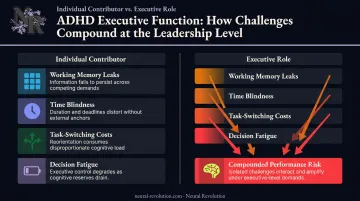
A standard ADHD time management challenge becomes much harder at the executive level. The cognitive demands of senior leadership — calendar density, stakeholder management, strategic planning, high-context switching — pile pressure onto the exact executive function vulnerabilities ADHD brains already carry.
Working memory leaks, task-switching costs, decision fatigue, and time blindness don't stack additively at senior levels. They compound — in ways that rarely surface at individual contributor roles until someone steps into an executive seat.
Why Most Tools Fail ADHD Executives
Conventional productivity systems were designed for neurotypical brains that:
- Check in with tools consistently
- Remember where they saved things
- Build habits through repetition without novelty decay
ADHD brains don't operate this way. Effective tools need to be automatic, visual, and low-friction — built for variable focus, not against it.
Best ADHD Time Management Tools for Executives
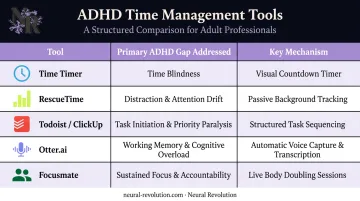
These five tools were chosen for immediate utility, low setup burden, and direct relevance to the executive function gaps most common in ADHD — not for feature count.
Time Timer (Visual Time Management)
Time Timer displays remaining time as a shrinking red disk — making the abstract passage of time physically visible. It's available as both a physical device (starting at $24.95 for the MOD Home Edition) and as a free/paid app for iOS and Android.
The key advantage for ADHD executives: it requires zero behavioral change. No app to open, no habit to build. It works passively in the background, creating a gentle urgency signal without the anxiety spike that ADHD brains often associate with deadlines.
| Attribute | Detail |
|---|---|
| Key Feature | Visual countdown format; directly counteracts time blindness |
| Platform & Pricing | Physical timer from $24.95; app available free/paid for iOS and Android |
| Best For | Executives managing deep work blocks, meeting transitions, or project sprints |
RescueTime (Automatic Time Tracking)
RescueTime runs in the background across devices and automatically logs how time is spent — no manual input required. It generates weekly reports comparing actual time allocation to perceived allocation, often revealing a significant gap between the two.
For ADHD executives, the passivity is the point. Manual timers require remembering to start and stop them — a behavioral loop that breaks down fast. RescueTime removes that failure point entirely while surfacing real data about where the day actually goes.
| Attribute | Detail |
|---|---|
| Key Feature | Passive, automatic tracking with optional distraction-blocking |
| Platform & Pricing | Desktop and mobile; free tier available; Solo Focus plan $9/month ($7/month billed annually) |
| Best For | Executives who want data-driven insight into time leaks without adding another task |
Todoist / ClickUp (Task & Priority Management)
Both platforms capture and organize work across projects. Todoist is simpler with lower friction; ClickUp offers more power for complex executive workflows. Both support natural-language input — type "prep board deck Thursday 3pm" and it becomes a task — allowing fast capture without breaking flow.
The ADHD-critical differentiator: both platforms let executives break large, undefined initiatives into small, specific actions. Undefined projects are a top task-initiation barrier for ADHD brains. Seeing "Q3 strategy review" broken into five concrete steps removes most of that friction.
| Attribute | Detail |
|---|---|
| Key Feature | Natural-language capture, subtask breakdown, priority labeling, calendar integration |
| Platform & Pricing | Both have free tiers; Todoist Pro $5/user/month (billed annually); ClickUp Unlimited $7/user/month (billed annually) |
| Best For | Executives managing multiple high-stakes projects who need fast capture and clear daily priorities |
Otter.ai (Meeting Transcription & Capture)
Otter.ai transcribes meetings in real time, identifies speakers, and extracts key points and action items — removing the need to simultaneously listen, contribute, and take notes.
CHADD has recognized AI notetakers like Otter.ai as tools that help neurodiverse professionals engage and reduce cognitive load. For ADHD executives specifically, knowing the transcript is captured frees up bandwidth for the parts of leadership where ADHD brains often excel: pattern recognition, lateral thinking, and strategic contribution. Follow-up commitments stay on record without requiring active attention during the meeting.
| Attribute | Detail |
|---|---|
| Key Feature | Real-time transcription with speaker ID, summaries, and action item extraction |
| Platform & Pricing | Free tier (300 min/month); Pro $16.99/month; integrates with Zoom, Teams, Google Meet |
| Best For | Executives with heavy meeting loads who struggle to track commitments and follow-ups |
Focusmate (Body Doubling & Accountability)
Focusmate pairs users with a virtual co-working partner for 25- or 50-minute sessions. Both state their goals at the start, work on camera, and check in at the end. The mechanism is body doubling — a strategy with direct professional support from both CHADD and ADDA for ADHD productivity.
Social presence activates different attention and motivation circuits in the ADHD brain — circuits that an empty office or silent home simply can't trigger. For executives who keep deferring important-but-not-urgent strategic work, that social context is often what finally gets it started.
| Attribute | Detail |
|---|---|
| Key Feature | Scheduled co-working sessions with accountability partner; sessions available across 150+ countries |
| Platform & Pricing | 3 free sessions/week; Plus plan $12/month ($8/month billed annually) |
| Best For | Executives who procrastinate on important but non-urgent strategic work when working solo |
How to Choose the Right ADHD Time Management Tool
Start With a Diagnostic Question
The most common mistake: choosing tools based on popularity or a peer's recommendation. A better starting point is identifying your primary failure mode first:
- "I can't feel how much time is passing" → Start with Time Timer
- "I don't know where my time actually goes" → Start with RescueTime
- "I have too many tasks and can't decide what to do next" → Start with Todoist or ClickUp
- "I lose meeting details and drop follow-ups" → Start with Otter.ai
- "I avoid starting important work even when I have time" → Start with Focusmate
One gap. One tool. That's the implementation rule that separates successful adoption from system collapse.
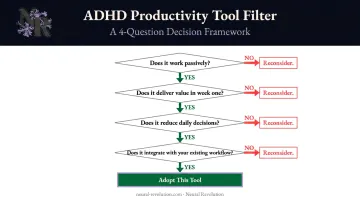
The ADHD Executive Adoption Filter
Before committing to any tool, run it through these questions:
- Does it work passively, or does it require consistent manual input?
- Does it deliver value in the first week, before any habit forms?
- Does it reduce daily decisions, or add new ones?
- Does it integrate with what already exists in your workflow?
Tools that require complex setup or sustained behavior change before delivering value almost always fail ADHD users. The novelty-reward cycle — where a new system feels exciting and then rapidly loses its pull — is a documented feature of ADHD reward processing. Low-friction, automatic tools survive that cycle much better than elaborate systems that demand early investment.
Why Coaching Accelerates Tool Success
The filter above tells you which questions to ask. But knowing which tool to pick still depends on knowing your specific ADHD profile — where your energy peaks, which executive function gaps cost you most, how your brain responds to urgency and novelty.
That self-knowledge changes everything: which tools you reach for, how you configure them, and whether you actually use them past week two.
Working with a specialist ADHD coach shortens that learning curve considerably. Neural Revolution's intake process surfaces these friction points directly: executive function gaps, time blindness patterns, working memory leaks, and task-initiation barriers. Rather than defaulting to what worked for someone else, that process helps executives identify which tools actually align with how their specific brain operates.
Conclusion
ADHD time management challenges for executives are neurological, not motivational. The right tools, chosen strategically and implemented one at a time, provide the external scaffolding the ADHD brain genuinely needs. That's not a workaround — it's how the brain actually works best.
No single tool is a complete solution. Executives who sustain high performance combine the right tools with genuine self-understanding and a system built around their own brain — not retrofitted from a neurotypical productivity playbook. Start with one tool from this list and commit to it for four weeks before you evaluate. The next tool will still be there.
If you're ready to move beyond trial and error, Neural Revolution's evidence-based coaching is designed to help high-achieving executives build time management systems that actually fit their brains. Dr. Eliza Barach brings both a PhD in cognitive psychology and her own ADHD experience to every engagement — so the work is grounded in research and in reality. Book a discovery consult to explore whether coaching is the right next step.
Frequently Asked Questions
What is the best time management tool for ADHD?
There's no single best tool — the right choice depends on your specific executive function gap. Time Timer works best for time blindness, RescueTime for passive tracking without added tasks, and Focusmate for overcoming task initiation barriers. Matching tool to gap is what makes the difference.
What is the "30% rule" of ADHD?
The "30% rule" isn't a verified statistic from peer-reviewed research. What research does confirm is that adults with ADHD show consistent errors in time estimation across multiple interval lengths. Build explicit buffers into your schedule — ADHD brains routinely underestimate how long things take.
Why do ADHD executives keep abandoning their time management systems?
Two patterns drive abandonment: the ADHD novelty-reward cycle fades quickly once a system stops feeling new, and systems that demand heavy behavior change before delivering payoff lose the race against dopamine. Low-friction, automatic tools implemented one at a time significantly improve follow-through.
How does time blindness affect executive performance specifically?
Time blindness causes executives to underestimate meeting prep, over-commit to deliverables, miss strategic planning windows, and operate in reactive mode. Compounded across weeks and quarters, these patterns erode leadership credibility and create chronic, low-grade burnout.
Do ADHD time management tools work without coaching or medication?
Tools provide external structure and can reduce the daily burden of ADHD symptoms on their own. They work best as part of a broader support system — coaching helps executives map their specific brain patterns and build systems around them, which is why tools chosen with that self-knowledge tend to stick.