This isn't a discipline problem. It's a predictable pattern of how the ADHD brain manages time and motivation — and it happens to some of the most capable, creative professionals out there.
Here's what most productivity advice misses: standard time management systems were built for neurotypical brains, which are wired around importance. ADHD brains run on a different operating system — one driven by interest, novelty, challenge, and urgency. That's not a flaw to fix. It's a specification to design around.
This post covers the genuine strengths and real challenges of freelancing with ADHD, followed by brain-based strategies for time management, structure, environment, and focus — so you can build a business that works with your brain.
Key Takeaways
- Freelancing can work well for ADHD brains — but only when systems are built around how those brains actually work
- Time blindness, task initiation difficulty, and working memory gaps each require a targeted fix — willpower alone won't cut it
- ADHD-friendly time management creates external urgency and visible deadlines rather than relying on internal motivation
- Environment and energy management are functional tools, not lifestyle upgrades
- Accountability structures — body doubling, coaching, accountability partners — move the needle for freelancers who've already tried everything else
Why Freelancing Can Be a Natural Fit for ADHD Brains
There's a reason so many freelancers and founders identify with ADHD. Research from a 2019 study in Small Business Economics found that 29% of entrepreneurs reported ADHD — a striking overrepresentation compared to the general adult population. A separate large-scale study found that hyperactivity symptoms were positively associated with self-employment across two independent samples totaling over 20,000 participants.
Freelancing's built-in deadline pressure, task variety, and autonomy closely mirror the conditions under which ADHD brains sustain engagement and produce their best work.
The Strengths Freelancing Rewards
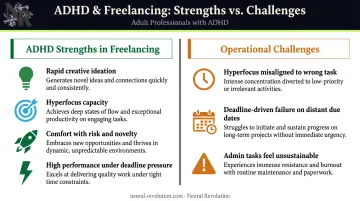
Specific ADHD traits map directly onto what independent work demands:
- Rapid ideation and creative connection-making — valuable in pitching, brainstorming, and solving client problems quickly
- Hyperfocus capacity — enables deep, high-quality output in compressed bursts, ideal for project-based work
- Comfort with risk and novelty — essential for client acquisition, pivoting, and building something from scratch
- High performance under deadline pressure — when urgency is real and present, ADHD brains often outperform
As Dr. Eliza Barach describes it: "the reward-seeking, novelty-hungry, pattern-recognizing, risk-comfortable ADHD profile maps directly onto founder behavior."
The Honest Flip Side
These same strengths carry real operational costs:
- Hyperfocus can devour hours meant for a different client
- Deadline-driven productivity fails when due dates are three weeks out
- Novelty-seeking makes repetitive admin work — invoicing, follow-up, scheduling — feel nearly impossible to sustain
Acknowledging this isn't pessimism. It's where the real work begins — because the strategies that help aren't generic productivity advice. They're built around how the ADHD brain actually operates.
The Real Reasons Freelancing Is Hard with ADHD
Time Blindness
ADHD brains often perceive time in only two categories: now and not now. Russell Barkley has described this as "temporal myopia" — events farther in the future are genuinely harder to perceive and act on.
CHADD's workplace research identified timekeeping as the top cause of job loss for adults with ADHD. For freelancers, the consequences are the same: over-committing, underestimating project scope, and deferring work until the anxiety of nearness forces a start.
Task Initiation
Difficulty starting tasks isn't procrastination in the conventional sense. Thomas Brown's executive function model identifies "activation" as a distinct ADHD impairment — the struggle to organize, prioritize, and initiate tasks that aren't an acute emergency. Without an external boss, bell, or coworker presence triggering the start of work, ADHD freelancers often stall entirely.
Working Memory Limits
A meta-analysis of 38 adult ADHD studies found consistent working memory deficits across phonological and visuospatial domains. Managing multiple clients, tracking deliverables, and holding project details in mind simultaneously is more cognitively demanding for ADHD brains. This isn't carelessness — the brain's available RAM is structurally limited.
Without external systems, things fall through the cracks. The fix isn't trying harder. It's building better scaffolding.
Time Management Strategies Built for the ADHD Brain
Create Artificial Urgency
The ADHD brain activates around urgency, not importance. This is why Pomodoro timers and countdown clocks work when calendar reminders don't — they manufacture the feeling of nearness and stakes externally.
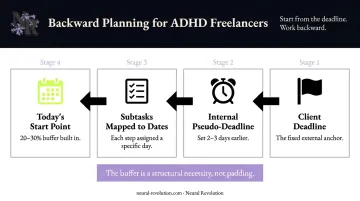
One practical application: set an internal deadline 2–3 days before the real client deadline and treat it as non-negotiable. The ADHD brain can't feel the pull of a deadline three weeks away. It can respond to one that's tomorrow.
Use Time-Boxed Intervals
CHADD recommends the Pomodoro Technique as an external time support for adults with ADHD. Here's why it works through an ADHD lens:
- The 25-minute interval creates a micro-deadline that activates the urgency response
- The built-in break prevents cognitive fatigue from compounding
- The finite structure removes the open-ended ambiguity that makes starting so hard
Some ADHD brains work better with longer intervals — 45/15 or 52/17. Experiment to find what actually fits your activation pattern, not what the standard recommendation says.
Brain Dump + Single Next Action
Before any work session, spend 3–5 minutes externalizing everything swirling in working memory — onto paper, a whiteboard, or a digital tool. Then identify only one concrete next physical action to begin.
It works because it offloads working memory AND removes the ambiguity that drives avoidance — two of the biggest friction points for ADHD brains.
"Write the intro section" is still ambiguous. "Open the document and type the first sentence" isn't.
Anchor Blocks Instead of Packed Calendars
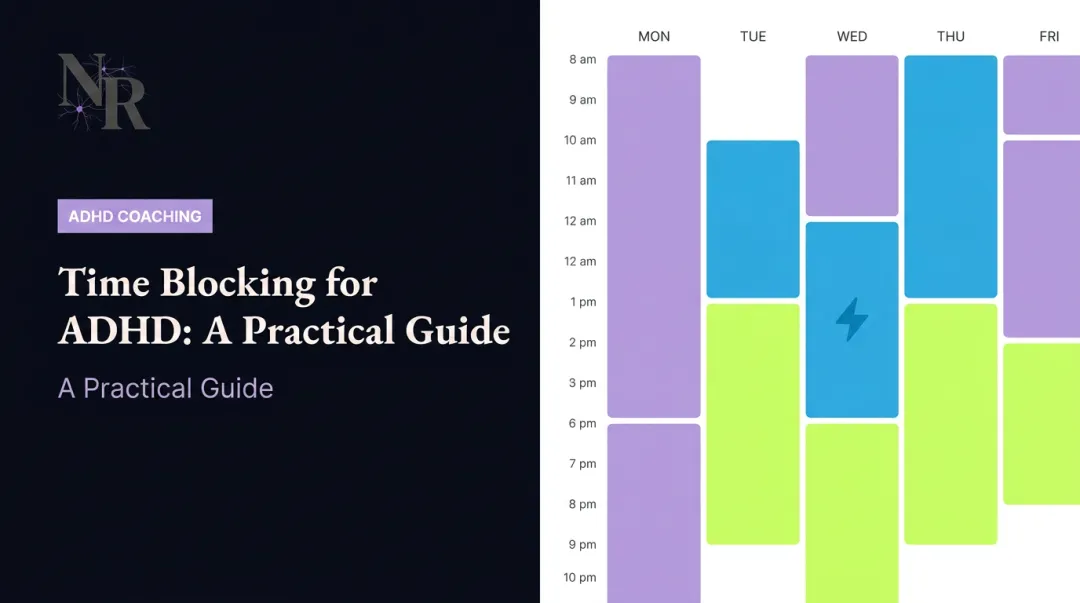
Rather than scheduling every hour, identify 2–3 non-negotiable deep work windows per day aligned with your peak cognitive hours. ADHD brains do better with fewer, larger blocks than a heavily fragmented calendar.
Build transition time between those blocks too. Context-switching costs run higher for ADHD brains, and running tasks back-to-back without a gap accelerates cognitive depletion faster than most people expect.
Backward Planning for Projects
Start from the deadline, map backward to today, and assign each subtask to a specific date.
This technique makes abstract future tasks feel concrete and present, countering the ADHD brain's tendency to perceive all future obligations as equally distant. Once your subtasks are mapped, add a 20–30% time buffer to the whole project. For ADHD brains, this isn't padding — it's a structural necessity that accounts for underestimation bias.
Building Structure Without Rigidity
Minimum Viable Structure
Rigid systems fail ADHD freelancers because they demand consistency that's neurologically difficult to sustain. The goal is minimum viable structure: the smallest set of systems that provide enough scaffolding to function, without requiring perfection to stay intact.
For project tracking, use visual, at-a-glance tools — Trello, Notion, or a physical whiteboard. The guiding rule: if a system takes more than 30 seconds to update, it will be abandoned. Track only three things:
- Active projects
- The next action for each
- Their deadlines
Theme Your Days
Instead of context-switching across all clients and tasks daily, assign types of work to specific time windows. For example:
- Mornings: Client deliverables
- Thursday afternoons: Admin and invoicing
- Fridays: Pitching and business development
This reduces the executive function cost of deciding what to work on and minimizes the cognitive friction of repeated task-switching.
Transition Rituals
ADHD brains struggle to automatically signal "time to start" or "time to stop." A brief, consistent start ritual (same beverage, a 3-minute scan of the day's anchor task) acts as a neurological cue that reduces activation energy.
An end-of-day shutdown routine does the same in reverse: log tomorrow's first task, close all tabs, done. That predictable sequence makes it easier to actually disengage.
The DREAMS™ Framework as a SMART Goals Alternative
Traditional SMART goals were designed for neurotypical motivation patterns. They often backfire for ADHD brains, triggering perfectionism, shame, or becoming irrelevant when motivation shifts — which is exactly the kind of rigid structure this section is arguing against.
Dr. Barach's DREAMS™ framework is built to be emotionally resonant and flexible enough to accommodate how ADHD motivation actually works, rather than demanding sustained drive toward a fixed future outcome.
Designing Your Environment and Energy for ADHD Focus
Why Environment Is a Functional Intervention
The ADHD brain's ability to engage is highly responsive to environmental stimuli. Changing your environment is often more efficient per unit of effort than trying to change behavior through willpower alone.
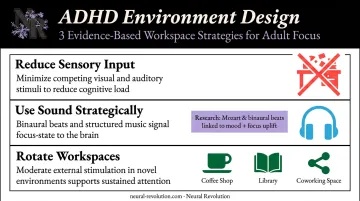
Practical environmental design principles:
- Reduce visual clutter to lower competing sensory input
- Use background sound strategically — a pilot RCT found binaural beats significantly improved studying performance in adult ADHD patients (mean difference = 2.7, p < 0.001); separate research found Mozart listening decreased negative mood in adults with ADHD
- Rotate workspaces — coffee shops, libraries, and coworking spaces provide external stimulation that combats ADHD boredom without requiring the task itself to be inherently engaging
Manage Your Digital Environment
Every notification isn't a minor distraction — it's a full context switch. For ADHD brains, the re-engagement cost after an interruption is substantial. Start with these defaults:
- Close all non-essential browser tabs before deep work sessions
- Use website blockers (Freedom, Cold Turkey) during focus blocks
- Batch email and Slack to 2–3 set check-in windows per day
- Mute all non-urgent notifications during anchor work blocks
Match Cognitive Load to Energy Windows
Executive function and attention resources deplete faster under cognitive load for ADHD brains. Schedule the highest-demand work — complex writing, client strategy, problem-solving — during your peak energy window (typically mid-morning for most people).
When that peak window closes, movement is one of the most effective resets available. Research published in Frontiers in Psychiatry found that acute aerobic exercise improved attention and processing speed in adult ADHD patients. Treat movement breaks as brain maintenance, not rewards — schedule them the same way you'd schedule a client call.
Key scheduling principles:
- Reserve complex cognitive tasks (writing, strategy, problem-solving) for your peak energy window
- Use low-demand tasks (email, invoicing, admin) to fill low-energy periods
- Build movement breaks between major work blocks, not just at end of day
When Self-Strategies Aren't Enough
Body Doubling and Accountability
External accountability changes follow-through for ADHD adults in ways that internal motivation cannot reliably replicate. A survey of 220 neurodivergent adults found that 186 of 220 respondents were more likely to finish tasks in another person's presence. Body doubling — working alongside another person, even virtually — provides social facilitation that supports task engagement when internal drive isn't sufficient.
Practical options:
- Virtual body doubling sessions (platforms like Focused Space, which is included with Neural Revolution's FOCUS Forward program)
- Accountability check-in calls with another freelancer
- Public progress updates in a community group
ADHD Coaching
If self-directed strategies haven't held, the issue isn't strategy selection — it's the absence of the external structure that makes strategies stick.
ADHD-specific coaching is meaningfully different from general productivity coaching. It's built on cognitive psychology and neuroscience rather than generic hustle frameworks. Research on a 12-session adult ADHD coaching engagement found statistically significant improvements in ADHD symptoms, executive functioning, and functional impairment, with medium-to-large effect sizes.
Neural Revolution's 1:1 coaching for ADHD freelancers and entrepreneurs addresses this directly: time blindness, task initiation, working memory systems, and sustainable client load architecture. The engagement starts with an intake session that maps your specific ADHD profile, friction points, and the operational structures your business actually needs.

Engagement structure:
- Discovery consult: 30 minutes, $0–$50 deposit applied toward your first session
- Coaching sessions: 60 minutes, $150–$250
- No long-term contract required
For freelancers who want structured support within a community, the FOCUS Forward group coaching program runs monthly with four weekly sessions and includes virtual co-working access — well-suited for independent workers who lack built-in social structure.
Outsource What Drains Your Working Memory
For tasks that reliably consume disproportionate cognitive bandwidth — invoicing, tax prep, inbox management — outsourcing isn't a luxury. It's a working memory budget decision. The goal is preserving executive function for the work only you can do.
Frequently Asked Questions
Is freelancing a good option for people with ADHD?
Freelancing suits ADHD brains well. Deadline pressure, task variety, schedule flexibility, and autonomy all sustain ADHD engagement in ways traditional employment often doesn't. Success comes from building brain-compatible systems, not forcing neurotypical productivity frameworks onto a brain that was never the target audience.
How do ADHD freelancers deal with time blindness?
Time blindness is a neurological reality, not a character flaw. Countermeasures include visual timers, backward project planning from deadlines, mandatory 20–30% time buffers, and internal pseudo-deadlines set 2–3 days before the real client deadline.
What are the best productivity tools for ADHD freelancers?
Keep tools simple and visual — Trello or Notion for project tracking, Toggl for time awareness, and Freedom or Cold Turkey for distraction blocking. The best tool is the one you'll actually use consistently, not the most feature-rich option.
Can ADHD be an advantage in freelancing?
Yes. Hyperfocus, rapid creative ideation, comfort with risk, and high-quality output under deadline pressure are genuine competitive strengths — provided you build enough structure around them to stay consistent.
How do you handle inconsistent motivation as an ADHD freelancer?
Inconsistent motivation is a feature of the ADHD interest-based nervous system, not a character flaw. Task variety, artificial urgency, micro-steps, body doubling, and scheduling around peak energy windows all help sustain momentum when drive is low.
How do you avoid burnout as a freelancer with ADHD?
ADHD burnout often follows a pattern of over-committing during high-motivation phases, then crashing. Cap your client load deliberately and treat rest and movement as brain maintenance. Build recovery time into your weekly schedule as a non-negotiable — not an afterthought.