The problem isn't willpower. When you remove the commute that signaled "work mode," the colleagues who created ambient accountability, and the physical separation between your desk and your couch, you strip away the exact external scaffolding that ADHD brains rely on to function. According to Gallup, 5 in 10 full-time U.S. employees now have remote-capable jobs — meaning this isn't a niche challenge. It's a mainstream workforce reality.
The good news: with intentional design, remote work can actually be one of the best setups for an ADHD brain. The goal isn't to fight your neurology. It's to build an environment and system your brain can genuinely work with.
This article covers not just what to do, but why each strategy works for ADHD specifically — and why standard productivity advice so often fails.
Key Takeaways
- WFH strips away the external scaffolding ADHD brains depend on — which also means you have room to build something that actually fits your brain
- Environment design is one of the most powerful and underused tools for ADHD productivity at home
- Rigid routines backfire; flexible structure uses anchor habits and external cues instead of willpower
- Managing distraction is about reducing friction, not muscling through with self-control
- Body doubling and accountability systems recreate the "someone's watching" effect that naturally regulates ADHD executive function
Why WFH Is Uniquely Hard for ADHD Brains — and When It Works in Your Favor
The office, for all its frustrations, was doing a lot of cognitive work on your behalf — without you ever noticing.
What the Office Was Actually Doing for You
ADHD is fundamentally an executive function and self-regulation challenge, as research by Dr. Russell Barkley has extensively documented. The office compensated for those gaps automatically:
- The commute created a mental transition between home and work mode
- Visible colleagues generated ambient social accountability
- Scheduled meetings externalized time markers and forced task switching
- Physical separation meant your brain associated one space with work and another with rest
None of that required effort. It just existed. WFH removes it all at once.
The Interest-Based Nervous System Problem
ADHD brains don't run on importance or willpower — they run on interest, challenge, novelty, and urgency. Without those activators built into the environment, even genuinely motivated professionals stall on tasks that feel low-stakes or routine.
The specific WFH symptoms that worsen as a result:
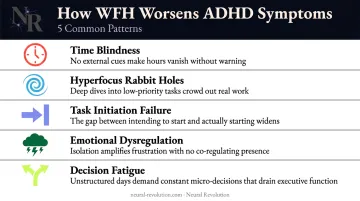
- Time blindness: hours disappear without any internal sense of their passing
- Hyperfocus rabbit holes: forgetting to eat, stop working, or switch tasks
- Task initiation failure: knowing exactly what needs doing and still not starting
- Emotional dysregulation: isolation amplifies frustration and shame spirals after unproductive stretches
- Decision fatigue: no external structure means every choice — when to start, what to work on, when to stop — falls on you
The Case for WFH When It's Designed Well
Here's the reframe worth holding onto: WFH also eliminates common office-based ADHD aggressors. Open-plan noise. Unpredictable colleague interruptions. Rigid meeting schedules that shatter flow states before they develop.
When the home environment is thoughtfully structured, it becomes one of the few places where an ADHD professional can actually design their own optimal conditions. That's not a small thing. For most ADHD brains, control over environment is the difference between a productive day and a lost one.
Design a Home Office That Acts as an External Brain
When ADHD weakens working memory and executive function, the workspace itself needs to compensate — offloading cognitive load onto the physical environment so your brain isn't carrying everything alone.
The Dedicated Workspace Principle
There's real psychological value in a space used exclusively for work. A consistent spot conditions the brain to associate that location with work mode — effectively creating an environmental cue that triggers focus without effort.
That said, some ADHD brains respond better to novelty. If you feel stagnant at the same desk every day, rotating between two or three designated spots can work. The key word is designated — not the couch where you also watch TV.
CHADD notes that small screens, limited workspace, and missing equipment make executive functioning more taxing for ADHD adults. A spacious, low-friction setup matters more than it might for neurotypical colleagues.
Sensory Setup
Sensory environment is highly individual — experiment rather than following a prescription. Common starting points:
- Noise-cancelling headphones to block unpredictable household sounds
- Brown noise or lo-fi music as a consistent audio background (research on white/pink noise for focus is mixed and largely youth-focused, so treat this as personal experimentation)
- Adequate lighting that doesn't strain attention
- Reduced visual clutter in your field of view — each visual stimulus is a potential distraction capture
Visual Cues and Analog Tools
Because ADHD working memory is fragile, the workspace should make priorities visible without requiring internal recall:
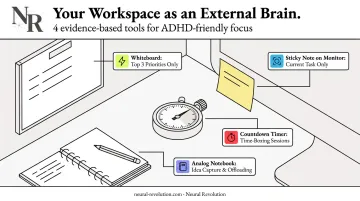
- A whiteboard with today's top three priorities in direct line of sight
- Sticky notes on the monitor showing the current task (only the current task)
- A physical countdown timer — visible time passing is more effective for ADHD brains than a phone alarm that fires once and disappears
- An analog notebook for capture, so ideas don't derail focus by demanding you track them mentally
Startup and Shutdown Rituals
Two of the biggest WFH pain points for ADHD are starting the day and stopping it. Without a commute to signal transitions, both ends of the workday become fuzzy.
A consistent five-minute startup ritual trains the brain to shift into work mode. Try:
- Reviewing the day's top three tasks
- Putting on specific focus music
- Making coffee at the desk before opening a single tab
A shutdown ritual signals that work is done and keeps hyperfocus from bleeding into personal time. Simple options: write tomorrow's top three priorities, then physically close the laptop.
Build Flexible Structure: Routines That Stick Without Suffocating You
Rigid schedules fail ADHD adults for a practical reason: they require sustained executive function to maintain, even when energy, mood, and focus fluctuate — which they do, daily, for ADHD brains.
Flexible structure works differently — it anchors the day to habits and external cues rather than demanding minute-by-minute willpower. Three design principles make that work in practice.
Anchor Habits as Time Markers
Choose two or three fixed daily events — morning coffee, a lunchtime walk, a consistent end-of-day ritual — and treat them as anchors. Work blocks get scheduled around these anchors, not the other way around.
This does two things: it reduces decision fatigue (no figuring out when to take a break) and creates natural transition cues throughout the day.
Schedule to Energy, Not Just Time
Research confirms that ADHD is strongly associated with evening chronotype and phase-delayed biological rhythms. Cognitive peak for ADHD professionals often doesn't hit until mid-morning or early afternoon.
Matching work to energy patterns:
- Peak focus windows → high-demand cognitive work (writing, analysis, strategy, creative output)
- Low-energy periods → admin, email, scheduling, routine tasks
- Transition times → built-in buffers between tasks, not crammed scheduling
Track your focus and energy for one week before locking in a schedule — your actual pattern may surprise you.
Time-Blocking That Accounts for Time Blindness
A 2023 review found that time perception is genuinely impaired in adult ADHD — this isn't a discipline issue, it's a neurological one. Practical compensations:
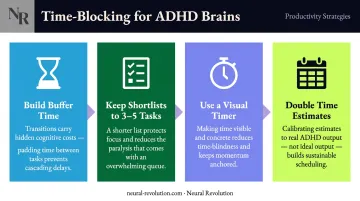
- Build buffer time between tasks — ADHD transition costs are real, and ignoring them guarantees a blown schedule
- Keep daily shortlists to 3-5 tasks, not 15-item lists that set you up to feel behind by noon
- Use a physical or visual timer instead of phone alarms — seeing time move makes it concrete
- Double your time estimates for important tasks until your numbers calibrate to actual output
Focus Protection: Managing Distractions Without White-Knuckling It
Willpower-based distraction resistance fails for ADHD brains. The dopamine pull of a notification is neurologically stronger — this isn't a character flaw, it's how the ADHD self-regulation system works. The strategy is environmental: make distraction harder to access, not resistance stronger.
Friction-Based Tools
- Website and app blockers (Freedom, Cold Turkey) scheduled during work blocks — set them before the session starts, when you have the most cognitive control
- Phone in another room or face-down during focused work
- A dedicated browser profile with only work-relevant tabs open
- Notifications off at the system level, not just muted on each app individually
The goal is reducing the number of decisions required to stay focused. Every temptation you have to consciously resist depletes the limited executive function available for actual work.
Digital distractions are only half the picture. Household interruptions operate on a different logic entirely and need their own set of solutions.
Household Interruptions as a Distinct Category
Family members, chores that catch your eye, ambient noise from other rooms — these each pull attention in ways that no browser blocker can address:
- Shared calendar showing work blocks, communicated clearly to household members
- A visual "do not disturb" signal (closed door, headphones on, a physical sign)
- Designated break times that give household members predictable windows to connect
ADHD itself can make enforcing these limits feel harder than it should. Rejection Sensitive Dysphoria — the ADHD-associated pattern where perceived social disappointment triggers a sharp emotional response — can make saying "I'm unavailable right now" feel like a relational risk. Naming it as a neurological response, not a personal failing, can make it easier to hold the boundary anyway.
ADHD-Friendly Goal-Setting and Task Management
Traditional to-do lists and SMART goals assume consistent motivation, linear time perception, and reliable working memory — none of which are reliable features of the ADHD brain. A 15-item to-do list doesn't organize priorities; it creates overwhelm and a clear path to shame.
The Task Initiation Problem
ADHD procrastination is rarely an ambition problem. It's an activation problem. "Write the client report" is not a task the ADHD brain can start — it's a project without a clear entry point.
The fix is specificity:
- ❌ "Write report"
- ✅ "Open the document and write the first bullet point"
That single micro-step dramatically reduces the activation energy needed to begin. The ADHD brain is wired to engage once it has a foothold — getting started is almost always the hardest part.
Pair this with a brain dump + daily shortlist approach: capture everything onto a master list, then commit to no more than 3-5 tasks per day. The master list handles working memory. The shortlist handles focus.
Why SMART Goals Often Backfire
SMART goals were designed for brains that experience time, motivation, and progress linearly. Most ADHD brains don't. When a rigid goal structure meets an inconsistent executive function system, the result is usually a shame spiral — not a missed deadline, but a belief that the person is the problem.
Dr. Eliza Barach developed the DREAMS™ framework as a direct alternative — built around emotional resonance, flexibility, and realistic self-knowledge rather than binary pass/fail checkpoints. Where SMART goals penalize deviation, DREAMS accounts for it. The difference isn't just structural; it's whether the goal system works with the ADHD brain or against it.
Time-Boxed Working Methods
The Pomodoro method (25-minute work / 5-minute break cycles) works well for many ADHD brains — externalized time creates urgency and prevents tasks from expanding into formless marathons. The catch: 25 minutes can be too short to build real momentum, and scheduled breaks sometimes become unscheduled hour-long detours.
Treat the interval as a starting point, not a rule. Experiment with 15-minute blocks if initiation is the main struggle, or 45-minute blocks if you need depth to produce quality work. And when genuine hyperfocus kicks in on the right task, ignore the timer entirely — that state is an asset, not something to interrupt on principle.
Accountability, Body Doubling, and Emotional Regulation
Body Doubling: Why It Works
Body doubling — working in the presence of another person — activates the ADHD brain's social regulation system in ways that solo work doesn't. The other person doesn't need to monitor you or even engage with your work. Their presence alone changes the neural context.
A 2024 survey study of neurodivergent participants documented body doubling's effectiveness for focus and follow-through. Practical options for remote workers:
- Virtual coworking platforms like Focusmate (scheduled 1:1 video work sessions)
- "Study with me" livestreams on YouTube
- A phone call with a friend working on their own tasks
- A colleague on a video call, each working independently

Accountability Structures
Beyond body doubling, external accountability structures replicate the "someone is watching" effect that office environments provided automatically:
- Morning check-ins with a colleague, sharing the day's top three intentions
- Shared goal-tracking with an accountability partner
- Scheduled end-of-day wrap-up rituals that create social commitment to stopping
ADHD coaching takes this further. At Neural Revolution, 1:1 coaching builds ongoing external accountability into a personalized system — one designed around how each client's brain actually works, not a generic productivity template applied once and forgotten.
Emotional Regulation Is a Productivity Issue
Research shows emotional dysregulation affects 30–70% of adults with ADHD and is a major source of impairment. In WFH contexts, isolation amplifies this: a frustrating hour can spiral into a written-off afternoon.
Practical regulation strategies:
- Name the emotion — labeling frustration or shame reduces its intensity
- Short physical movement — even two minutes changes the physiological state
- A daily wins log — three things that went well, reviewed at shutdown to counteract negative self-perception
Self-compassion matters here in a practical sense. Shame after an unproductive block makes re-entry harder. Neural Revolution's coaching is built around this reality: productivity failures signal a system mismatch, not a character flaw — and fixing the system is what actually moves things forward.
Frequently Asked Questions
Do people with ADHD struggle to work from home?
Yes. WFH removes the external structure ADHD brains rely on — ambient accountability, clear environmental cues, built-in transitions — making symptoms like time blindness, task initiation difficulty, and distraction more pronounced. With intentional strategies, however, the same flexibility that removes structure can be used to build better structure.
Is working from home better or worse for ADHD?
It depends entirely on how the environment is set up. WFH eliminates office-based ADHD stressors like open-plan noise and unpredictable interruptions, but removes built-in scaffolding. With deliberate environment design and anchor-habit routines, many ADHD adults find remote work more sustainable than a traditional office.
How do I stay focused while working from home with ADHD when no one is watching?
Self-directed focus is the core WFH challenge for ADHD. Body doubling, time-boxed work intervals, visual task cues (whiteboard, sticky notes), and website blockers all replicate the external accountability an office provided — without requiring willpower in the moment.
What are the best tools for ADHD remote workers?
It varies by need, but these cover the core challenges:
- Focus protection: website blockers like Freedom or Cold Turkey
- Task management: a whiteboard or short digital task list
- Time awareness: a physical visual timer
- Accountability: Focusmate or similar body-doubling platforms
The best tool is whichever one you'll actually use consistently.
What is body doubling and does it really work for ADHD?
Body doubling is working alongside another person — virtually or in-person — to activate the ADHD brain's social regulation system. The presence of someone else (even silently, on a video call) increases activation and follow-through in ways self-directed effort alone often can't. Virtual platforms like Focusmate make it practical for remote workers.
When should I consider ADHD coaching if I'm struggling with remote work?
If strategies feel inconsistent, motivation keeps collapsing, or productivity problems are affecting job performance or well-being, it's worth talking to an ADHD coach. Generic advice rarely sticks — coaching builds systems around how your specific brain operates. Neural Revolution offers a 30-minute Discovery Consult as a low-stakes starting point for high-performing professionals who want to find out if coaching is the right fit.