For adults with ADHD, this isn't a character flaw or a bad day. It's a neurological pattern called emotional dysregulation, and it's one of the most impairing — and least discussed — aspects of ADHD in adults. Research places it in roughly 34–70% of adults with ADHD, yet it doesn't appear as a core diagnostic criterion in the DSM-5. Many high-achieving adults spend years cycling through shame and confusion before they understand what's actually happening in their brain.
This post covers the neuroscience behind it, how it shows up across work and relationships, what makes it worse, and practical strategies that actually fit how the ADHD brain works.
Key Takeaways
- Emotional dysregulation is a core feature of ADHD — not a personality problem — rooted in differences between the amygdala and prefrontal cortex
- It affects 34–70% of adults with ADHD and significantly impairs careers, relationships, and quality of life
- Symptoms range from explosive anger and rapid mood shifts to Rejection Sensitive Dysphoria and emotional flooding, often cycling within a single day
- Managing it takes layered strategies — in-the-moment pauses, cognitive reframing, body-based practices, and proactive systems design
- Frequent or severe dysregulation responds faster with an ADHD-informed coach or therapist than self-help alone
What Is ADHD Emotional Dysregulation?
Emotional dysregulation is a breakdown in the brain's ability to modulate the intensity, duration, and expression of emotional responses. When that system is impaired, a critical email doesn't produce mild concern. It produces a full threat response.
The Brain Science (Made Accessible)
Two regions explain most of what's happening:
- The amygdala processes emotional stimuli and generates rapid threat responses
- The prefrontal cortex (PFC) normally acts as a brake — evaluating the signal, providing context, and dialing down the reaction
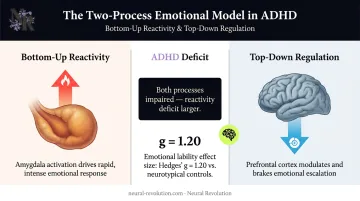
In the ADHD brain, the PFC is less active during emotional interference. Research on adults with persistent ADHD has found altered lateral prefrontal functioning during emotional processing, meaning the brake engages less reliably and the amygdala's signal can dominate unchecked.
This follows a two-process model: emotions involve a fast, bottom-up reactivity process (how intensely you feel something) and a slower, top-down regulatory process (what you do with that feeling). ADHD affects both, but the reactivity deficit may actually be larger than the regulatory deficit. ADHD brains may genuinely feel things more intensely, not just struggle to manage what they already feel. A meta-analysis found emotional lability in ADHD showed a large effect size compared to neurotypical controls (Hedges' g = 1.20).
The Diagnostic Blind Spot
The DSM-5 lists emotional dysregulation as an "associated feature" of ADHD, not a core criterion. That gap matters enormously in practice. Clinicians often attribute emotional symptoms to anxiety or depression, and many adults spend years in treatment for the wrong thing before the ADHD connection is identified.
Rejection Sensitive Dysphoria (RSD)
RSD, a term popularized by psychiatrist Dr. William Dodson, describes intense, often sudden emotional pain triggered by perceived criticism, rejection, or failure. It's not a formal DSM diagnosis, but the experience is well-documented: a 2026 qualitative study found that perceived rejection in ADHD adults produced anxiousness, despair, social withdrawal, and physical sensations like chest tightness or nausea.
For high-achieving professionals, RSD often shows up as extreme sensitivity to feedback, difficulty in performance reviews, or the inability to send work without anticipating criticism. It can be one of the most privately debilitating aspects of adult ADHD.
How ADHD Emotional Dysregulation Shows Up in Daily Life
Research on adults with ADHD identifies two broad clusters. In a study of 385 newly diagnosed adults, roughly half showed more severe emotional regulation deficits, higher psychological distress, greater negative affect, and more comorbid conditions — while the other half showed milder emotional profiles. Most adults recognize themselves in one cluster or the other, though presentations vary.
Both profiles show up across the same life domains — just at different intensities.
Across the Domains That Matter Most
At work:
- Disproportionate responses to critical feedback — a one-line comment triggers hours of rumination
- Conflict in leadership roles, particularly around unexpected changes or perceived disrespect
- Anxiety that spirals around deadlines, often escalating into paralysis
In relationships:
- Arguments that escalate faster than either person intended
- Withdrawal after perceived slights, followed by difficulty repairing the rupture
- The exhausting cycle of overreaction → shame → overcorrection
Internally:
- Shame spirals after emotional outbursts
- Rumination that extends well past the triggering event
- Chronic exhaustion from managing the emotional load that others never see
The functional impact is measurable. One study found emotional impulsiveness made a unique contribution to impairment across 7 of 10 major life domains, including occupational, financial, and interpersonal outcomes — beyond what ADHD symptoms alone predicted.
The Reframe Worth Holding Onto
The same intensity that drives dysregulation is also the source of deep passion, creative drive, and the capacity to care fiercely. Dr. Eliza Barach's approach at Neural Revolution — grounded in neurodiversity research and her own lived ADHD experience — treats this intensity as an asset, not a problem to fix. The goal is not to flatten emotions but to build enough regulation to direct them.
Common Triggers That Make Emotional Dysregulation Worse
Triggers are not random. They follow recognizable patterns — and understanding yours is the first step toward getting ahead of them.
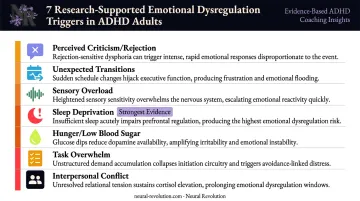
Research-supported triggers include:
- Perceived criticism or rejection: the most emotionally activating for many ADHD adults, often triggering RSD responses
- Unexpected transitions and plan changes: abrupt context shifts hit the ADHD brain harder than most people expect
- Sensory overload: sensory and emotional dysregulation are linked in ADHD, each making the other worse
- Sleep deprivation: the strongest evidence-backed trigger (more on this below)
- Hunger and low blood sugar: low blood sugar directly increases mood reactivity and irritability
- Accumulated task overwhelm: when the to-do list becomes unmanageable, emotional threshold drops
- Interpersonal conflict: especially unresolved conflict, which tends to cycle into rumination
Why Sleep Is in a Category of Its Own
Sleep deprivation doesn't just make you tired — it directly reduces prefrontal cortex regulatory capacity. Emotional flooding becomes more likely, and harder to pull back from. A study of 39 adults with ADHD found a significant positive correlation between sleep quality and emotion-regulation difficulty. When sleep goes, the brake on the amygdala weakens.
The "Emotional Debt" Problem
For high-achieving adults with ADHD, stressors tend to accumulate faster than recovery happens. Each unprocessed demand, each suppressed reaction, each skipped break adds to a running load. When that load gets heavy enough, a small trigger can produce a massive response — not because of what just happened, but because of everything that was already being carried.
That's not a character flaw. It's what happens when a nervous system that's already at capacity gets one more thing. Recognizing the pattern is what makes it possible to interrupt it before the next eruption.
Strategies to Manage ADHD Emotional Dysregulation
Effective strategies work with the ADHD brain's architecture. There's no single fix — what works is a layered approach: tools for in-the-moment regulation, recovery practices, and proactive systems design.
Building In-the-Moment Pauses
The goal of a pause isn't to suppress the emotion — it's to create a brief gap between stimulus and response so the PFC can come back online.
Practical pause strategies for ADHD adults:
- Physiological sigh: Double inhale through the nose, long slow exhale through the mouth. Research on 108 adults found this specific breathing pattern produced greater mood improvement than mindfulness meditation alone
- Physical state change: Stand up, move to a different room — the body shift interrupts the emotional cascade
- Sensory grounding: Name five things you can see, hear, or feel; this redirects attention from the internal spiral
One important caveat: once a full amygdala hijack has occurred, pausing becomes very difficult. The key is learning to recognize early warning signs — facial flushing, chest tightness, rising urgency — and intervening before the flood reaches full intensity. That early recognition is a skill, and it takes deliberate practice to build.
Reframing and Cognitive Tools
Cognitive reappraisal — reconsidering the meaning or context of a trigger to reduce its emotional charge — is among the most evidence-supported regulation strategies. Adults with ADHD tend to use it less and rely on suppression more, not because they lack insight, but because reappraisal requires working memory and cognitive flexibility that the ADHD brain doesn't always have on tap.
Making it work in practice:
- Write it down — externalizing the thought takes it out of the loop
- Say it aloud — hearing yourself name the assumption creates distance from it
- Fact-check the story — separate what is actually known from what you're inferring. "My manager didn't respond" is a fact; "my manager is angry with me" is an interpretation
The RAIN method (Recognize, Allow, Investigate, Non-identify) offers a useful mindfulness-based frame for this process. RAIN comes from contemplative practice rather than ADHD-specific research, but it maps well onto cognitive reappraisal when adapted for how the ADHD brain works.
Body-Based and Lifestyle Regulation
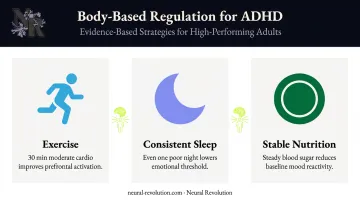
Because emotional dysregulation in ADHD is partly physiological, body-based inputs have direct impact on the brain's regulatory capacity:
- Regular cardiovascular exercise supports prefrontal and executive function; 30 minutes of moderate-intensity aerobic activity produces measurable improvements in brain activation for adults with ADHD
- Consistent sleep restores emotional threshold — even one poor night measurably lowers your emotional threshold
- Stable nutrition reduces baseline irritability reactivity
Building Proactive Systems
This is where coaching offers something that self-help rarely does: designing the environment and schedule to reduce unnecessary dysregulation triggers before they arise.
Practical systems-design moves:
- Build transition buffers between back-to-back meetings or tasks
- Schedule recovery time after high-stakes events (presentations, difficult conversations, travel)
- Create low-stakes decompression routines after socially or professionally demanding stretches
- Communicate needs proactively — in relationships and at work — so you're not managing emotional fallout from misaligned expectations
This kind of intentional design is a core focus of evidence-based ADHD coaching. At Neural Revolution, Dr. Eliza Barach's work with high-achieving professionals centers on building systems that work with the ADHD brain rather than relying on willpower to override it.
When to Seek Additional Support
Self-management strategies are valuable — but when dysregulation is frequent, intense, and impairing multiple areas of life, they may not be sufficient on their own.
Evidence-based clinical options include:
- DBT (Dialectical Behavior Therapy): The most direct psychotherapy evidence for emotional dysregulation in ADHD. A 2025 meta-analysis found DBT reduces ADHD symptoms and comorbid anxiety/depression, though authors note the evidence base still needs more research
- CBT adapted for ADHD: Includes modules for cognitive restructuring and anger/frustration management, with good evidence for residual ADHD symptoms
- Medication: Research shows small-to-moderate effects on emotional dysregulation — methylphenidate (SMD = 0.34), atomoxetine (SMD = 0.24), and lisdexamfetamine (SMD = 0.50) versus placebo. Helpful for some, but not a complete solution for bottom-up emotional reactivity
ADHD coaching occupies a distinct and complementary space. Unlike therapy, coaching focuses on building functional systems, self-awareness, and strengths-based strategies in real time. For professionals who don't need clinical treatment but do need personalized, evidence-informed support, it can be genuinely transformative.
At Neural Revolution, Dr. Cheryl Browne — a developmental psychologist, mindfulness practitioner, and ADHD coach — specializes in emotional regulation, self-compassion, and identity-based coaching, particularly for creatives, AuDHDers, and late-diagnosed adults. Her approach integrates mindfulness practice with the neuroscience of ADHD in a coaching (not clinical) context.
Research consistently shows that adults with ADHD are more likely to rely on maladaptive coping strategies — suppression, avoidance — and less likely to use adaptive ones like reappraisal. This isn't a question of insight. It reflects what they've been taught, and what they haven't. For most high-achieving adults, seeking support isn't a last resort. It's the most strategic move available.
Frequently Asked Questions
Do adults with ADHD struggle with emotional regulation?
Yes — research consistently shows emotional dysregulation affects 34–70% of adults with ADHD, linked to differences in amygdala reactivity and prefrontal regulatory function. Because it's not a core DSM criterion, it's frequently underdiagnosed and misattributed to mood disorders.
What are the 7 triggers that make ADHD worse?
The most research-supported triggers for emotional dysregulation include perceived criticism or rejection, unexpected transitions, sensory overload, sleep deprivation, hunger, accumulated task overwhelm, and interpersonal conflict. Sleep deprivation has the strongest direct evidence.
What is rejection sensitive dysphoria (RSD) in ADHD?
RSD describes an intense, often sudden emotional response to perceived rejection or criticism that can feel disproportionate to the triggering event. It's a clinician-recognized construct in ADHD communities, not a formal DSM diagnosis, but its impact on daily functioning is well-documented in qualitative research.
Can ADHD emotional dysregulation be managed without medication?
Yes. CBT, DBT, mindfulness, and ADHD coaching all have evidence for improving emotional regulation outcomes. Medication shows small-to-moderate effects for some people, but behavioral and coaching approaches provide meaningful improvement on their own for many people.
How does emotional dysregulation affect relationships for adults with ADHD?
Emotional flooding, RSD, and reactive responses can create rapid conflict escalation, communication breakdowns, and withdrawal cycles. Building shared awareness of ADHD-related emotional patterns, paired with proactive communication strategies, can reduce conflict frequency and strengthen connection over time.
Is emotional dysregulation in ADHD the same as a mood disorder?
No, though they can co-occur. ADHD emotional dysregulation tends to be fast-onset, short-duration, and tied to specific triggers. Mood disorders like depression or bipolar disorder involve more sustained shifts that aren't as directly trigger-linked. The overlap frequently causes misdiagnosis in both directions.