Introduction
You start the meeting with good intentions — notebook open, pen ready, or app pulled up. Then someone says something important, you reach for the thought, and it's already gone. You end up with three disconnected bullet points, a doodle in the margin, and a vague sense you missed something critical.
Sound familiar? This isn't a focus problem or a discipline problem. It's a systems problem.
Most note-taking advice was built for neurotypical brains — brains that can comfortably hold incoming information in mind while simultaneously filtering, sequencing, and writing it down. The ADHD brain processes information in rapid, non-linear bursts. Ask it to listen, evaluate, organize, and transcribe all at once, and something gets dropped. Usually the most important thing.
This article covers why traditional note-taking fails with ADHD, which methods actually work with your brain's chemistry, and how to build a system that holds up in the real world — not just a list of tactics you'll abandon by Thursday.
Key Takeaways:
- Working memory and executive function gaps drive note-taking difficulty — not effort or discipline
- Both handwriting and typing support learning; the only losing move is skipping notes entirely
- Non-linear methods like mind mapping often work better than rigid outlines for ADHD brains
- Separating capture from organization reduces cognitive load significantly
- A five-minute post-session review does more for retention than any elaborate filing system
Why Note-Taking Is Such a Battle for the ADHD Brain
Note-taking is cognitively demanding for everyone. Researchers Piolat, Olive, and Kellogg found that note-taking requires more cognitive effort than reading or learning because it forces simultaneous comprehension, selection, and written production. Before ADHD enters the picture, that's already a heavy load.
Add ADHD, and the load multiplies.
The Working Memory Problem
Neural Revolution describes working memory as "the limited cognitive workspace that holds active information for short-term manipulation." The ADHD brain has a smaller, more easily disrupted version of that workspace than the neurotypical brain.
In practical terms, this looks like:
- A colleague gives you three things to remember; by the time you process the second, the first has vanished
- An action item is clearly assigned in a meeting, then disappears during the walk back to your desk
- You're writing a thought down and the next sentence has already overwritten the previous one
Research by Roberts, Milich, and Fillmore found that adults with ADHD showed a larger "psychological refractory period" effect — a response-selection bottleneck that becomes particularly costly when two cognitive tasks compete for the same resources simultaneously. Real-time note-taking is exactly that kind of dual-task demand.
Executive Function and Attention Gaps
Two additional factors compound the working memory problem:
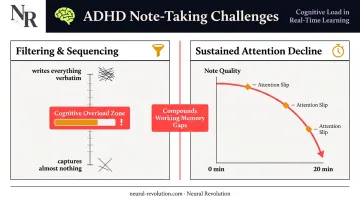
- Filtering and sequencing: Rosello et al. found that adults with ADHD showed significantly higher planning and organizational deficits than neurotypical controls. Without reliable filtering, people with ADHD often swing between two extremes — writing everything verbatim (exhausting and unusable later) or capturing almost nothing (because deciding what matters is itself overwhelming).
- Sustained attention decline: Tucha et al. found that adults with ADHD showed greater time-on-task performance decline over just 20 minutes. A single long meeting creates multiple attention slips — and each one leaves a gap in the notes.
Why Active Note-Taking Matters Anyway
A 2025 Indiana University study by Shimko and James found that not taking notes was especially detrimental as ADHD symptom severity increased. Both handwriting and typing produced comparable learning benefits — the encoding process itself (actively transcribing information) creates a retention benefit that passive listening cannot replicate.
The goal isn't to fix how your brain works. It's to design a note-taking approach that works with it.
Note-Taking Methods That Actually Work With Your ADHD Brain
Non-Linear Methods for Non-Linear Thinkers
Mind mapping is one of the most ADHD-compatible note-taking formats available. Instead of forcing a linear hierarchy the brain doesn't naturally impose, mind maps let you capture ideas as they occur and add structure afterward. The basic mechanics: write a central concept in the middle of the page, branch out to related ideas, add sub-branches as needed.
CHADD recommends mind maps specifically for adults with ADHD, noting they help with visualizing concepts, forming connections, and breaking complex topics into manageable parts. The associative, non-linear structure mirrors how many ADHD brains actually think, so there's less friction between having a thought and getting it down.
The Cornell Method works well for more structured contexts like lectures or formal meetings. The format divides a page into three zones:
- Notes column (right side): main content captured during the session
- Cue column (left margin): keywords, questions, or prompts added afterward
- Summary section (bottom): a brief synthesis written after the session ends
The built-in summary section functions as an active recall exercise — you're required to synthesize what you captured rather than just file it away. Retrieval practice — recalling information rather than passively re-reading it — is one of the most durable memory strategies cognitive science has produced.
Capture Now, Organize Later
The single most effective cognitive shift for ADHD note-takers is this: stop trying to take organized notes in real time.
Real-time organization compounds an already overloaded system. Instead, separate the two tasks:
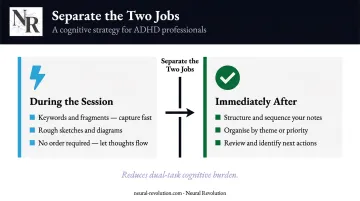
- During the session — capture keywords, fragments, quick sketches, anything that keeps you tethered to the content. Don't worry about order.
- Immediately after — spend five minutes structuring what you captured. This is when organization happens, not during.
This approach reduces the dual-task burden: listening and capturing become one job, organizing becomes a separate job done sequentially.
Color coding and visual markers support this system without adding much cognitive overhead. A consistent set of two or three symbols — a star for key points, a box for action items, a question mark for follow-ups — creates visual anchors that make later review faster. AskJAN lists color-coded systems and visual organizational tools among its ADHD workplace accommodation guidelines.
Voice and Multimodal Capturing
For many ADHD brains, speaking is faster and less demanding than writing. Voice capture removes the motor bottleneck and keeps you present in the conversation.
Tools like Otter.ai transcribe meetings in real time, flag action items, and make recordings searchable — so the details are recoverable without keeping them lodged in working memory the whole time. That's the practical value: full presence during the meeting, full documentation after it.
The combination of live participation plus audio backup is a practical middle ground for high-stakes meetings where presence matters as much as documentation.
Handwritten vs. Digital Notes: What the Research Actually Says
The handwriting-versus-typing debate has generated strong opinions, but the research is more nuanced than either camp typically acknowledges.
The 2025 Shimko and James study found:
- Both modalities produced learning benefits compared to taking no notes
- No significant learning advantage was found for handwriting over typing
- Handwriting speed was slower in students with ADHD or higher symptom severity, while typing speed showed no significant group difference between ADHD and neurotypical participants
A companion study by Shimko in Applied Cognitive Psychology added an important finding: as inattentive ADHD symptoms increased, lecture learning decreased with handwriting and increased with typing.
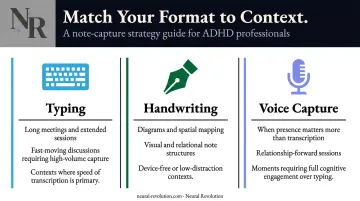
That finding has direct implications for how you choose your format. The research doesn't prescribe one tool — it suggests matching format to cognitive load and context:
| Format | When it works well |
|---|---|
| Typing | Long meetings, lectures, fast-moving discussions where handwriting speed creates a bottleneck |
| Handwriting | Quick sketches, diagrams, spatial mapping, client contexts where devices feel intrusive |
| Voice capture | Any situation where presence matters more than simultaneous transcription |
If handwriting creates more frustration than focus, switching to typing is a research-supported decision. Choose based on context and your own cognitive profile — not some inherited rule about what "serious" note-takers do.
How to Build a Note-Taking Environment That Reduces Friction
The best note-taking system is the one you'll actually use — and ADHD brains often don't start things that require more than a few steps to set up.
The underlying principle is straightforward: the less activation energy required to begin, the more likely the habit actually sticks. Designing your environment so that note-taking is the path of least resistance is the goal — not willpower, not better intentions.
Practical friction reducers:
- Keep your preferred note-taking tool already open before the meeting starts
- Use the same notebook, app, or template every time — consistency removes the setup decision
- Have your capture method ready in the same place each session, physical or digital
On sensory environment: AskJAN lists quiet workspaces and noise cancellation among recognized ADHD accommodations. Many ADHD professionals find that low-level background sound (white noise, lo-fi music) reduces distracting stimuli during focused capture. What works varies by individual — this is worth deliberate experimentation rather than following generic advice.
On tool selection: Too many app options is its own problem. Adults with ADHD show impairments in attentional set-shifting and task switching, which means researching and cycling between productivity tools has a real cognitive cost. Commit to one primary system — physical or digital. Keep the setup simple enough that starting doesn't become its own obstacle.
From Captured to Useful: Making Your Notes Work for You
Capturing notes is only half the system. The half most ADHD advice skips is retrieval.
The Review Window
Memory consolidation research — based on replications of Ebbinghaus's forgetting curve — shows that retention drops sharply within the first 24 hours without review or reactivation. For ADHD brains with working memory constraints, the gap between capture and review is particularly costly.
A five-minute review within 24 hours of any significant note session does more for retention than elaborate filing systems. The review doesn't need to be comprehensive — read, highlight, and extract. That's it.
Storage vs. Retrieval
Most note-taking advice treats storage as the goal. It isn't. Usable notes require retrieval — the ability to find and act on what you captured when it's actually relevant.
A simple approach that works without requiring heavy maintenance:
- Tag or folder by context: project name, client, meeting date — not elaborate categories
- Keep the taxonomy flat: the more levels of organization, the less likely it gets maintained
- Avoid building systems you'd need to be well-organized to maintain
The Extract and Transfer Habit
For professionals with ADHD, a note session's real output is a small number of next actions. The moment between capture and action — the walk back to your desk, the context switch to the next call — is where information most reliably disappears.
Build this into your review ritual:
- Read through your notes once
- Pull out every task, follow-up, or commitment and transfer it immediately to wherever tasks live — a to-do app, calendar, or project board
- Keep this step non-negotiable, even if the note review itself is incomplete
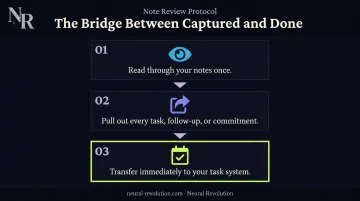
This habit is the bridge between information captured and work actually done.
When You Need More Than Tactics
Tactics help. But for high-achieving professionals with ADHD, scattered tactics rarely add up to a coherent system on their own.
The real challenge is building infrastructure calibrated to how your specific brain works — not borrowing frameworks designed for neurotypical defaults. Neural Revolution's approach addresses this at the systems level: structured capture patterns, retrieval systems, and working memory offload tools designed around the individual brain. When the structure fits, maintaining it stops feeling like a willpower problem.
Frequently Asked Questions
Is it hard for people with ADHD to take notes?
Yes — note-taking is genuinely harder with ADHD because it requires simultaneous listening, filtering, organizing, and writing, which directly taxes working memory, sustained attention, and executive function. This is a brain-design issue, not a character flaw, and targeted strategies can meaningfully close the gap.
Should people with ADHD handwrite or type their notes?
Both have learning benefits — 2025 research by Shimko and James found equivalent typing speeds for ADHD students versus slower handwriting rates. Choose based on your context and cognitive profile: if handwriting creates friction or bottlenecks, typing is a well-supported alternative.
What is the best note-taking method for ADHD?
Mind mapping and the Cornell Method are strong starting points — mind mapping suits non-linear thinking, Cornell works well for structured meetings or lectures. The most effective method is whichever one you'll actually use consistently with minimal setup friction.
What should I do when I zone out and miss important information?
Audio recording with transcription (such as Otter.ai) serves as a practical safety net — it allows you to stay present without the anxiety of missing details. A brief post-session review ritual catches gaps without requiring perfect real-time attention throughout.
How do I actually review my notes when I have ADHD?
Schedule a five-minute review within 24 hours: read through, highlight key points, and pull out any action items. Anchor it to an existing routine — right after lunch or at day's end — so you're not relying on motivation to trigger it.
Can ADHD coaching help with note-taking and organization?
Coaching addresses the systems-level challenge — helping you build personalized structures around how your brain actually processes and retrieves information. At Neural Revolution, that means practical support for executive function and sustainable follow-through, so scattered tactics become a framework that sticks.