Introduction
You finish a client presentation that wowed the room, then spend three days unable to send the follow-up email. You can architect an entire product roadmap in your head during a shower, then freeze when it's time to open the project tracking tool. Sound familiar?
This isn't a discipline problem. It's a brain architecture mismatch.
According to the CDC, 15.5 million U.S. adults — 6% of the adult population — have a current ADHD diagnosis, with 55.9% diagnosed in adulthood. Many are high-performing professionals who've built impressive careers despite, not because of, the systems they're using.
Research shows ADHD is associated with 35 lost work-performance days annually. That's not a talent gap. It's the friction between ADHD brains and neurotypical productivity frameworks.
This article explains why standard project management systems fail ADHD brains, what genuine strengths ADHD brings to project leadership, and which strategies — including the 1-3-5 rule, the 30% rule, and the 24-hour rule — create real momentum.
Key Takeaways
- ADHD brains run on an interest-based nervous system, not an importance-based one — most PM systems never account for this
- Traditional tools like rigid task lists and SMART goals create friction, not focus
- Real strategic advantages come with ADHD: hyperfocus, divergent thinking, and adaptability under pressure
- Brain-aligned strategies work by externalizing executive function rather than demanding more of it
- Neural Revolution's DREAMS™ framework outperforms SMART goals by building in motivation and emotional resonance
Why Traditional Project Management Systems Fail ADHD Brains
The Interest-Based Nervous System
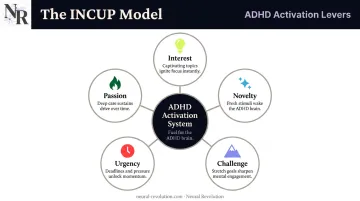
Dr. William Dodson's clinical framework describes the ADHD nervous system as interest-based rather than importance-based. Attention activates through interest, novelty, urgency, and challenge — not through logic or priority ranking.
This is why "just prioritize the most important task" fails completely. When a task isn't interesting or urgent, the ADHD brain can't generate the neurochemical ignition to start — not because of laziness, but because the brain's activation system requires a different kind of fuel.
Dodson's INCUP model (Interest, Novelty, Challenge, Urgency, Passion) captures exactly what that fuel looks like. Effective work structures for ADHD brains are built around these activation levers, not around conventional priority rankings.
Time Blindness and Task Initiation
Two other mechanisms consistently derail ADHD professionals in project work:
- Time blindness: Adult ADHD is associated with significant time-perception differences — the brain's ability to mentally project into the future and feel the passage of time is impaired, which makes deadline management, project sequencing, and duration estimation genuinely unreliable
- Task initiation failure: Thomas Brown's executive function model defines activation as organizing tasks, estimating time, and getting started. For ADHD brains, this is the highest-friction moment. Knowing exactly what to do and being able to start doing it are two separate neurological events. No amount of willpower closes that gap reliably
Why Long Task Lists Backfire
Standard PM tools hand you a comprehensive list of 40 items and expect you to begin. For an ADHD brain, that list does several damaging things at once:
- Creates overwhelm by presenting everything simultaneously
- Offers no built-in salience to trigger engagement
- Makes identifying the single next action nearly impossible
- Depletes working memory before the work even starts
Research confirms that larger memory loads reduce working-memory capacity in adults with ADHD. The solution isn't a better list — it's fewer items visible at once, clearer immediate actions, and external triggers that compensate for weak internal cues.
The Emotional Layer Most Systems Ignore
Emotion dysregulation shows up throughout the ADHD experience — and it's not a side issue in project work. Project-related anxiety, the emotional sting when momentum stalls, the overwhelm that hits when a to-do list expands: these are often the primary reason high-achievers stall on projects they're entirely capable of completing.
Standard PM frameworks treat emotional friction as irrelevant. That gap leaves ADHD professionals without support exactly when their capacity is already taxed.
The ADHD Advantage in Project Management
The same brain that struggles with routine status updates also brings capabilities that most PM frameworks can't replicate.
Divergent Thinking Under Pressure
CHADD reports that adults with ADHD showed more creativity on divergent-thinking tasks than adults without ADHD under competitive conditions. This translates directly to project value: when a project hits an unexpected obstacle, the ADHD brain's capacity to generate non-obvious solutions quickly is a genuine competitive advantage. Not a consolation prize.
Hyperfocus as a Strategic Tool
When an ADHD professional is engaged, the output can be extraordinary. Research has validated hyperfocus as a real, measurable phenomenon — intense concentration on high-interest work that produces exceptional results in compressed time.
The key is design, not luck. Hyperfocus fires reliably when work has:
- Genuine novelty that hasn't worn thin yet
- Clear stakes that create real urgency
- A compelling reason that connects the work to something that actually matters
Leaving hyperfocus to chance is what creates the 14-hour rabbit hole on a low-leverage task. Deliberately engineering the conditions for it is what makes it a strategic tool. At Neural Revolution, hyperfocus channeling is an explicit coaching focus: structuring high-leverage project work to carry the salience characteristics that earn deep engagement, rather than letting that capacity spill onto lower-priority tasks.
Adaptability and Ambiguity Tolerance
ADHD professionals are accustomed to solving problems non-linearly. In project environments that require rapid reprioritization, crisis response, or agile pivots, this becomes a clear edge. Research on ADHD and entrepreneurship suggests that traits including innovation, proactivity, and risk-taking can translate into real performance advantages, particularly where rigid, routine-bound thinking becomes a liability.
ADHD-Friendly Project Planning Strategies
The 1-3-5 Rule
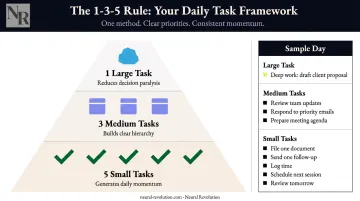
Each workday, identify 1 large task, 3 medium tasks, and 5 small tasks to complete. That's your entire day.
This works for ADHD brains because it:
- Constrains choice — reducing decision paralysis before the day starts
- Creates a clear hierarchy without overwhelming the working memory
- Builds in multiple small wins — the medium and small tasks generate dopamine that sustains momentum through the day
Example: A project manager's day might look like this:
- 1 large task: Complete the project scope document
- 3 medium tasks: Review contractor deliverables, send the client update, run the team standup
- 5 small tasks: Update the Kanban board, reply to two emails, book next week's review, file invoices, check the budget tracker
The 30% Rule
At roughly the 30% completion mark of any project, schedule a deliberate review. Assess:
- Is the project still aligned with its original goals?
- Has scope shifted without being acknowledged?
- Is the current approach still the right one?
For ADHD professionals, this counters two opposite failure modes: hyperfocusing so deep that direction drift goes unnoticed, or losing engagement once the initial novelty fades. The 30% mark is a structured checkpoint that restores engagement and catches scope creep before it compounds.
The 24-Hour Rule
When a significant project problem, conflict, or temptation to pivot arises — wait 24 hours before acting.
ADHD brains are prone to impulsive decision-making, especially under stress. Delay discounting research consistently shows that ADHD brains weight immediate rewards more heavily than future ones. The 24-hour buffer allows the prefrontal cortex to re-engage before a reactive decision derails a project mid-stream. This isn't about slowing down — it's about protecting momentum from impulsivity.
Time Externalization and Thought Dumps
Externalizing time: Analog clocks in your workspace, time-blocked calendars you can see, countdown timers on your desk. These compensate for the ADHD brain's weak internal time perception. Separate your calendar into deep-work blocks (for hyperfocus-worthy tasks) and shallow-work blocks (admin, email), and build buffer time into every estimate as a non-negotiable standard.
Thought dumps: When unrelated ideas surface during focused project work, immediately write them in a dedicated capture space — a notebook, phone note, or sticky note — then return to the task. CHADD explicitly recommends this as a working-memory offload strategy. The dump list gets reviewed at a scheduled time, not acted on immediately.
Lowering the Activation Threshold
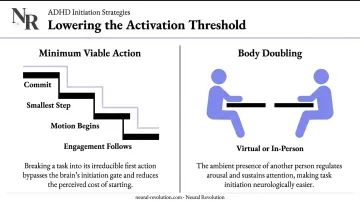
Task initiation is the highest-friction moment. Two approaches that work:
- The minimum viable action: Commit only to the smallest possible first step. Open the document. Write the first bullet. Close the browser tab. For ADHD brains, starting is the bottleneck — once motion begins, engagement often follows
- Body doubling: Working alongside another person, virtually or in-person, reduces initiation friction and increases follow-through. While formal efficacy research is still limited, it's widely used and practically effective for many ADHD professionals
ADHD Goal-Setting for Projects: The DREAMS™ Framework
Why SMART Goals Fall Short
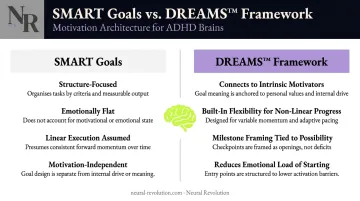
SMART goals are structured for linear, motivation-stable execution. For ADHD professionals, they tend to be emotionally flat: they describe what to do but don't connect to why it matters or what will keep you engaged when novelty fades.
Motivation isn't a character trait for people with ADHD. It's a neurochemical event tied to meaning, emotion, and salience. Abstract, future-oriented goals fail not because the professional lacks commitment — but because the goal doesn't generate enough activation signal to compete with everything else demanding attention.
When SMART goals fall short for ADHD professionals, the pattern tends to look like:
- Clear objectives that feel meaningless three weeks in
- Strong starts that stall once the novelty wears off
- Work that's technically scoped but emotionally disconnected
- Capable professionals who know what to do but can't seem to start
The DREAMS™ Framework
Dr. Eliza Barach developed the DREAMS™ framework, detailed in her book ADHD DREAMS: A Brain-Based Guide to Setting Goals That Actually Work, as a direct response to this gap. Her core conviction: traditional goal-setting systems were built for neurotypical brains, and their chronic failure for ADHDers isn't a personal shortcoming. It's a design mismatch.
Where SMART goals provide structure, DREAMS™ provides motivation architecture. The framework is built around the neurological and psychological realities of ADHD, including how the brain processes rewards, time, and priorities differently. Emotional resonance directly raises the perceived reward value of a goal, making it more likely to clear the brain's "worth-it threshold" for initiation and follow-through.
What distinguishes DREAMS™ in practice:
- Connects project goals to intrinsic motivators (identity, values, genuine excitement) rather than external obligations
- Incorporates flexibility for non-linear progress, so the framework survives the post-novelty trough that kills most ADHD projects mid-stream
- Frames milestones in terms of what they make possible, not just what they require
- Reduces the emotional load of starting complex work, which is where most capable professionals actually stall
A conventional project goal might be: "Complete the Q3 marketing report by August 31." An ADHD-aligned reframe connects that same deliverable to what completing it actually enables: the professional credibility, the client relationship, the personal standard that matters to this specific person. Then it breaks the path into steps that each carry their own engagement mechanisms.
The DREAMS™ framework is applied in Neural Revolution's 1:1 coaching sessions and integrated into the FOCUS Forward group coaching program, where members build a personalized success playbook alongside structured goal-setting support.
Dr. Barach and her team use the framework to help high-achieving professionals scope new projects, break work into sustainable phases, and re-engage with projects that have stalled, which is where capable people with ADHD most often get stuck.
Building Your Personal ADHD Project Management System
No single tool or method works for every ADHD brain. The goal is a minimum viable system that handles four functions:
| Function | What It Means |
|---|---|
| Capture | Get everything out of your head into one place |
| Clarify | Decide what actually needs to happen |
| Organize | Group by project or context |
| Review | A scheduled daily or weekly check-in |
Simpler is always better. The most sophisticated PM tool fails if the setup process itself becomes a hyperfocus rabbit hole.
Environment and Context Design
Your workspace is not neutral — it either supports or undermines initiation. Practical principles:
- Reduce visual clutter in your primary work area
- Create distinct "project zones" for different types of work
- Use visual Kanban boards to externalize project status so you never have to reconstruct where things stand from memory
- Use body doubling or coworking environments for tasks requiring sustained focus
Self-Knowledge and Iteration
The best ADHD project management system is built from understanding your brain's specific patterns:
- When do your peak focus windows occur?
- Which task types drain you fastest?
- What environmental cues reliably trigger you to start?
Your system should evolve as you learn more about your patterns — what worked in one role or season of life may need recalibrating in another. When stalling, avoidance, or overwhelm persists despite solid systems and good intentions, that's often a signal the underlying brain-based patterns need attention, not just a different app.
That's where coaching comes in. Neural Revolution works with high-performing ADHD professionals to surface the specific patterns causing projects to stall, then builds personalized infrastructure around how your brain actually operates — starting with a 30-minute discovery consult.
Frequently Asked Questions
Can people with ADHD be project managers?
Yes — and many thrive in the role. ADHD creates specific friction with certain PM demands (routine tracking, time estimation), but also provides genuine strengths — hyperfocus, creative problem-solving, and big-picture thinking — that are highly valuable in complex environments. The key is building systems designed for an ADHD brain, not forcing neurotypical frameworks.
What are the 1-3-5, 30%, and 24-hour rules and how do they help?
The 1-3-5 rule structures daily output into 1 large, 3 medium, and 5 small tasks to reduce decision paralysis. The 30% rule builds a mid-project review checkpoint to maintain alignment and re-ignite engagement. The 24-hour rule creates a buffer before reactive decisions to counter ADHD impulsivity. Together, they create a low-friction structure that works with how the ADHD brain actually operates.
Why is traditional project management so hard for ADHD brains?
Traditional PM systems assume motivation can be summoned by importance and willpower alone, while ADHD brains require interest, novelty, or urgency to activate. The mismatch between how neurotypical systems are designed and how ADHD executive function works is the core problem — not lack of skill or intelligence.
How do I stop procrastinating and start a project when I have ADHD?
Commit to the smallest possible first step — open the document, write one bullet, set a 10-minute timer. Pair it with a body double or environmental cue that signals "work mode." For ADHD brains, initiation is the highest-friction moment — once started, engagement typically follows.
What project management tools work best for ADHD professionals?
The best tool is the simplest one that handles capture, organization, and visual progress tracking. Kanban-style boards, calendar time-blocking, and analog tools like paper lists and sticky notes work well because they externalize information that ADHD working memory struggles to hold — without over-engineering your setup.
How can working with an ADHD coach help with project management?
An ADHD coach identifies the specific brain-based patterns causing your projects to stall, then builds personalized systems around those patterns rather than applying generic advice. Coaching combines accountability structure with a cognitive science framework — so changes actually stick.