ADHD adults are regularly handed time blocking as the productivity solution. And for many, it becomes one more failed experiment that quietly reinforces the belief that something is fundamentally wrong with them. That belief is wrong. The system is wrong.
Time blocking can work for ADHD brains — but not in its standard form. The conventional version was built around neurotypical executive function: the assumption that you can decide on Monday to focus from 9–11am, and your brain will simply comply. ADHD brains don't work that way. They run on interest, urgency, and reward salience — not intention alone.
This guide explains why standard time blocking breaks down neurologically, walks through a six-step ADHD-adapted approach, and covers the key variables that determine whether any system actually sticks.
Key Takeaways
- Standard time blocking fails ADHD brains because executive function is interest- and dopamine-driven, not available on demand
- ADHD-friendly time blocking uses flexible "float blocks" assigned to task categories, not specific tasks
- Energy mapping matters more than clock time — matching task type to your real focus windows is the foundation
- Build in transition time and buffer blocks; without them, the schedule cascades by midday
- When systems consistently break down despite genuine effort, the barrier is neurological, not motivational
Why Standard Time Blocking Fails ADHD Brains
Cal Newport's Deep Work popularized the time blocking model most people know: map your day in focused blocks, protect them, and your output will follow. It's a compelling framework — for brains with consistent, on-demand executive function. The ADHD brain doesn't have that.
Time Is Experienced Differently
Research on adult ADHD and time perception consistently identifies impaired time estimation and prospective time-task difficulty as core features of the condition — not peripheral inconveniences. Adults with ADHD frequently experience time as essentially two states: now and not now. A block scheduled for 2:00 PM carries no felt urgency until it arrives — or passes.
This is why ADHD clients at Neural Revolution describe their calendars as feeling "abstract" or "unreal." The blocked slot exists visually; the brain doesn't register it as approaching.
Executive Function Isn't a Consistent Resource
In ADHD, dopamine dysregulation means the capacity to initiate, sustain, and shift attention varies with sleep quality, interest level, stress, novelty, and stakes. PET imaging research by Volkow et al. found dopamine reward-pathway disruption associated with motivation deficits in ADHD adults — which is why the same task can feel effortless on Tuesday and neurologically impossible on Wednesday. A fixed time-based schedule assumes that capacity is stable. It isn't.
Hyperfocus Works Both Directions
ADHD brains don't always struggle to focus — sometimes they lock in so completely they can't stop. Research on hyperfocus in adult ADHD describes it as long-lasting, intense concentration with significant difficulty disengaging. Standard time blocking has no mechanism for managing hyperfocus overshoots. A block meant to end at 11am becomes irrelevant when your brain is still locked in at 1pm.
Rigid Schedules Can Trigger Avoidance
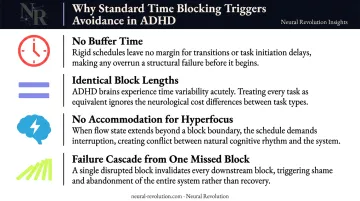
For many ADHD adults, a densely packed calendar doesn't feel like structure — it feels like a trap. When every hour is assigned and a single missed block throws off the entire day, the brain's response is often to abandon the system entirely rather than adapt it. That's not a discipline problem. It's a design problem — and it points to what an ADHD-adapted approach needs to do differently.
Common avoidance triggers built into standard time blocking:
- No buffer time between blocks, leaving zero recovery room
- Identical block lengths regardless of task complexity or energy demands
- No accommodation for variable-focus days or hyperfocus episodes
- Failure cascades where one missed block invalidates the whole day
How to Set Up ADHD-Friendly Time Blocking
The reframe here matters: ADHD-friendly time blocking isn't about scheduling every minute. It's about creating external structure that tells your brain where it is in the day and what kind of thinking is expected right now. Like a GPS, it gives direction and recalculates when you go off route — without punishing you for missing a turn.
Step 1: Brain Dump and Categorize by Cognitive Demand
Start with two phases:
- Get everything out of your head — tasks, obligations, half-formed "I should do that" thoughts — onto paper or a digital doc
- Sort by cognitive demand, not deadline:
- Deep focus work: sustained concentration, high cognitive load
- Admin and low-stakes tasks: routine, low cognitive demand
- Creative or exploratory work: high interest, scattered attention is fine
This categorization is the foundation. Each task gets matched to the brain state it actually needs — not just slotted into whatever's next on the list.
Step 2: Map Your Energy Windows
Before building any schedule, identify your actual peak focus windows — not your aspirational ones. Research consistently links ADHD in adults to a later or evening chronotype, meaning many ADHD adults who've been told they "should" be morning people are running against their own neurology.
Track your energy patterns over one to two weeks. Note when focus feels accessible versus forced. The goal is to match task type to energy type — deep focus work goes in high-executive-function windows, admin fills lower-energy periods.
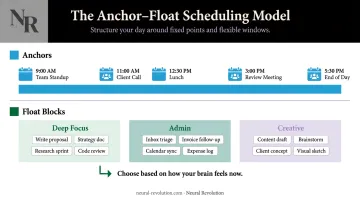
Step 3: Anchor Fixed Commitments, Then Build Float Blocks
The anchor-float model:
- Anchors go in first: meetings, appointments, school pickup — anything external and fixed
- Float blocks fill the open windows around them, each assigned to a task category rather than a specific task
Within each float block, you choose from the appropriate task pool based on how your brain actually feels at that moment. This gives structure without rigidity. If your 10am float block is "deep focus" and you're running at 60% that morning, you can pull a medium-demand task instead without the whole day collapsing.
Step 4: Build in Transition Time and Buffer Blocks
ADHD brains need more transition time than standard planners account for. A practical starting rule: estimate how long a task will take, then add 25–30% to that estimate.
Include explicit 5–10 minute transition blocks between major float blocks. These aren't wasted time — they're cognitive gear-shifting time. Without them, one task running long cascades into the rest of the day.
Step 5: Schedule Breaks as Non-Negotiable Blocks
Breaks are not rewards earned through productivity. They're a neurological requirement. Research on sustained attention in adult ADHD found stronger performance deterioration over time-on-task in ADHD adults compared to controls — meaning executive function depletes faster and needs more recovery time.
What makes a good ADHD brain break:
- Movement (particularly aerobic — acute exercise research supports attention recovery in ADHD adults)
- Sensory change: stepping outside, changing rooms
- Low-demand activity: stretching, a short walk
What masquerades as a break but doesn't restore focus:
- Doomscrolling and social media (likely maintains or increases cognitive load)
- Checking email or Slack
Breaks go on the calendar and get treated like appointments.
Step 6: The End-of-Day Reset
Ten minutes, no judgment. Every evening:
- Check what actually happened versus what was planned
- Move incomplete tasks to new float blocks
- Update your task pool lists
- Set one clear intention for tomorrow's first float block
This reset is what allows the system to survive imperfect days. A bad Tuesday stays a bad Tuesday — it doesn't have to rewrite Wednesday too.
Key Variables That Determine Whether This Actually Sticks
Two people can follow the same six steps and get completely different results. These variables are why.
Time Estimation Accuracy
ADHD adults are at elevated risk for inaccurate time estimates — systematically misjudging how long tasks take in ways that make any schedule structurally unrealistic before it starts. Neural Revolution's coaching work consistently observes clients underestimating project duration by 50–200% — not occasionally, but as a persistent pattern across tasks.
Practical fix: Track actual time spent on recurring tasks for one to two weeks before building your schedule. Use real data to set block lengths, not guesses. This is uncomfortable at first and then becomes invaluable.
Self-Knowledge of Energy Patterns
The system only works if you know when your real peak focus hours are. Many ADHD adults have internalized the belief that they should be productive in the morning — and then feel like failures when they're not. The data you track over time may reveal a completely different pattern. Invest in this self-knowledge before over-optimizing your schedule — it takes weeks to develop and saves months of friction.
Block Size and Granularity
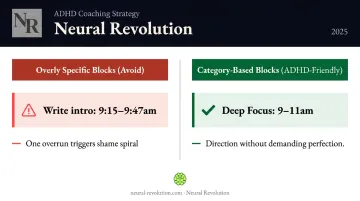
Overly specific blocks ("write introduction: 9:15–9:47am") are a setup for failure. The minute something runs two minutes long, the whole structure triggers a shame spiral.
ADHD brains do significantly better with category-based blocks — "deep focus: 9–11am" — that provide direction without demanding perfection. Block length should reflect your actual focus stamina, not an idealized 90-minute deep work session that the research doesn't support for ADHD brains anyway.
External Cues and Environmental Design
ADHD time blocking works best when paired with external anchors that do the time-awareness work your brain isn't doing automatically:
- Visual timers that show time passing visually, not just numerically
- Alarms set at block transitions, not just at deadlines
- Body doubling: working alongside someone else, virtually or in person
- Start rituals: a consistent 2–3 minute sequence that signals your brain a block is beginning
Which of these works depends entirely on your specific brain — what functions as a perfect anchor for one ADHD adult can feel pointless to another. Neural Revolution's FOCUS Forward group program includes a virtual co-working community for body doubling if that's the lever worth testing first.
Common Mistakes That Undermine ADHD Time Blocking
Over-Scheduling and Eliminating White Space
A packed calendar is a trap, not a productivity strategy. ADHD brains need unscheduled buffer space to handle hyperfocus overshoots, unexpected tasks, and cognitive recovery. A practical rule of thumb: leave at least 30–40% of your calendar unscheduled. If your calendar looks like a Tetris board, it will collapse.
Treating the Plan as a Moral Test
This is the all-or-nothing trap. When ADHD adults miss a block, they often abandon the rest of the day's schedule, interpreting the deviation as personal failure rather than normal variance.
The plan is a tool, not a measure of your worth. Moving blocks, skipping blocks, and resetting mid-day are features of the system. The goal is a system you can return to, not a perfect day.
No Exit Strategy for Hyperfocus
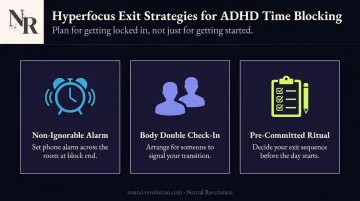
Many ADHD adults build their schedule assuming they'll struggle to start, and forget to plan for the opposite: getting lost in a task entirely. Without a hard alarm or external interruption built into deep focus blocks, hyperfocus can consume the entire day. Practical exit strategies:
- Set a non-ignorable alarm at block end (phone across the room works well)
- Arrange for a body double to check in at the scheduled transition
- Commit to a brief transition ritual before the day starts
When Time Blocking Alone Isn't Enough
Time blocking is a structural tool, not a treatment for ADHD. For some people — particularly those dealing with significant task initiation difficulties, emotional dysregulation, or rejection sensitivity — no scheduling system alone will be sufficient.
Three approaches — ranging from light structural add-ons to more individualized support — can fill the gaps where time blocking falls short:
Pomodoro Technique
Structured work sprints (25 minutes on, 5 minutes off) can be layered inside float blocks for ADHD adults who struggle to initiate tasks within a block. Works best when the task type is clear but starting feels neurologically impossible. Evidence comes primarily from qualitative coping research rather than clinical trials, but the structure is simple enough to test without much risk.
Task Batching Without Fixed Times
For ADHD adults who find any time-based structure aversive, a looser version works — task pools with no clock assignments, worked through based on energy and interest. The tradeoff: without time anchors protecting them, important tasks can get perpetually deprioritized.
ADHD Coaching
When self-directed systems consistently break down despite genuine effort, it often signals that the underlying executive function barriers need individualized attention — not more willpower or a different app. That's where coaching becomes relevant.
Neural Revolution's coaches, led by Dr. Eliza Barach (PhD in cognitive psychology, Board Certified Coach, ADHD-diagnosed at 17), work with high-performing ADHD professionals to pinpoint what's specifically getting in the way and build systems around their actual neurology — not a generic template.
Conclusion
Time blocking can be a genuinely useful tool for ADHD brains — but only when it's redesigned to work with ADHD neurology rather than demanding the ADHD brain perform like a neurotypical one.
Most time blocking failures aren't about discipline. They're about using a system that was never designed for how ADHD executive function actually works. Adjusting the system — not applying more willpower to a broken one — is what actually changes the outcome.
Start small. One or two float blocks a day. Track what's real. Adjust from there. A system that holds up on a hard Tuesday is worth far more than a perfect one you abandoned by Wednesday.
Frequently Asked Questions
Is time blocking bad for ADHD?
Standard time blocking is often poorly suited to ADHD brains because it assumes consistent, on-demand executive function — which ADHD brains don't have. An adapted version with flexible float blocks, energy mapping, and built-in buffer time can be highly effective.
How long should time blocks be for ADHD?
There's no universal answer — block length should reflect your real focus stamina, which varies by person and task type. A reasonable starting point is 30–60 minute blocks for deep focus work, with explicit transition buffers between them. The 90-minute blocks common in general productivity literature aren't supported by ADHD-specific research.
What is the best time management method for ADHD?
No single method works for all ADHD brains. The approaches that consistently outperform rigid calendar-based systems share a few traits: external structure, visual time awareness, flexible scheduling by energy and interest, and low shame when plans change. Time blocking, Pomodoro, and task batching each have a role depending on the person and the day.
How do you time block when you have ADHD and time blindness?
The key modification is pairing time blocking with external time cues — visual timers, countdown alarms, auditory cues — so the schedule doesn't rely on an internal sense of time passing. Also, calibrate block lengths using tracked data from real past performance, not estimates, to compensate for ADHD's tendency toward inaccurate time estimation.
Why do people with ADHD struggle with scheduling?
Scheduling difficulty in ADHD is neurological, not motivational. It stems from impaired time perception, dopamine-dependent executive function, and difficulty sustaining the mental future-orientation that planning requires. Schedules designed for neurotypical executive function — consistent, on-demand attention — are a structural mismatch for an ADHD brain whose focus depends on interest, urgency, and novelty.
Can I use a regular calendar app for ADHD time blocking?
Yes — any calendar tool works, including Google Calendar or a paper planner, as long as it makes time visually explicit and is easy to adjust. The key is choosing something with low friction to update. ADHD adults are significantly more likely to abandon systems that are cumbersome to rearrange when — not if — plans change.