This isn't a discipline problem, and it isn't attitude. It's how the ADHD brain operates.
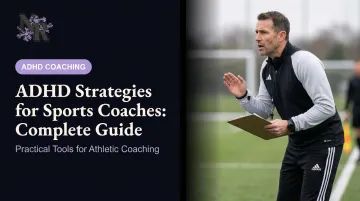
According to the CDC, 11.3% of U.S. children ages 5–17 have been diagnosed with ADHD — that's roughly 7.1 million kids, many of whom are on your roster right now. Yet most coaches receive little to no training on how to support these athletes. Without the right adjustments, ADHD athletes are at higher risk of disengaging, losing confidence, or walking away from sport altogether.
This guide covers what you actually need: how the ADHD brain works, why sports environments make symptoms more visible, practical strategies for practice and game day, communication techniques that land, and how to handle emotional moments without losing the relationship.
Key Takeaways
- ADHD shows up as inattention, impulsivity, and emotional reactivity — not laziness or poor attitude
- Structured sessions, visual cues, and single-step instructions dramatically improve engagement
- ADHD athletes bring real strengths — hyperfocus, energy, competitive drive, and resilience — that coaches can learn to channel
- Immediate, specific, and private feedback works far better than public correction or delayed praise
- Emotional dysregulation is neurological — build regulation strategies into your sessions before you need them
What Coaches Need to Know About the ADHD Brain
ADHD is a neurodevelopmental difference in how the brain regulates dopamine and executive function — not a gap in intelligence or effort. The CDC describes three presentations:
- Inattentive: difficulty sustaining focus, following multi-step directions, and completing tasks
- Hyperactive-impulsive: excessive movement, interrupting, acting before thinking
- Combined: features of both
Any athlete on your team may show one, two, or all three patterns, and the mix often looks different in sport than it does in a classroom.
How ADHD Shows Up on the Field
On the field or court, ADHD symptoms tend to surface as:
- Zoning out during downtime between plays or drills
- Following only part of a multi-step instruction (usually the first or last step)
- Impulsive decisions mid-play — shooting early, jumping a route, committing to the wrong read
- Explosive or withdrawn reactions after mistakes
- Difficulty switching mentally between activities
These aren't choices. They're neurological. Research confirms that ADHD involves complex differences in monoaminergic neurotransmission, affecting how the brain sustains attention, inhibits impulses, and regulates emotional response. Those aren't character flaws. They're structural features of how the ADHD brain is built.
Why Sports Environments Are Especially Hard
Sports create specific conditions where ADHD symptoms become most visible:
- Variable attention demands (high intensity, then waiting, then high intensity again)
- Multi-step tactical instructions delivered quickly
- Extended low-activity periods — bench time, outfield, set plays — where focus drifts
- High emotional stakes that amplify reactivity
Coaches who understand these conditions can adjust their approach before frustration sets in on either side — and that shift makes a measurable difference in how ADHD athletes perform and stay engaged.
ADHD as a Sporting Advantage: Reframing What You See on the Field
Here's what the research actually shows: ADHD traits and elite athletic performance aren't in conflict. A 2019 review estimated ADHD prevalence among elite athletes at 7–8%, and a 2021 study found prevalence estimates ranging from 4.2% to 14.1% in young athlete populations. That's not coincidence.
The same traits that create friction in structured environments can be genuine competitive assets:
- Hyperfocus activates in high-stimulation, goal-oriented settings — which is exactly what competitive sport provides
- High physical energy and a bias toward action translate to intensity and hustle
- Impulsivity, channeled correctly, looks like fast reaction time and instinctive play-reading
- Emotional intensity becomes competitive fire and the refusal to quit
Reframing Common Coaching Frustrations
| What you see | What it might actually be |
|---|---|
| "Can't focus during drills" | First to spot an unexpected gap in the defense |
| "Overreacts to everything" | Plays with extraordinary passion and won't back down |
| "Impulsive decision-making" | Fast-twitch processing that wins split-second moments |
| "Disruptive during downtime" | High activation level that needs direction, not suppression |
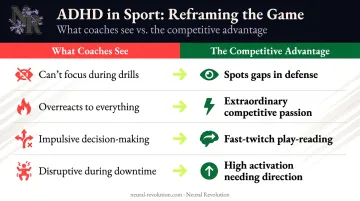
A strength-based approach doesn't mean lowering expectations. It means designing an environment where the athlete's best qualities activate consistently. This is the core philosophy behind effective ADHD coaching, and it's the approach Neural Revolution uses to help ADHD individuals harness their brain chemistry rather than fight it.
Dr. Eliza Barach, Neural Revolution's founder, competed as a nationally ranked gymnast and Division 1 athlete with ADHD — approaching her diagnosis not as a limitation but as an operating system that needed the right instructions.
Coaches who learn to channel these tendencies — rather than suppress them — consistently get better results from their athletes.
How to Structure Practices for ADHD Athletes
Minimize Wait Time and Keep Sessions Up-Tempo
Idle time is disproportionately costly for ADHD athletes. When dopamine drops, attention drifts fast, and disruptive behavior tends to fill the gap. If an athlete has nothing to do, they will find something to do.
Design drills and rotations so athletes stay continuously active. When waiting is unavoidable, assign active waiting tasks:
- Count passes or defensive resets
- Track a specific opponent's movement pattern
- Manage equipment or assist in demonstrating the next drill
These tasks keep the ADHD brain tied to the game, and the observations often yield useful tactical information.
Post and Review a Session Plan
Uncertainty about what comes next creates anxiety that impairs focus. A simple whiteboard agenda — even four or five bullet points — gives athletes a cognitive map that reduces transition friction. A 2022 review found visual activity schedules improved on-task behavior and transition behavior in children with ADHD.
When possible, share the plan in advance via a team app or locker room posting. Predictability isn't rigidity. Knowing the structure frees up mental bandwidth for execution.
Give One Instruction at a Time
A 2017 study found children with ADHD showed impaired working memory for multi-step instructions compared to typically developing peers. A three-step direction may result in only the first or last step being retained.
Break all directions into single steps and confirm comprehension before moving on. Position ADHD athletes near the front of the group or as the demonstration model when introducing new drills. Proximity to the coach improves attention; active participation in the demo reinforces understanding.
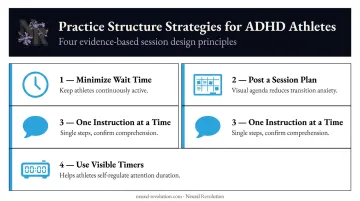
Use Visible Timers and Predictable Transitions
ADHD athletes often struggle with time perception, not because they're careless, but because time blindness is a documented neurological feature of ADHD. Making a clock or timer visible during drills lets athletes self-regulate: they know exactly how long they need to sustain focus.
Build short, consistent transition rituals that signal shifts in activity. A specific whistle pattern, a call-and-response phrase, or a physical cue all work. Consistent signals reduce the dysregulation that often spikes at transition points.
In-Game Strategies to Keep ADHD Athletes Focused and Engaged
Assign Active Attention Tasks During Downtime
Bench time, low-activity fielding positions, and waiting for a substitution are peak vulnerability periods for ADHD athletes. Rather than hoping they stay engaged, assign specific observation tasks:
- Track how many times the opponent passes before shooting
- Watch for a specific defensive player's positioning habit
- Count resets after a turnover
Make these verbal check-ins so you can confirm engagement. The dual benefit: the athlete stays mentally in the game, and their observations can give you actual tactical information.
Use Discreet Visual and Auditory Cues
Public redirection in front of teammates damages trust and confidence. A private signal system achieves the same result without the social cost. Develop cues in practice so they become automatic:
- A specific hand gesture that means "reset your focus"
- A pre-agreed word or tap on the shoulder for redirection
- A fist bump that signals "slow down and read the play"
Once these cues are automatic, you can redirect an athlete mid-game without breaking their rhythm — or their confidence.
Encourage Controlled, Purposeful Movement
A 2024 study found that fidgeting during cognitively demanding tasks was associated with better performance in ADHD, suggesting movement helps regulate attention rather than distract from it. Trying to eliminate it entirely tends to backfire, adding frustration without improving focus.
Instead, teach channeled movement: quick leg taps, a specific ready-stance that builds in slight motion, controlled finger movements. Physical self-regulation should be permitted and actively directed.
Build a "Reset" Protocol for Moments of Overwhelm
High-stimulation game environments — missed plays, crowd noise, conflict with a teammate — can tip ADHD athletes into dysregulation fast. Pre-establish a brief, non-punitive break option before you need it:
- A designated spot on the bench with no pressure attached
- A signal the athlete can give the coach when they need a moment
- A short task (grab water, adjust equipment) that creates space to reset
- A simple 3-breath cue they can use without leaving the field
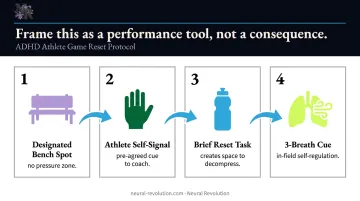
Frame this as a performance tool, not a consequence. Athletes who have a practiced reset routine are far more likely to self-regulate in the moment — which is the whole point.
How to Give Feedback and Communicate with ADHD Athletes
Make Feedback Immediate and Specific
Delayed feedback is significantly less effective for ADHD athletes. Working memory limitations make it hard to connect feedback to the original action once time has passed. The closer to the moment of performance, the better.
Specific feedback sounds like: "Great job watching the ball all the way in — now try bringing your elbow up."
Vague feedback sounds like: "Nice try, work on your form."
The first gives the ADHD brain something concrete to act on. The second doesn't.
Use the Private Check-In Habit
After giving group instructions, briefly check in with ADHD athletes — not to single them out, but to ask what they're thinking about for the drill. This surfaces confusion before it becomes a mistake on the field, and it signals that you're invested in their success.
Frame it collaboratively: "What are you focusing on for this one?" rather than "Did you understand?" The first opens a dialogue. The second just invites a yes or no.
Lead With Strengths in Every Conversation
A simple feedback formula that works well with ADHD athletes:
- Open with a specific strength or correct behavior you observed
- Address one area to improve
- Close with confidence in their ability to execute
This structure protects motivation and reduces the sting of rejection sensitivity, which we'll cover in the next section. For athletes who carry shame around their ADHD — and many do — a coach who consistently finds and names their strengths can be relationship-changing.
Communicate with Parents as Partners
That same investment in the athlete extends beyond the field. Parents are your best source of information about what works, and a brief conversation at the start of a season covering three questions makes a real difference:
- What does this athlete do well?
- What do they find hardest?
- What strategies have worked or failed in the past?
Keep it two-way. You share your coaching approach; they share the athlete's context. For families whose athletes need more structured support off the field, adult ADHD coaching — such as the evidence-based work done at Neural Revolution — can help with executive function and self-advocacy as athletes move into adult performance contexts.
Managing Emotional Regulation and Setbacks
Emotional dysregulation in ADHD is neurological, not a temperament problem. Research identifies dysfunction in the amygdala, ventral striatum, and orbitofrontal cortex as underlying drivers — meaning emotional reactions can be faster, more intense, and harder to recover from than in neurotypical peers.
Understanding Rejection Sensitive Dysphoria (RSD)
Many ADHD athletes experience rejection sensitive dysphoria — an acute emotional response to perceived criticism, exclusion, or failure that can feel almost physical in intensity. A coach who doesn't know about RSD may interpret an athlete's shutdown or outburst as defiance. Understanding it changes the response entirely.
RSD doesn't require actual rejection to trigger — perceived criticism is enough. A tone of voice, a substitution, a look from a teammate can set it off.
Three Practical Tools for Emotional Moments
Knowing RSD exists is only half the work — the other half is having a plan before emotions escalate. These tools give coaches something concrete to reach for.
Name the emotional climate before high-stakes moments. Before a big game: "I know this feels intense — let's talk about how we want to handle mistakes today." Proactive naming gives athletes a framework before they're flooded with emotion.
Avoid public correction. The combination of ADHD and RSD means criticism in front of teammates lands harder and lingers longer than it does for neurotypical athletes. One comment can derail the rest of their performance.
Normalize emotional recovery. After a dysregulated moment, check in privately. Give the athlete a chance to name what happened, then move forward — the goal is reconnection, not a post-mortem.
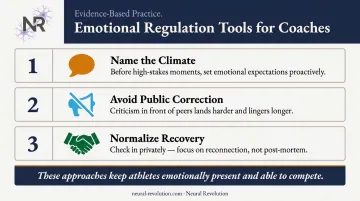
Used consistently, these approaches don't lower the bar. They keep athletes emotionally present and able to compete.
Frequently Asked Questions
What are the biggest challenges ADHD athletes face in team sports?
The four most common are: losing attention during low-activity moments, difficulty following multi-step instructions, impulsive in-game decisions, and emotional dysregulation after mistakes. Each is manageable with consistent structural adjustments. None require lowering competitive expectations.
How do I give instructions without losing an ADHD athlete's attention?
Give one direction at a time, pair verbal instruction with a physical demonstration, and check in privately to confirm comprehension. Positioning the athlete near you and using them as a demonstrator helps too — active participation reinforces understanding better than listening alone.
Should I tell the rest of the team that a player has ADHD?
Disclosure is the athlete's and family's decision, not the coach's. Focus on building a team culture where different needs are normalized, not on labeling individual athletes to their peers. You can model inclusive behavior without announcing diagnoses.
How do I handle an emotional outburst during a game?
Stay calm, avoid public confrontation, and use whatever pre-established reset signal or break protocol you've built together. Don't try to process what happened in the heat of the moment — follow up privately afterward, give the athlete space to talk through what happened, and move forward.
Are individual sports better for athletes with ADHD?
There's no universal answer. Individual sports with continuous movement — martial arts, swimming, gymnastics, track — tend to suit ADHD athletes well because they eliminate waiting and maintain high stimulation. But many ADHD athletes thrive in team sports with the right structure and coaching.
How do I know if behavior is ADHD-related or a discipline issue?
ADHD behaviors are consistent, involuntary, and show up across multiple contexts — not just with one coach or in one type of situation. If an athlete struggles persistently despite clear expectations and genuine effort, it's worth a conversation with parents and potentially a professional evaluation rather than escalating consequences.