Introduction
You know your material cold. You've thought about this topic from every angle, probably more than anyone else in the room. Then you stand up to present — and something shifts.
Thoughts accelerate. The structure you rehearsed starts to splinter. Words that were perfectly organized five minutes ago now feel just out of reach.
Public speaking places extreme demands on exactly the executive function systems that ADHD disrupts — working memory, impulse control, pacing, self-monitoring — all at once, in real time, in front of an audience. That's a cognitive mismatch, not a competence gap.
According to the WHO World Mental Health Survey Initiative, adults with ADHD lose an average of 22.1 excess role-performance days per year compared to otherwise similar workers. Without tools built for how the ADHD brain actually operates, high-stakes presentations become one of the most costly recurring drains on professional performance.
This article covers what's happening neurologically when ADHD meets public speaking, the genuine strengths ADHD brings to the stage, and a concrete preparation and delivery system that works with your neurology — not despite it.
Key Takeaways
- ADHD disrupts public speaking through executive function gaps — not through lack of knowledge or preparation
- High energy, rapid ideation, and narrative thinking are genuine ADHD advantages when paired with the right structure
- External scaffolding (cue cards, anchor phrases, visual outlines) outperforms memorized scripts for ADHD brains
- Deliberate pauses and breath anchors are high-leverage delivery tools, not just comfort techniques
- An ADHD-specialized coach helps you build a personalized speaking system that actually holds up under pressure
How ADHD Affects Public Speaking: What's Actually Happening in Your Brain
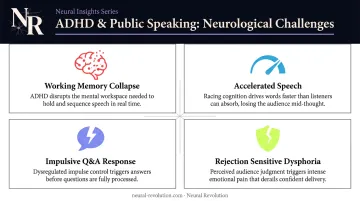
Public speaking stacks more executive function demands than almost any other professional task. You're simultaneously holding your structure in working memory, filtering what to include versus omit, regulating your pace, monitoring audience response, and managing physical anxiety. For ADHD brains, that concurrent load creates a genuine neurological bottleneck.
The Working Memory Problem
Research on ADHD and working memory identifies marked central executive deficits as a core feature of the condition. When you add the cognitive load of live performance, the "holding space" for your next point can simply collapse — not because you forgot the material, but because the retrieval pathway gets disrupted by everything else the brain is managing simultaneously.
This is why ADHD professionals lose their train of thought mid-sentence on topics they know thoroughly. The knowledge is there; real-time access to it collapses under cognitive load.
Why You Speed Up Instead of Slow Down
ADHD attention is interest-based. The arousal of a live audience — pressure, novelty, the energy in the room — doesn't calm the ADHD brain. It accelerates it. Thought generation speeds up, widening the gap between how fast ideas arrive and how fast speech can carry them. What feels internally like urgent, exciting clarity often reads externally as rushing.
The Q&A Dimension
ADHD pattern-matching is fast. Responses begin forming before a question finishes — occasionally answering a predicted question rather than the actual one asked. A 2023 study on response inhibition in adults with ADHD found significantly impaired response inhibition compared to controls, with longer Stop-Signal Response Times indicating difficulty slowing the impulse to respond. This is a speed calibration issue, not a listening deficit.
The RSD Layer
Many ADHD professionals carry an additional layer into the room: rejection sensitive dysphoria (RSD). The Cleveland Clinic links RSD to ADHD, describing it as intense emotional pain triggered by perceived rejection or disapproval — including vague interactions that may not even be negative. A qualitative study found that ADHD adults describing RSD reported rumination, self-blame, and somatic distress following perceived social failure.
One stumble, one distracted audience member, one moment of blank silence — and the internal shame response can be disproportionate enough to disrupt the rest of the talk. That's not a character flaw. It's a neurological pattern — and one you can build specific contingencies around.
The ADHD Speaking Edge: Strengths That Make You Memorable
The traits that make public speaking harder for ADHD professionals are often the same ones that make them genuinely compelling speakers — once they know how to use them.
Rapid, Associative Thinking
The racing mind that makes linear structure difficult also produces unexpected connections, original angles, and genuine intellectual energy that audiences can feel. Polished, scripted speakers rarely generate this quality of live thinking. Channeled rather than suppressed, it produces the kind of spontaneous insight that no amount of rehearsal can replicate.
Narrative by Default
ADHD brains naturally think in examples, stories, and analogies rather than abstract categories. This is a speaking advantage. A 2024 empirical study confirmed that stories enhance comprehension, retention, and persuasion — which means the ADHD brain's default associative mode is already wired for communication that sticks.
Hyperfocus as Presence
Hyperfocus — a state of heightened, focused attention frequently reported by people with ADHD — can transform a presentation when the topic genuinely matters to the speaker. ADHD professionals speaking on subjects they care deeply about often describe a quality of presence that's nearly impossible to manufacture. The audience feels it.
That said, passion alone doesn't close the deal. Research on business-plan presentations found that preparedness — not energy — drove positive outcomes. The goal is both: genuine engagement backed by solid structure.
Before You Speak: Building an ADHD-Friendly Preparation System
Most ADHD professionals prepare the wrong way — they try to generate content and organize it at the same time. That dual-task demand overloads working memory before the first rehearsal begins.
Phase One: The Brain Dump
Separate idea generation from organization entirely. Get everything out first — uncensored, unordered. Voice memos, sticky notes, a whiteboard, a chaotic document — whatever lets you externalize without simultaneously judging. Once it's all out, then you shape it.
Trying to do both at once splits attention across two cognitively expensive tasks. Doing them in sequence removes that tax entirely.
The "One Thing" Anchor
Before you build anything, identify one central message: what should your audience leave knowing or doing that they didn't before? Write it in a single sentence. This becomes your cognitive anchor during both preparation and live delivery. Every slide, story, and point should serve that one thing. Anything that doesn't? Cut it without guilt.
External Structure Over Internal Scripts
Memorizing a word-for-word script seems like the safest option — until it isn't. Scripts collapse under deviation. One unexpected question, one skipped slide, and the whole structure falls apart because it was held internally.
What works better for ADHD brains:
- Keyword cue cards — single words or phrases that trigger the point, not full sentences
- Visual outlines — a one-page map of the flow you can glance at during delivery
- Anchor phrases — short verbal transitions that orient you ("The second piece of this is...") and buy a moment to locate the next point
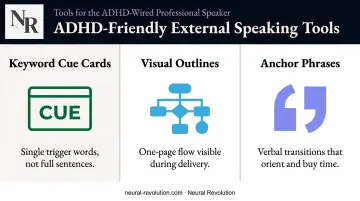
As Dr. Russell Barkley's research on executive function consistently shows, adults with ADHD are best supported by externalizing information that would otherwise need to be held internally: making it physical, visible, and present at the point of performance.
Rehearse Out Loud, With a Timer
Reading notes silently is not rehearsal. It doesn't reveal pacing, it doesn't expose which transitions are rough, and it doesn't load the retrieval pathways the way live delivery does.
Rehearse out loud. Record yourself. Build in deliberate time markers: "I should be finishing point two by minute eight." ADHD professionals consistently underestimate how long sections take when spoken aloud. Time blindness affects rehearsal as much as any other task. Neural Revolution's coaching work with high-performing professionals documents time underestimation of 50–200% as a consistent ADHD pattern. Building external time scaffolding into the actual talk compensates for this directly.
Working with an ADHD coach can help you build a preparation system calibrated to your specific executive function profile — how you initiate tasks, sustain focus during rehearsal, and structure content in a way that actually holds under pressure.
In the Room: Real-Time Strategies for ADHD Professionals
Managing Pacing, Focus, and Delivery
The pause is your primary tool. Deliberate pauses serve two functions at once: they give you a moment to locate your next anchor point, and they give your audience time to absorb what you just said. Research on speech rate and pause duration shows that pauses at natural syntactic boundaries — between sentences or phrases — support listener comprehension and perceived effectiveness.
The discomfort of pausing is real. It feels much longer from the inside than it registers externally. Build pause points into your talk's physical structure — mark them on your cue cards — rather than relying on remembering to pause under pressure.
Breath as a pacing mechanism. Slow, controlled breathing before you start and during transitions activates the parasympathetic nervous system, counterbalancing the high sympathetic arousal that drives accelerated speech. A 2023 review of breathing interventions confirmed parasympathetic support as a reliable physiological effect. Use it at any transition point in the talk — not just the start.
Q&A: pause, paraphrase, then answer. Make this a consistent habit:
- Pause after the question ends — full stop, no rushing in.
- Paraphrase it back before answering.
- Answer from a place of organized thought, not impulse.
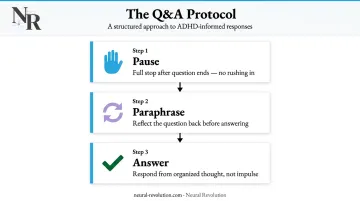
This slows the ADHD response reflex and confirms you heard what was actually asked (not what you anticipated). You won't appear hesitant — you'll appear considered.
When Things Go Sideways
Losing the thread mid-talk is a predictable event for ADHD speakers, not a failure. The recovery strategy is not trying to find exactly where you left off. Return to your "one thing" anchor — your central message — and re-enter the talk from there. Any point in your structure connects back to the one thing, so you're never actually lost.
The RSD spiral mid-talk is trickier. A stumble, an awkward silence, one person checking their phone — and suddenly the shame response is louder than the presentation. Before you go on stage, design a return phrase: a simple internal signal that interrupts the spiral and redirects focus to the next point rather than the mistake. It can be as simple as "next point" said silently, or a physical anchor like touching your notes.
Frequently Asked Questions
Are people with ADHD good at public speaking?
Many are. ADHD traits like intellectual energy, creative thinking, and authentic engagement are genuine advantages on stage. The key is pairing those strengths with a preparation system that supports the ADHD brain — not one designed for how neurotypical speakers work.
Do people with ADHD tend to be talkative?
ADHD can drive talkativeness through impulsivity, rapid ideation, and difficulty filtering which thoughts to voice. With the right structure, that verbal energy becomes an asset — ADHD speakers often land as dynamic and engaging rather than hard to follow.
Why do I lose my train of thought mid-presentation even when I know my material cold?
This is a working memory issue under cognitive load. The knowledge is intact — but the retrieval pathway gets disrupted when your brain is simultaneously managing delivery, audience monitoring, and pacing. External cues like keyword cards and anchor phrases reduce that load directly.
How can I slow down my speaking pace when my ADHD thoughts race ahead?
Record your rehearsals — perceived pace and actual pace are often very different. Build deliberate pause points into your structure rather than intending to pause. Use breath at transitions as a physical pacer, not a willpower-dependent intention.
What is the best way to prepare for a presentation when you have ADHD?
Two phases: brain dump first (everything out, unordered), then shape around one central message. Rehearse out loud with a timer rather than reviewing notes silently — out-loud rehearsal loads the actual retrieval pathways you'll need in the room.
How does ADHD coaching help with public speaking skills?
An ADHD coach identifies which executive function patterns affect your speaking — working memory gaps, impulsivity, time blindness, or RSD — then builds a preparation and delivery system around your specific profile. The result is a speaking approach that works with how your brain operates, not against it.