This isn't a character flaw. For adults with ADHD, this gap between external performance and internal self-perception is one of the most common — and least discussed — experiences in the room.
Research published in the Journal of Attention Disorders found that 5 of 6 controlled studies reported significantly lower self-esteem scores in adults with ADHD compared to neurotypical peers. That's not a motivational problem. That's a documented pattern with identifiable roots.
This article covers why low self-esteem and ADHD are so deeply linked, why high achievers are particularly vulnerable, what neuroscience actually explains about the experience, and what strategies genuinely work for building confidence when your brain runs on different wiring.
Key Takeaways
- Low self-esteem in ADHD adults comes from years of being misread and penalized in neurotypical environments — not personal failure
- The high-achiever paradox (looking capable, feeling fraudulent) is especially common in ADHD professionals
- Real confidence builds through genuine wins and brain-aligned systems, not affirmations or willpower
- Treating ADHD as a neurobiological difference — not a character flaw — is where lasting confidence starts
- ADHD-specific coaching drives behavior change that generic self-help rarely achieves
Why ADHD and Low Self-Esteem Are So Deeply Linked
This connection isn't accidental — it's the predictable result of years spent in environments that weren't designed for how your brain works.
Children with ADHD receive a disproportionate amount of corrective feedback early in life. A widely cited clinical estimate suggests as many as 20,000 additional critical comments before age 12 (referenced in CHADD's Attention Magazine by Dr. William Dodson, though this is a clinical estimate rather than peer-reviewed epidemiological data).
What matters more than the exact number is the cumulative effect: repeated negative feedback doesn't stay external. It gets internalized as identity.
The ADHD brain begins translating "you're not doing this right" into "I am the problem."
This dynamic compounds in school and work settings. You genuinely try. You repeatedly fall short of external standards — not because of effort, but because the strategies being demanded don't match how your brain operates. The message: try harder. This breeds chronic self-blame rather than the strategic adaptation that would actually help.
Rejection Sensitive Dysphoria: The Hidden Driver
Rejection Sensitive Dysphoria (RSD) is one of the least recognized contributors to ADHD self-esteem damage. A qualitative study of 43 adults with ADHD (Ginapp et al., 2023, PLOS ONE) found that the majority described RSD as a central feature of their experience: intense emotional pain in response to perceived criticism, rejection, or failure, accompanied by self-blame and rumination.
RSD is not oversensitivity. It's a neurologically driven feature of ADHD, not a personality problem.
For late-diagnosed adults, the picture is even more complex. By the time many people receive a diagnosis in their 30s, 40s, or 50s, they've already built an identity around being "too much," "not enough," or "difficult."
Research by Carr-Fanning and McGuckin (2025) describes adult ADHD diagnosis as a meaning-making process involving both relief and grief: relief that there's finally an explanation, and grief for the years spent in unnecessary self-blame.
The Compounding Cycle: How ADHD Symptoms Feed Low Self-Esteem
Low self-esteem doesn't just co-exist with ADHD. It amplifies the very symptoms that caused it in the first place.
The cycle looks like this:
- ADHD symptoms (missed deadlines, disorganization, impulsivity) produce visible failures
- External criticism and internal shame follow
- Negative self-belief takes root ("I'm fundamentally unreliable")
- Anxiety and avoidance increase
- ADHD symptoms worsen as a result
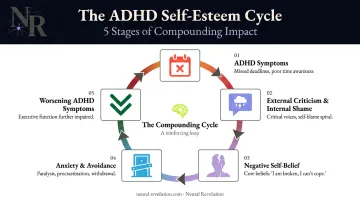
Breaking this cycle requires addressing the belief layer — not just the behavior layer. That's why surface-level productivity tips rarely improve self-esteem on their own.
The High-Achiever Paradox: Looking Capable While Feeling Like a Fraud
Many high-performing adults with ADHD succeed through hyperfocus, raw intelligence, or sustained brute-force effort. Externally, the results look impressive. Internally, the experience is something closer to controlled chaos.
This is distinct from generalized imposter syndrome because it's rooted in something real: the genuine unpredictability of the ADHD brain. ADHD performance is uneven by nature — brilliance in high-interest, high-stakes situations; struggle with routine, administrative, or low-novelty tasks.
That inconsistency makes it nearly impossible to build a stable sense of competence, even when external results are strong.
Research by Palmini (2008) studied professionally successful adults with ADHD and found that achievement frequently coexisted with significant executive dysfunction — sustained through energy-demanding compensation strategies like constant vigilance and last-minute pushes. Success and hidden impairment are not mutually exclusive.
The Exhausting Math of Masking
High-achieving ADHD adults spend enormous cognitive and emotional energy hiding their struggles:
- Arriving early to compensate for time blindness
- Over-preparing to mask memory gaps
- Staying late to redo work completed impulsively
- Performing confidence in meetings while internally spinning
A 2025 study (Mylett et al.) found 91.6% of 202 adults with ADHD reported camouflaging behaviors, with reported costs including exhaustion, anxiety, depression, and identity disturbance. While masking produces short-term results, it reinforces the core belief that the "real" self is defective.
For driven ADHD professionals and entrepreneurs, this gap between visible achievement and internal self-doubt is often widest. These individuals frequently don't seek support because they're "doing fine" by every measurable standard. What doesn't show up on the scorecard is the cognitive overhead required to maintain that appearance — and the quiet erosion of confidence that comes with it. Neural Revolution works specifically with this population, because high performance and hidden struggle are not opposites.
The Neuroscience Behind ADHD and Confidence
Understanding the neuroscience doesn't excuse anything. It reframes everything.
Volkow et al. (2009, JAMA) found lower dopamine receptor and transporter availability in reward-pathway regions in adults with ADHD compared to controls. Follow-up research linked this dopamine reward-pathway dysfunction directly to motivation deficits in adults with ADHD.
What this means practically: effort without immediate feedback doesn't register the same way in an ADHD brain. Finishing a project doesn't automatically produce a felt sense of accomplishment. The neurological signal is muted or absent — not because the achievement didn't happen, but because the brain's reward machinery is wired differently.
Research by Shaw et al. (2014) documents that emotion dysregulation is prevalent in adults with ADHD, with estimates ranging from 30–70% of adults showing significant emotional dysregulation. This creates an asymmetric experience of performance:
- Setbacks land hard and tend to linger
- Wins evaporate quickly — often before they can register as evidence of competence
- The confidence ledger ends up perpetually underwater, even when the actual record is solid
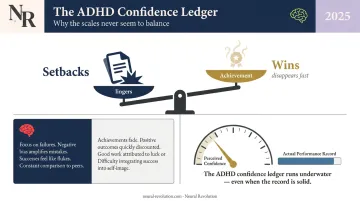
When an adult with ADHD understands that their intense self-criticism after a mistake has a neurological driver, they can begin to respond to it strategically. That recognition shifts the harsh inner voice from evidence of character to data about the brain — and data can be worked with.
Reframing ADHD: From Personal Failing to Brain Difference
Self-esteem rebuilding for ADHD adults has to start here. Not as toxic positivity, but as a scientifically grounded correction.
ADHD is a neurodevelopmental difference in how the brain regulates attention, motivation, and emotion. It is not evidence of laziness, stupidity, or moral weakness. CHADD is direct on this point: ADHD is characterized by developmentally inappropriate inattention, impulsivity, and hyperactivity — full stop. Character is not in the diagnostic criteria.
Accepting this reframe is not the same as lowering standards or excusing behavior. It's about understanding why certain strategies work and others don't — and working with the ADHD brain's actual biology rather than against it.
That biology also comes with genuine strengths. Hargitai et al. (2025) found that adults with ADHD who endorsed psychological strengths — including hyperfocus, creativity, and humor — showed measurably better life outcomes.
For entrepreneurs, executives, and creatives, these aren't consolation prizes. They're cognitive assets that show up as:
- Rapid ideation and divergent thinking
- Pattern recognition across unrelated domains
- High risk tolerance in ambiguous situations
- Sustained intensity when engaged (hyperfocus)
Recognizing these traits isn't spin — it's the kind of accurate self-knowledge that makes confidence actually sustainable.
Building Real Confidence With an ADHD Brain: Strategies That Actually Work
The foundational principle here separates brain-based confidence building from generic advice: the ADHD brain needs evidence, not affirmations. Confidence built on positive self-talk without the behavioral track record to support it is fragile. The strategies below are designed to create that track record systematically.
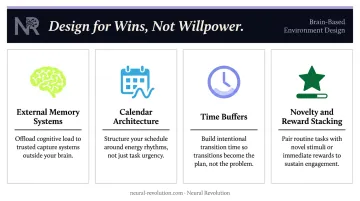
Design for Wins, Not Willpower
Environmental and systems design is where ADHD-friendly confidence building starts. When the environment reduces friction — visual reminders, time buffers, reduced decision fatigue — the ADHD brain is more likely to follow through. Repeated follow-through creates neurological confidence that willpower cannot.
Concrete examples:
- External memory systems: capture tools and structured handoff patterns that don't rely on working memory
- Calendar architecture: scheduling calibrated to actual ADHD energy rhythms, not neurotypical productivity defaults
- Time buffers: building in the transition time ADHD brains routinely underestimate
- Novelty and reward stacking: restructuring tasks so they clear the brain's "worth it" threshold
Traditional SMART goals often fail ADHD adults because they lack emotional resonance and flexibility, triggering shame and perfectionism rather than action. Dr. Eliza Barach of Neural Revolution developed the DREAMS™ framework as a brain-based alternative: emotionally resonant, flexible goal-setting built around how ADHD brains actually engage with motivation and reward. Goals designed this way produce better follow-through and more genuine wins to build on.
Address the Inner Critic Directly
The ADHD inner critic is frequently an internalized version of childhood external feedback, not an accurate read of actual capability. A practical starting point: when the self-critical voice activates, ask is this an observation about my behavior, or a judgment about my worth? That separation matters. It's the beginning of cognitive reframing, not a feel-good exercise.
Self-compassion also plays a direct performance role here. Beaton, Sirois, and Milne (2022) found that adults with ADHD scored significantly lower on self-compassion than neurotypical peers, and that lower self-compassion partially explained higher rates of depression, anxiety, and stress. That deficit has real consequences for follow-through: Breines and Chen (2012) found self-compassion increased self-improvement motivation after personal failure, including more follow-through after initial setbacks.
In the ADHD context, self-compassion means treating setbacks as information about what the brain needs, not as evidence of who you are.
Leverage Strengths Deliberately
Strengths identification works best as an ongoing strategy, not a one-time intake exercise. ADHD adults benefit from mapping the specific contexts, tasks, and environments where their ADHD traits work for them:
- Hyperfocus during creative sprints or high-stakes projects
- Rapid ideation in brainstorming sessions
- Pattern recognition across complex, ambiguous problems
- High energy and risk tolerance in entrepreneurial decisions
When these moments are intentional and recognized, they build a track record of genuine competence the brain can actually draw on.
When Self-Help Isn't Enough: Getting the Right Support
Self-help strategies matter, but they have limits when the behavioral patterns are deeply established and the belief layer hasn't been addressed.
ADHD coaching specifically targets real-world behavior change in the context of an ADHD brain. It creates accountability, helps build systems that generate repeated evidence of capability, and addresses the gap between understanding ADHD and actually living differently. A 2010 study (Kubik, Journal of Attention Disorders) evaluated 45 adults and found coaching had positive impact across 22 areas of concern, including executive function and life satisfaction — promising evidence, though not equivalent in rigor to clinical RCT data.
At Neural Revolution, coaching is built at the intersection of doctoral-level cognitive psychology and lived ADHD experience. The practice explicitly addresses RSD, masking recovery, self-concept integration after late diagnosis, and the design of ADHD-friendly systems — not just generic productivity frameworks. For high-performing professionals whose external success masks real internal cost, this level of precision is often what creates lasting change.

Other forms of support worth considering:
- ADHD-informed therapy: CBT adapted for ADHD has strong evidence — a meta-analysis of 28 RCTs (Liu et al., 2023) found improvements in core symptoms, self-esteem, and quality of life
- Formal diagnosis: If you haven't been evaluated, diagnosis is the starting point for everything else
- ADHD peer communities: Being understood by people with similar experiences has genuine therapeutic value
Seeking support is not an admission of failure. For adults who have spent years telling themselves they should be able to manage this alone, it's often the first real act of self-trust.
Frequently Asked Questions
Can ADHD cause low self-esteem in adults?
Yes. Adults with ADHD consistently score lower on self-esteem measures than neurotypical peers across multiple controlled studies — driven by years of accumulated negative feedback, performance inconsistency, and internalized shame. This is a neurobiological pattern, not a character issue.
What is the best environment for an adult with ADHD?
The best environment reduces unnecessary friction, supports clear structure, minimizes unhelpful distractions, and aligns tasks with the person's strengths and interests. Because every ADHD profile is different, the right setup is highly specific to the individual and their professional context.
How can people with ADHD be successful?
ADHD adults thrive when they design their work and life around how their brain actually operates: interest-based motivation, strengths-aligned roles, flexible systems, and external accountability. Forcing neurotypical approaches onto an ADHD brain rarely works long-term.
How do I stop negative self-talk with ADHD?
Recognize the thought as internalized external messaging, not truth, and ask whether it's about a behavior or your actual worth. Then build evidence through brain-friendly systems that create real wins — genuine self-trust comes from a track record, not from positive self-talk alone.
Does treating ADHD improve self-esteem?
Effective ADHD support — whether through medication, coaching, therapy, or a combination — interrupts the cycle of failure and self-blame that erodes self-esteem over time. Many adults report meaningful improvement in self-perception once their ADHD is properly understood and supported.