Maybe the timer fires mid-flow, severing the first real focus they've managed all day. Maybe 25 minutes feels impossibly long on a bad brain day. Or maybe they spend the entire first interval trying to decide which task to start.
The honest answer isn't that Pomodoro works or doesn't work for ADHD — it's more complicated than that. This article gives a neuroscience-grounded look at where the technique genuinely helps, where it predictably falls apart, and how to adapt it so it actually fits your brain.
Key Takeaways
- Pomodoro addresses real ADHD challenges like time blindness and task overwhelm, but the standard 25-minute format often needs adjustment
- Hyperfocus, emotional dysregulation, and task initiation are areas where the technique alone falls short
- Most ADHD adults find 10–20 minute intervals more realistic than the classic 25-minute block, especially at first
- What you do during breaks matters — scrolling doesn't reset an ADHD brain the way movement does
- Pomodoro works best as one tool within a broader, personalized strategy
What Is the Pomodoro Technique?
Francesco Cirillo developed the technique in the late 1980s while struggling to focus as a university student. He used a tomato-shaped kitchen timer — pomodoro is Italian for tomato — and the name stuck.
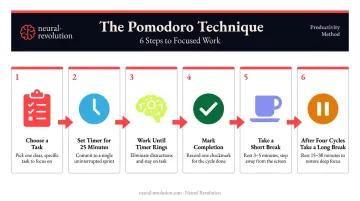
The standard method follows six steps:
- Choose a single task
- Set a timer for 25 minutes
- Work on that task only until the timer rings
- Mark a completion checkmark
- Take a short break (Cirillo's official guide specifies 3–5 minutes, not the widely cited 5 minutes)
- After four cycles, take a longer 15–30 minute break
The ADHD community gravitated toward this method for three specific reasons. It provides external time structure the ADHD brain doesn't generate internally. It creates visible progress through completed cycles. And it offers explicit permission to stop — something ADHD adults rarely give themselves.
Standard productivity advice rarely addresses any of these needs directly. Where the method gets tricky for ADHD brains is in the details: the 25-minute default, what happens at the break, and what to do when hyperfocus kicks in mid-cycle.
Why the ADHD Brain Responds to Pomodoro
Time Blindness and External Structure
Time blindness — sometimes called time agnosia — is one of the most disruptive ADHD symptoms in professional life. Research identifies time perception as a focal symptom of adult ADHD, linked to differences in prefrontal, basal ganglia, and dopaminergic systems. In practical terms: the ADHD brain doesn't feel time passing the way other brains do. Abstract deadlines feel equally urgent whether they're three hours or three weeks away.
Pomodoro directly addresses this by making time concrete and present-moment. A physical countdown timer converts "I should work on this" into "I have 18 minutes left." That shift from abstract to visible is exactly what externalized time structure is supposed to do.
Dopamine and the Reward of Completion
Dopamine dysregulation sits at the center of most ADHD executive function challenges. PET imaging research found reduced dopamine markers in reward regions of non-medicated ADHD adults, with lower motivation scores compared to controls. The ADHD brain isn't lazy — it's reward-starved.
Completing a discrete Pomodoro unit creates a small but real micro-reward: a sense of closure that the brain's reward circuitry responds to. Each checkmark is low-stakes positive reinforcement, delivered immediately after effort. That timing matters.
There's also a compounding benefit. ADHD adults frequently discount their own output — they remember the hours they lost but not the work they produced. A visible log of completed cycles creates an objective record that counteracts that distortion.
Pomodoro also addresses two more friction points that derail ADHD work before it starts:
- Task initiation: "Work on this project" triggers paralysis. "Work on this project for 15 minutes" crosses a different neurological threshold entirely — the perceived scope shrinks enough to begin.
- Working memory load: Writing the task down before starting the timer externalizes it, so attention can go toward the actual work. Russell Barkley consistently recommends this kind of externalization at the point of performance, and the Pomodoro setup ritual serves that function naturally.
Where the Pomodoro Technique Falls Short for ADHD
When the Timer Breaks Flow Instead of Creating It
Hyperfocus is the double-edged capacity of the ADHD brain. It can make sustained attention genuinely difficult — and it can also produce deep, highly productive states where creative or analytical work flows unusually well. For high-achieving ADHD professionals, that flow state is often where their best work happens.
A rigid 25-minute interrupt can sever genuine hyperfocus at exactly the moment it becomes most valuable. Research on hyperfocus in adults with ADHD shows that adults report these states as meaningful and productive — though the evidence on precisely how often they occur is mixed. What's clear is that for some ADHD adults, particularly those in creative or strategic roles, treating every 25-minute interval as sacred is counterproductive.
Task initiation is a separate problem entirely. Pomodoro's structure helps once someone is working. It does nothing to solve the activation problem — the ADHD brain's difficulty generating the initial motivation to sit down and begin. The timer assumes readiness that ADHD frequently doesn't provide.
Emotional dysregulation compounds this further. Research estimates that 34–70% of adults with ADHD experience significant emotional dysregulation, linked to differences in prefrontal and paralimbic systems. On high-anxiety or emotionally charged days — which are disproportionately common with ADHD — a rigid interval structure can amplify frustration rather than reduce it. The technique has no emotional regulation component, and for many ADHD adults, emotion is a bigger barrier to productivity than focus itself.

Where Coaching Addresses What Tools Can't
Pomodoro is a productivity tool, not a comprehensive ADHD management strategy. The gap between "having a timer" and "functioning well as an ADHD professional" is substantial.
This is where ADHD-specific coaching does different work. At Neural Revolution, coaching addresses the underlying architecture of how ADHD brains actually initiate and sustain effort — not just how they manage time.
The DREAMS™ framework, developed by Dr. Eliza Barach specifically for ADHD brains, builds goal structures calibrated to the ADHD reward-salience system. Unlike SMART goals, which systematically fail this population, DREAMS accounts for how motivation actually works in a neurodivergent brain.
Beyond goal-setting, Neural Revolution's coaching targets the conditions that make any productivity strategy succeed or fail:
- Environment design calibrated to ADHD energy rhythms
- Real-time emotional regulation tools for RSD and dysregulation
- Task initiation frameworks built around the "Worth-It Threshold" — the neurological cost-benefit calculation the ADHD brain runs before engaging with any task
Without those layers in place, even a well-designed system like Pomodoro hits a ceiling.
How to Adapt the Pomodoro Technique for Your ADHD Brain
Find Your Actual Focus Window
The 25-minute standard is a starting point, not a prescription. The right interval varies by ADHD presentation, task type, medication timing, and time of day — and there's no clinical evidence that 25 minutes is optimal for ADHD adults. CHADD's workplace guidance supports timers and short task chunks without specifying a validated interval length.
A practical approach:
- Start at 10–15 minutes, not 25
- Build upward in 5-minute increments through trial over several weeks
- Expect that creative deep work may warrant longer blocks; administrative tasks often need shorter ones
- Track which intervals actually feel sustainable — not which ones you think should work
Many ADHD adults find 15–20 minutes more realistic. That's not a failure of the technique; it's the technique being calibrated correctly.
Design Breaks That Actually Reset Your Brain
Not all breaks are equal. Scrolling social media during a break maintains mental stimulation without true recovery — the brain stays activated but doesn't genuinely reset. Research found that cellphone breaks left participants taking 19% longer and solving 22% fewer problems compared to phone-free breaks.
Breaks that actually help ADHD brains:
- Brief physical movement (walk to another room, stretch, step outside)
- A change of physical environment
- Sensory downtime — quiet, low-stimulation, screen-free
- Something genuinely restful rather than stimulating
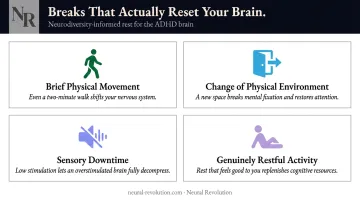
The goal isn't entertainment during the break. It's recovery before the next interval.
Set Up for Success Before the Timer Starts
Dealing with a mid-session distraction costs far more than setting up an interruption-free environment beforehand. Don't wait until you're already working to manage distractions.
Before starting the first timer:
- Phone on Do Not Disturb
- Notifications silenced on all devices
- One task written down and visible
- A physical (not digital) timer if possible — seeing a physical object tick down is more grounding than a screen notification
Use a Short Runway Ritual
External setup handles the environment — but the ADHD brain also needs a low-friction on-ramp to actually begin. A 2–3 minute entry activity before each Pomodoro can bridge the task initiation gap:
- Re-read the last paragraph or last line of code from the previous session
- Write one sentence stating exactly what you're about to do
- Review the task definition — specifically what "done" looks like for this interval
This isn't busywork. It's a low-stakes activation sequence that gives the ADHD brain something small and defined to start with, rather than requiring it to generate motivation from nothing.
Track Completion, Not Failure
Log completed Pomodoros without treating missed or incomplete sessions as evidence of inadequacy. ADHD brains are especially vulnerable to shame spirals that derail productivity further — and shame is not a reliable motivator for this population.
A non-judgmental record of what was completed, not what wasn't, is both more accurate and more sustainable. Over time, the log itself becomes evidence — a concrete record that counters the ADHD tendency to discount what's already been done.
Frequently Asked Questions
What is the best Pomodoro length for ADHD?
There's no single best interval. Many ADHD adults find 15–20 minutes more sustainable than the traditional 25, and task type matters — creative work may warrant longer blocks while administrative tasks often need shorter ones. Start shorter than you think you need and build up from there.
Does the Pomodoro Technique work for ADHD?
Yes, with important caveats. The technique addresses real ADHD challenges (time blindness, task overwhelm, working memory load) but works best when adapted to the individual, combined with other strategies, and understood as a tool rather than a complete solution.
What if I'm in a hyperfocus state when the Pomodoro timer goes off?
When hyperfocus is genuinely productive, you don't have to stop. The more useful practice is to pause briefly when the timer rings, consciously decide whether to continue, and note that decision — preserving intentional awareness of time and energy rather than mindlessly extending.
Can I use the Pomodoro Technique alongside ADHD medication?
The two aren't in conflict. Pomodoro can be particularly effective when timed to coincide with peak medication windows, since that's when focus capacity is typically highest. Medication timing varies significantly by formulation and individual; discuss the right scheduling with your prescribing provider.
What are the best Pomodoro apps for people with ADHD?
Focus Keeper and Forest are popular Pomodoro-style apps with ADHD-friendly designs. Focusmate is worth particular attention: it's a body-doubling platform where you work alongside a stranger in real time, adding social accountability to the time structure — addressing both task initiation and follow-through in ways a solo timer app cannot.